
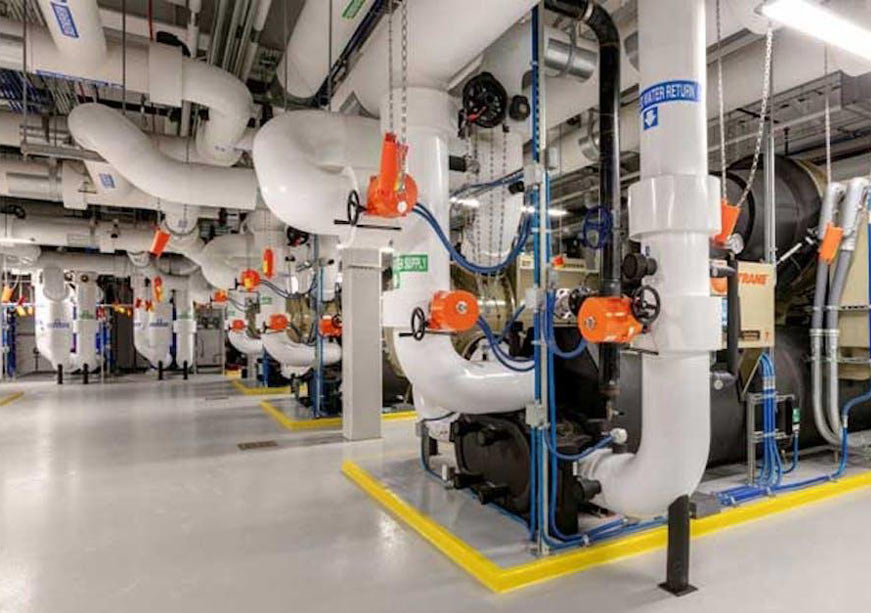

Image Source: Meta
The rise of artificial intelligence (AI) and the transformative innovations it promises come with a less visible but increasingly significant environmental cost: water consumption. AI data centres are projected to consume as much water as 1.3 billion people by 2030, bringing the technology’s hidden hydrological footprint into sharp focus. This raises an important policy question: can AI infrastructure expand while limiting its environmental costs, or will the pursuit of economic gains and shareholder returns intensify competition for scarce resources?
As the number of data centres grows alongside the rapid adoption of AI, their ecological footprint warrants increasing attention. One key aspect of this footprint is AI’s water demand. Water is a critical input for cooling data centres, enabling servers to operate safely despite the substantial heat generated by processing vast volumes of data. Data centres primarily rely on two cooling systems. The first is evaporative cooling, in which water absorbs heat from servers and is subsequently released as vapour, requiring a continuous supply of fresh water. The second is closed-loop cooling, in which water is cooled using chillers and recirculated within the system, substantially reducing freshwater consumption.
Like every major technological revolution, AI-driven growth comes with environmental costs or externalities that cannot be overlooked and therefore require policy intervention.
AI growth is expected to generate substantial economic gains by improving productivity, strengthening human-capital complementarities, creating agglomeration effects, and accelerating the digital economy. Yet, like every major technological revolution, AI-driven growth comes with environmental costs or externalities that cannot be overlooked and therefore require policy intervention and, where appropriate, should be internalised through pricing and regulation.
History offers several parallels. Industrialisation accelerated economic growth but contributed to severe air pollution; hydropower expanded access to clean energy while disrupting ecosystems; and synthetic fertilisers strengthened food security but led to water pollution and ecological degradation. Countries have addressed these environmental costs to varying degrees, reflecting differences in political economy, institutional capacity, levels of development, and market structures.
AI’s water footprint presents a distinct challenge. Beyond its direct and potentially consequential environmental impacts, it raises a broader resource-allocation trade-off. Water used to cool data centres competes with alternative uses across agriculture, drinking water supply, industry, and ecosystem conservation. As AI infrastructure expands, its rising water requirements could therefore intensify competing demands for an already constrained resource, making efficient water allocation an increasingly important policy consideration.
AI’s Growing Water Demand
Data centres’ water requirements are expected to rise sharply across major AI firms (Figure 1). A medium-sized data centre can consume up to 110 million gallons of water annually, with daily usage running into several million gallons of potable water. Google alone reported using more than 6 billion gallons of water across its global data centre operations in a single year. Globally, the water footprint of AI has been estimated at around 446 billion litres as of 2025, roughly equivalent to the world’s annual bottled water consumption.
Figure 1: Water Consumption from AI-related Big Tech Firms (Historical and Projected)

Source: Author’s Own. Prepared using Matplotlib. Data from The Conversation.
The implications become more tangible at the user level. Estimates from the Omni AI Footprint Calculator suggest that 10 ChatGPT queries consume water equivalent to approximately 23 toilet flushes, or about 276 half-litre bottles of water. While the water footprint of a single query appears negligible, the cumulative effect across millions of users and billions of interactions is substantial. If ChatGPT’s water consumption is estimated at 1.174 billion gallons each month, that is equivalent to filling 1,780 Olympic-size swimming pools. The trade-off over water allocation is already beginning to materialise. In the United States, the developer of a proposed 330 MW AI data centre in California, which would require approximately 287 million gallons of water from the Colorado River, has filed a lawsuit against the local water authority after being denied access to the region’s limited water supply. In a separate case, wastewater discharged by a contractor working on a Meta data centre contaminated the city’s reclaimed water system. This highlights how the environmental implications of data centres extend beyond water consumption to water quality and infrastructure management. Similar concerns are emerging in India, where rapid data centre expansion is taking place in a populous country with limited freshwater resources and growing water stress across many urban centres.
The Fifth Industrial Revolution is well underway and unlikely to be constrained by resource-allocation concerns or environmental externalities alone.
India has nearly 271 data centres as of January 2026, with most concentrated in Tier-1 urban centres, led by Mumbai, followed by Bengaluru, Chennai, and Hyderabad. With India’s ambition to emerge as a global AI hub and a leader in the AI revolution, the water-allocation challenge is becoming pertinent, particularly as the Union government has committed over INR 10,000 crore towards developing the country’s AI ecosystem in the coming years. Water challenges are already evident in cities such as Bengaluru, where government borewells have reportedly run dry. Similarly, Google’s proposed US$15 billion AI hub in Visakhapatnam has faced pushback from the local community and environmental activists, given the city’s existing water shortages and the proposed site’s proximity to a wildlife sanctuary.
The Fifth Industrial Revolution is well underway and unlikely to be constrained by resource-allocation concerns or environmental externalities alone. Innovation and growth remain natural pursuits; what is therefore critical is to anticipate and address the emerging externalities through proactive mitigation, drawing lessons from previous industrial and technological transitions. In this context, ensuring that AI-led growth is water-sustainable becomes imperative.
Making AI Water-Sustainable
As AI infrastructure continues to expand, several considerations merit attention. First, the location of data centres matters. Many facilities have been, and will be, established in already water-stressed regions, such as Arizona and Nevada in the United States, and Mumbai, Bengaluru, and Greater Noida in India, where growing industrial demand competes with local water needs.
Second, the opportunity cost of using potable water for data-centre cooling cannot be ignored, as the same water could support essential uses such as drinking and irrigation; firms must adequately compensate the affected stakeholders, undertake replenishment projects, and adopt efficient cooling technologies.
Third, transparency remains limited, as water consumption by data centres is often underreported, reducing accountability and obscuring the true environmental footprint of AI infrastructure and necessitating better regulation. For instance, in India, no regulatory requirements across states mandate data centres to disclose their water consumption.
Fourth, water is frequently underpriced, allowing large technology firms to access scarce water resources below their true economic value and weakening incentives for conservation.
Fifth, water-intensive cooling systems can generate broader ecological impacts through evaporation, discharge, and thermal pollution, affecting local ecosystems.
These concerns call for a stronger framework of economic and environmental accountability. First, require data centres to disclose water consumption publicly, with reporting standards that allow comparison across facilities and tracking of changes over time. Second, make permits contingent on a basin-level assessment of water availability and competing needs. Location decisions should also account for pressure on local ecosystems and electricity grids, rather than treating water availability alone as sufficient. Municipalities and other relevant authorities should review these impacts, including those on local communities, before approving new facilities or expansions. Third, use water pricing and regulatory oversight to reflect local scarcity and encourage efficient use. Finally, provide incentives and set technical standards to support the adoption of sustainable cooling technologies, particularly in water-stressed regions.
Conclusion
The relationship between AI-driven growth and economic development is promising, but its environmental implications require equal attention. The sector is characterised by a concentrated market structure, with a handful of large technology firms accounting for a substantial share of global AI infrastructure. Consequently, the industry’s environmental footprint and the extent to which it is addressed are shaped by the incentives and practices of these firms. Concerns about selective disclosure and greenwashing also highlight the need for greater accountability.
The relationship between AI-driven growth and economic development is promising, but its environmental implications require equal attention.
As AI continues to expand, particularly across the Global South, a robust policy framework for managing its water footprint becomes increasingly important. Many of these countries already face structural water scarcity and institutional constraints that complicate environmental governance. The broader welfare implications of the trade-off between technological growth and long-term water security cannot be ignored. Addressing these challenges will require stronger regulation, more appropriate water pricing, greater transparency, and effective institutional oversight. Such measures can help reduce AI’s environmental costs while ensuring that the benefits of technological progress do not compromise long-term water security.
Manish Vaidya is a Research Assistant with the Centre for New Economic Diplomacy at the Observer Research Foundation.
Disclosure: ChatGPT 6 Luna has been used for grammar and language refinements.
The views expressed above belong to the author(s). ORF research and analyses now available on Telegram! Click here to access our curated content — blogs, longforms and interviews.











Leave a Reply