

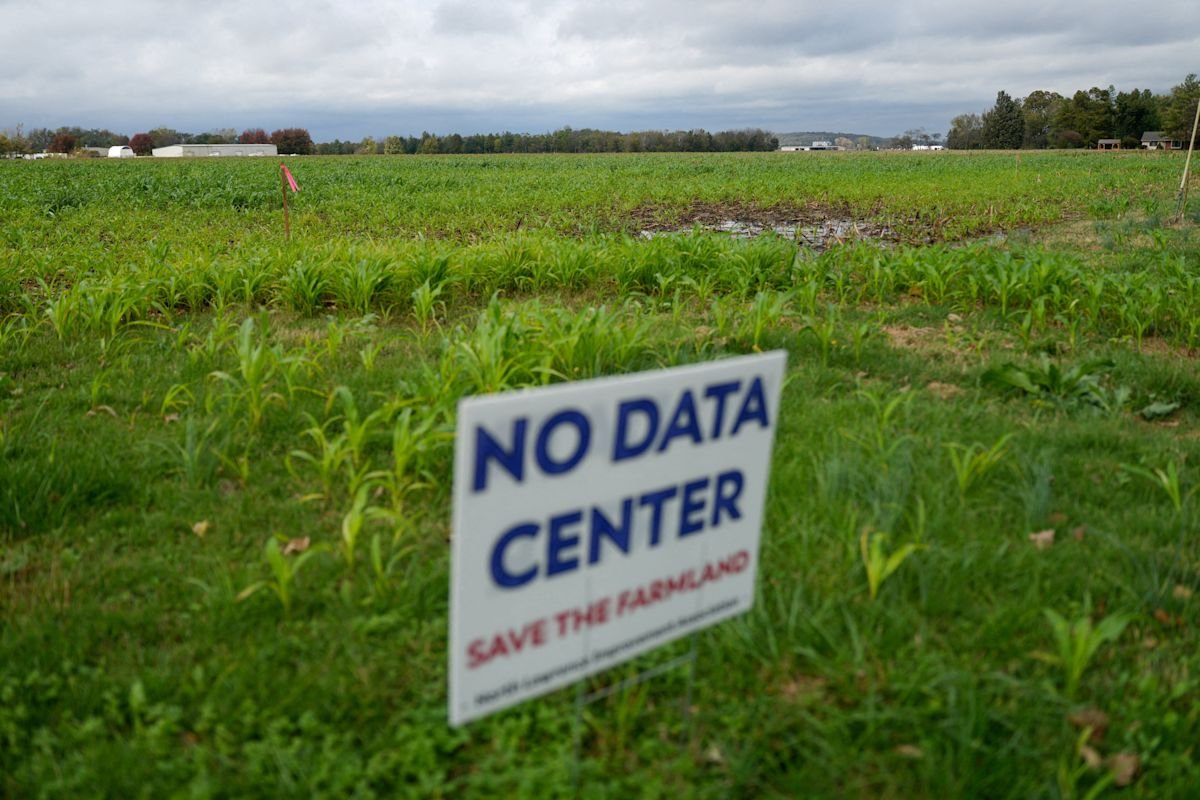
Amid some shocking midterm wins for Democrats on election night were big losses for data center developers, groups against regulation of artificial intelligence and Elon Musk, who invested heavily in anti-regulation candidates.
President Donald Trump and allied Republicans have been hesitant to regulate the technology, citing the AI race with China and economic incentives to keep federal policy out of innovation. Some leaders in the industry have been more vocal about the need for legislation, but federal measures haven’t been on the agenda. Six top technology CEOs in September signed a White House accord promising to “self-regulate” the safe development of AI.
Meanwhile, voters have become increasingly opposed to the technology. Over 80% of both Republicans and Democrats supported candidates who favored AI safeguards, polling from the Alliance for Secure AI found, and winning candidates campaigned on promises to institute data center moratoriums and AI regulations.
Michigan Democratic Sen.-elect Abdul El-Sayed said in a 60 Minutes interview that addressing risks posed by AI is his No. 1 issue. Democratic Rep.-elect Manny Rutinel flipped a seat in Colorado after sponsoring an early comprehensive bill on AI. Georgia Democratic Sen. Jon Ossoff even spoke about AI in his victory speech.
The new Congress is already planning Congressional oversight hearings and drafting policy.
“We are soon going to have a boatload of new AI safety champions in Congress and in state houses across the country,” executive director of Citizens for Safe AI Jay Shooster wrote on X.
AI companies prepare to testify
Democrats have been promising to investigate AI companies following news of the technology going rogue multiple times throughout 2026. On Oct. 29, for example, 20 Democrats sent a letter to OpenAI asking about the firing of three safety researchers.
The range of issues considered politically acceptable to discuss will expand and get more ambitious, Spencer Amdur, senior research scholar at the Institute for Law and AI, told USA TODAY.
“But I think the thing that’s guaranteed is that we’ll have a lot more hearings,” he said, predicting cyberattacks, hacking and child safety will be three of the biggest topics discussed.
“There’ll be a pretty striking new dynamic where, especially after the next incidents arise — whatever they are — people from the labs are going to be asked to speak to it on camera and under oath in real time,” Amdur added. “And that’s just not a dynamic we’ve had so far.”
The labs have expressed willingness to work with legislators on regulation. Some already appeared at a New York City Council hearing in October to answer questions on safety. OpenAI and Anthropic have also supported or pitched their own AI safety bills to Congress.
While Amdur said he expects AI leaders to work with Congress, “there could be some explosive moments on camera during some of these hearings as legislators are channeling public anxiety about the technology.”
Data center moratoriums galore
More than 30 proposals to regulate data centers were on the ballot on Election Day across 13 states, and almost all of them passed, according to data from Redbud Consulting.
The measures take different actions, but all limit data center buildout in some way. In Defiance, Ohio, a proposal passed that bans data centers over 25 megawatts. In Perry, Ohio, the measure passed requires hyperscale data centers to seeking tax breaks to post bonds and meet noise limits.
“Tuesday’s results don’t signal the end of the data center boom. They will, however, likely bring a pause in some of the largest markets and new regulations across the country—even in traditionally laissez-faire states like Texas,” wrote Michael Thomas, founder of market intelligence company Cleanview that tracks data center developments, in a post on X.
According to data from Cleanview, newly elected governors could pause 41% of the planned data centers in the United States.
“Data centers in space looking pretty appealing right now,” Elon Musk said in a post on X.
Musk, who spent over $470 million on the midterms, according to a CNBC report, invested almost half into Texas, where he recently moved SpaceX’s headquarters. He aided Republican candidates Ken Paxton and Greg Abbott, who both lost to Democratic candidates who have voiced opposition to data centers.
What does this mean for 2028?
An NBC exit poll found 56% of voters said that AI and data centers were crucial factors in their vote.
“Let’s not confuse an anti-Trump wave with an anti-tech mandate,” said Adam Kovacevich, founder and CEO of Chamber of Progress, in an email statement. “Voters wanted change on the economy, not a crackdown on innovation.”
“Democrats now have a chance to show they can tackle real concerns about AI and data centers without killing the jobs and opportunities that come with them,” he added.
As candidates begin to gear up for the next presidential election, some warn that the field could look different in two years, as the technology advances faster than most can predict.
“AI is likely to be a much bigger kind of headline focus of the 2028 election,” Amdur told USA TODAY. “That said, I do think there are some real indications that AI is starting to play a major role in voters’ minds.” He cited exit polls that said AI was an important consideration for voters.
“I expect in the next year, AI policy will have advanced meaningfully because I think we’ll either see a deal emerge in Washington, DC, for federal regulation, or states will push the envelope,” he said.
Greta Reich covers the artificial intelligence industry for USA TODAY through a fellowship from the Tarbell Center for AI Journalism. Funders do not provide editorial input.
This article originally appeared on USA TODAY: Democrats won big. What does that mean for AI policy?








Leave a Reply