

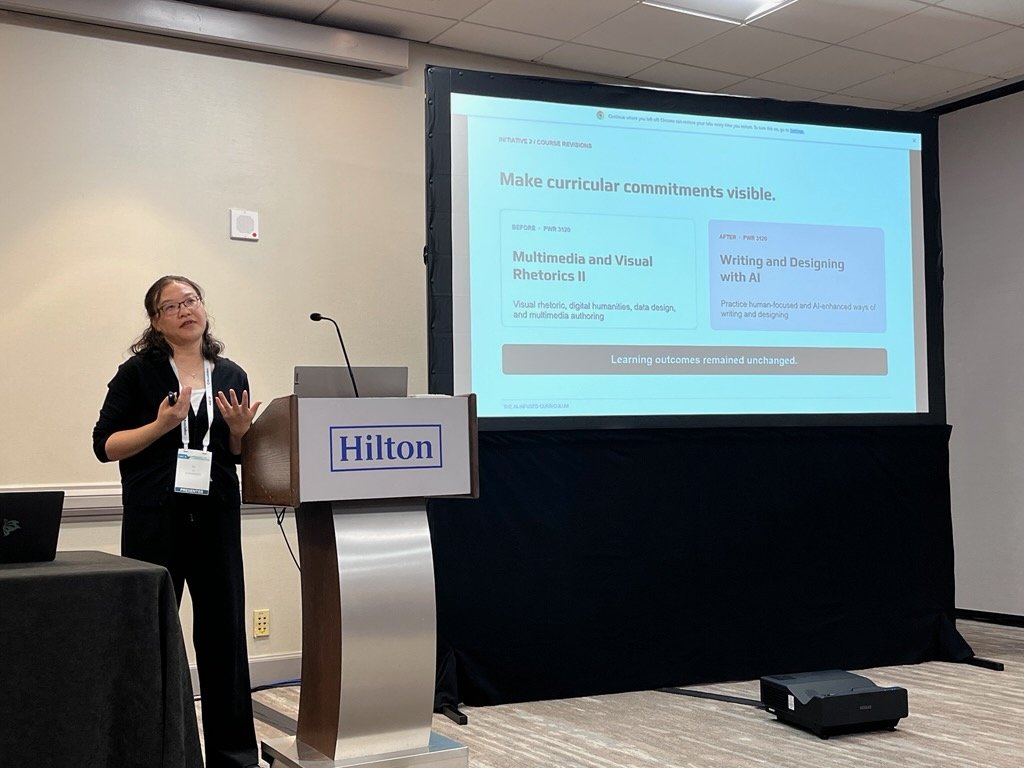
Professional Writing and Rhetoric faculty Travis Maynard and Li Li shared a model for integrating artificial intelligence across academic programs at AAC&U’s inaugural Conference on AI and Higher Education.
Share:
As colleges and universities grapple with the growing influence of generative artificial intelligence, Elon University’s Professional Writing and Rhetoric (PWR) program is developing a coordinated approach to preparing students for an AI-infused professional world.
Associate Professors of English Travis Maynard and Li Li presented “The AI-Infused Curriculum: A Scalable Model for Integrating Generative AI across Programs” at the Association of American Colleges and Universities’ inaugural Conference on AI and Higher Education, held Oct. 28–30 in Atlanta, Georgia.
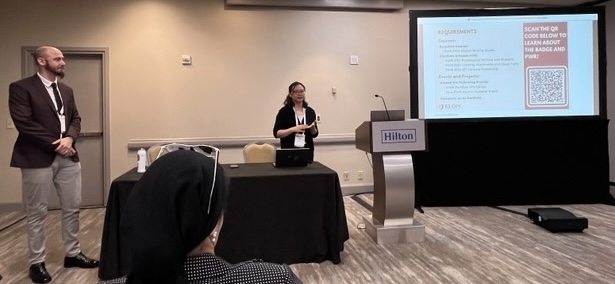
Their presentation highlighted an approach developed by PWR faculty to connect emerging writing practices with the program’s commitments to rhetorical thinking, ethical inquiry and adaptability.
Rather than focusing on a single AI assignment, course or technology, the program has developed four interconnected initiatives:
- Curriculum mapping: Identifying how AI-related learning develops across courses, with attention to students’ functional, critical and rhetorical AI literacies.
- Course revisions: Updating course titles and descriptions to make emerging writing technologies and practices more visible to students.
- Microcredentialing: Creating the AI and Professional Writing Digital Badge, which connects coursework, professional development opportunities and reflective portfolios.
- Institutional partnerships: Developing a writing-focused track within Elon’s AI Scholars Program, extending AI literacy through interdisciplinary engagement, student leadership and community-based projects.
Together, these initiatives reflect an effort to integrate emerging technologies into existing disciplinary and institutional structures.
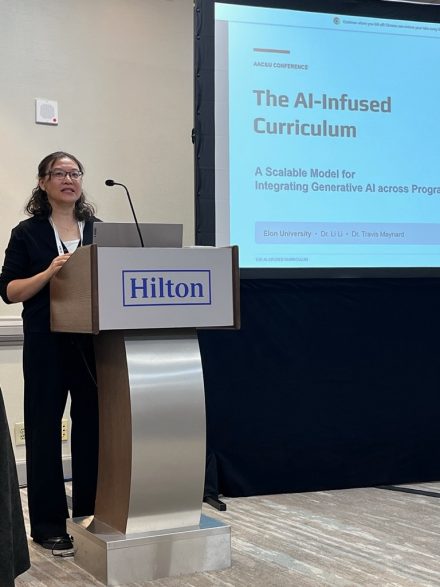
In the presentation, Li emphasized that students are already encountering AI in many aspects of their lives. She argued that educators have a responsibility to help students examine AI tools critically and prepare for workplaces increasingly shaped by AI.
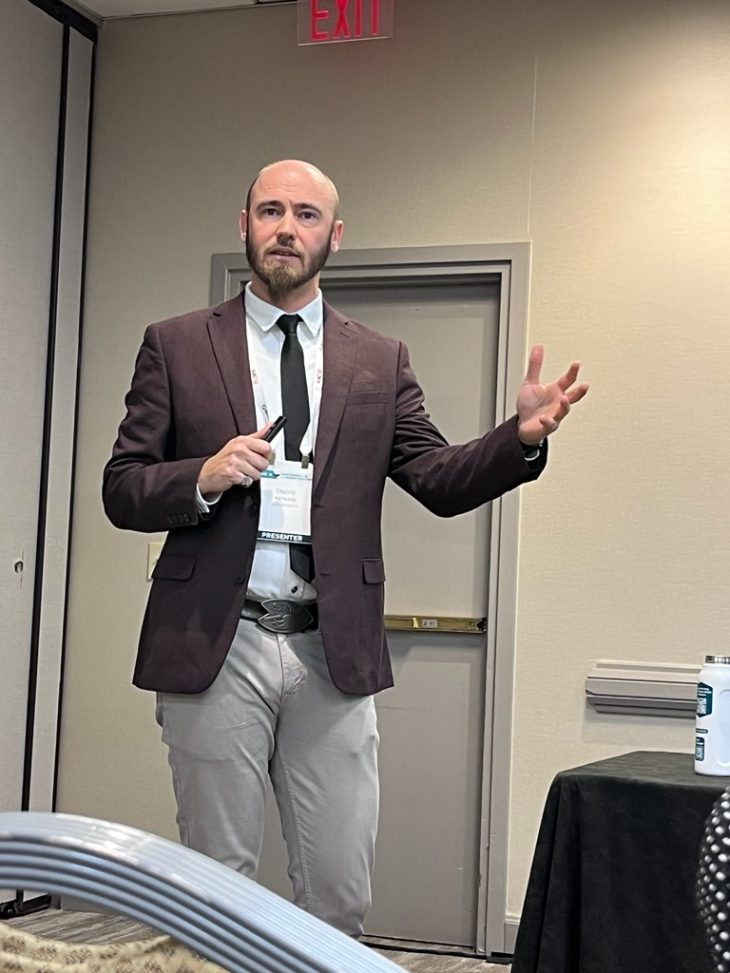
Maynard added that PWR integrates AI intentionally across the curriculum while helping students develop the judgment to decide if, how, and when to use these tools, rather than encouraging routine use of particular technologies.
The initiatives also draw on ongoing research into how Elon alumni use generative AI in their professional and personal writing, helping faculty connect curricular decisions with graduates’ changing communication practices.
The presentation prompted discussion among faculty and higher education administrators. Attendees asked practical questions about implementing AI microcredentials and conducting alumni research. Maynard and Li also shared curriculum-mapping and action-planning resources for participants to consider in their own programs and institutions.
Li said conversations with colleagues from across the country inspired her and reassured her that educators are taking meaningful steps to revise and update their teaching for the AI era.
The work reflects Elon’s broader commitment to advancing thoughtful, ethically informed AI education while preparing students to navigate changing professional environments.
The presentation draws on a forthcoming article, “The AI-Infused Curriculum: Enhancing Professional Writing Programs for the Generative AI Age,” by Maynard, Li, Paula Rosinski and Jessie L. Moore. Accepted for publication in “Writing Program Administration”, the article examines how PWR’s coordinated initiatives offer an adaptable model for integrating generative AI into academic programs while preserving disciplinary values and ethical responsibility.
By building on existing curricular strengths and university initiatives, PWR offers an example of how academic programs can respond to technological change while keeping educational values in view.












Leave a Reply