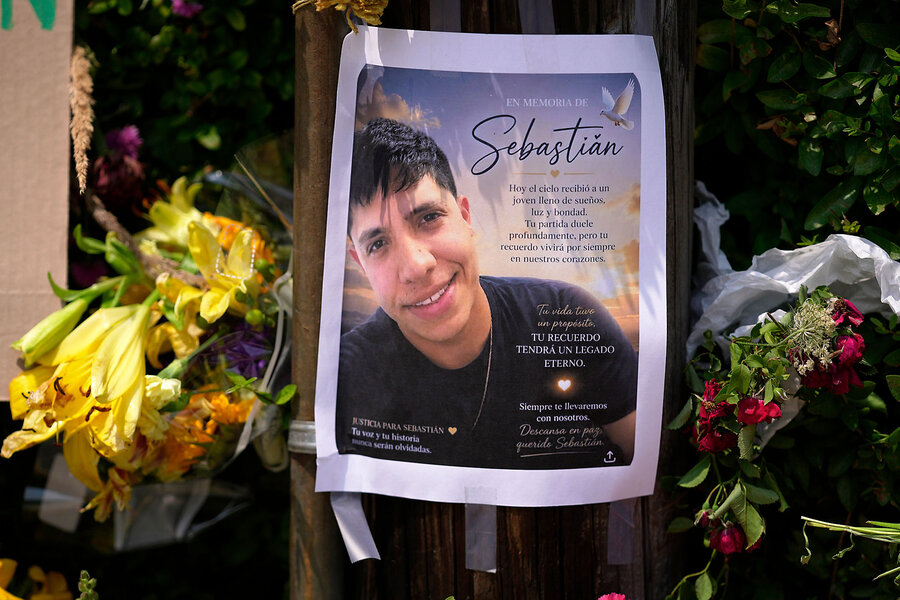
This week, and for the fourth time this year, Department of Homeland Security law enforcement officers fatally shot someone on a U.S. street. The initial narrative from the agency checked a familiar box.
The officers acted defensively, said DHS – though other federal agencies withheld comment as investigations commenced. Over the past six months, witnesses and video evidence have painted a fuller, more complex picture of each killing, at times contradicting official claims.
Monday’s fatal shooting of Johan Sebastián Durán Guerrero, a Colombian immigrant, by a U.S. Immigration and Customs Enforcement officer in Maine, followed the ICE killing of a Mexican man in Texas, Lorenzo Salgado Araujo, a week earlier. Officers in unmarked cars pursued both men as they drove, though in both cases, a lack of body-camera footage obscures the full facts. DHS claims the officer shot at Mr. Durán while “fearing for public safety” during an attempted traffic stop.
Why We Wrote This
Federal law enforcement participating in immigration operations have fatally shot four people this year. In each case, the Department of Homeland Security has quickly and publicly defended officials’ actions as investigations were just beginning.
“I clearly heard the victim say, ‘I tried to stop,’” witness Daniel Boucher told The Associated Press.
Trump administration officials have repeatedly blamed the bloodshed on disruptive protests, threats, and anti-ICE speech. This month, unlike in Minnesota earlier this year: They haven’t called the victims terrorists.
In January, the fatal shootings in Minneapolis of Renee Good and Alex Pretti, both U.S. citizens, led to scaled-back street arrests. This month’s deaths led to a pause on ICE vehicle stops, though President Donald Trump pushed back. During Mr. Trump’s second term, so far, at least 17 motorists have been shot – six fatally – amid immigration and border enforcement efforts, a Washington Post analysis found.
Meanwhile, the public has limited insight into federal investigations. In January, the DHS Office of Inspector General announced an audit of ICE’s handling of allegations of excessive use of force – a review that continues, according to a spokesperson. Both the Office of Inspector General and the FBI declined to comment on potential investigations into this year’s fatal shootings.
By contrast, DHS has spoken for the agencies, claiming their investigative involvement in the Houston case. The department did not answer all of the Monitor’s questions directly, but referred to a warning by Secretary Markwayne Mullin that “attempting to evade arrest is dangerous.”
Local and state officials have spoken up. In Maine, the state attorney general’s office announced an investigation into the use of deadly force in Biddeford. Houston’s mayor last week said his city has asked the FBI for access to evidence. Minnesota officials on Monday said federal authorities had given them access to previously withheld evidence, including Ms. Good’s car.
In each 2026 case, available facts might change as evidence grows. Here’s an overview of what we know now.
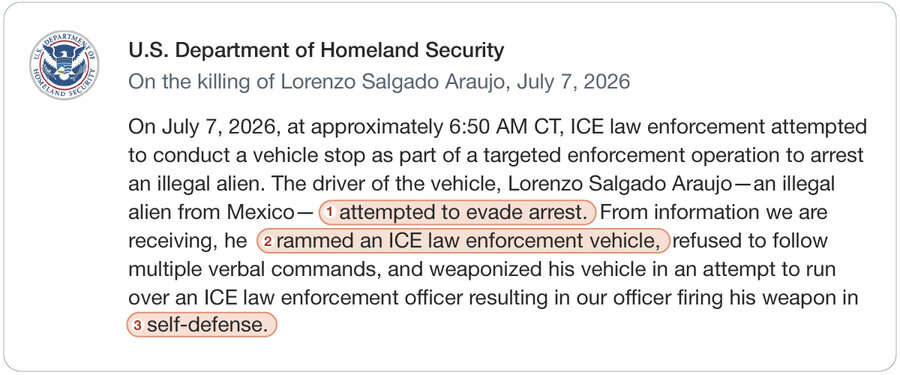
1. Salgado “attempted to evade arrest”
Mr. Salgado reportedly was driving three other men to work at a construction site. Whether ICE officers in pursuit identified themselves remains unknown, according to available security-camera and bystander footage. Two unmarked SUVs trailed Mr. Salgado.
One passenger in Mr. Salgado’s van, his brother Victor Salgado Araujo, told lawyer Ruby Powers the men didn’t know that it was law enforcement pursuing the van. After the brother heard a man on foot approach the front passenger door and yell “Stop!”, the lawyer says, the man fired a shot through the open passenger window, according to The New York Times.
2. He “rammed an ICE law enforcement vehicle”
So far, videos don’t show a vehicle ramming – or any attempt to run over an officer. During the chase of Mr. Salgado’s van, one SUV appears to careen toward him. Afterward, the van’s side paneling partly falls off, according to a New York Times analysis.
3. The officer fired in “self-defense”
The public lacks footage from the moment of the shooting. After the chase, video footage shows an officer pulling at least one passenger from the van and handcuffing him. On the other side of the van, Mr. Salgado lies face down on the ground, moaning beside two officers, with his hands behind his back.
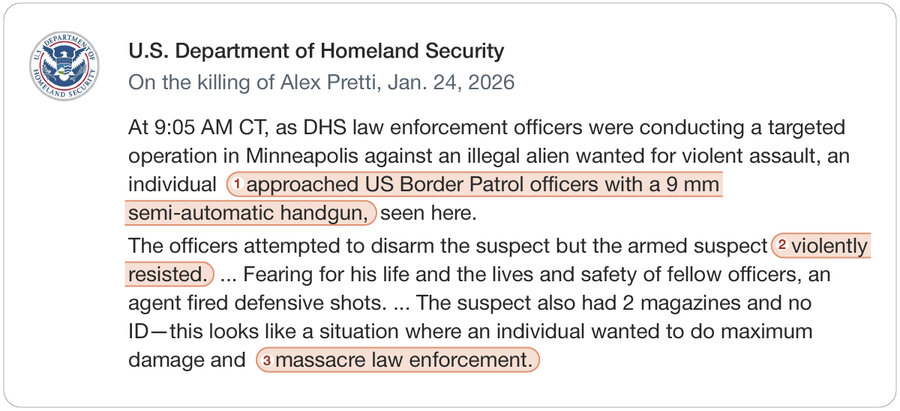
1. Pretti “approached US Border Patrol officers with a 9 mm semi-automatic handgun”
Videos filmed by bystanders show people on the street blowing whistles and shouting at members of law enforcement. Mr. Pretti appears to be recording with a phone in one hand, while his other hand is free.
After an officer pushes another person down, Mr. Pretti steps between that person and the officer, and momentarily appears to touch the officer’s waist. The officer sprays Mr. Pretti in the face with an irritant and pushes him.
Though Mr. Pretti had a handgun in what appeared to be his waistband, agents didn’t appear to notice it until they wrestled him to the ground.
2. He “violently resisted”
Mr. Pretti struggles as several law enforcement officers grab and push him to the ground. Someone yells about a gun.
An agent removes a handgun from Mr. Pretti’s hip. (The victim’s family says he had a permit to carry a handgun, according to The Associated Press.)

Julia Demaree Nikhinson/AP/File
As the agent turns away with Mr. Pretti’s gun, another officer – standing above Mr. Pretti – shoots. An initial report from Customs and Border Protection to Congress, obtained by CBS News, said both a Border Patrol agent and a CBP officer fired their guns.
“I didn’t see him touch any of them – he wasn’t even turned toward them. It didn’t look like he was trying to resist, just trying to help the woman up,” one Minneapolis resident said in a redacted court statement.
3. He appeared to want to “massacre law enforcement”
DHS didn’t produce evidence to prove such intent by Mr. Pretti. Then-DHS Secretary Kristi Noem called the slain man’s actions “domestic terrorism.” Stephen Miller, a White House adviser, called Mr. Pretti a “would-be assassin” who had attempted murder.
Though Mr. Pretti yelled at the officers, “I did not see him attack the agents or brandish a weapon of any kind,” wrote another witness in a court statement.
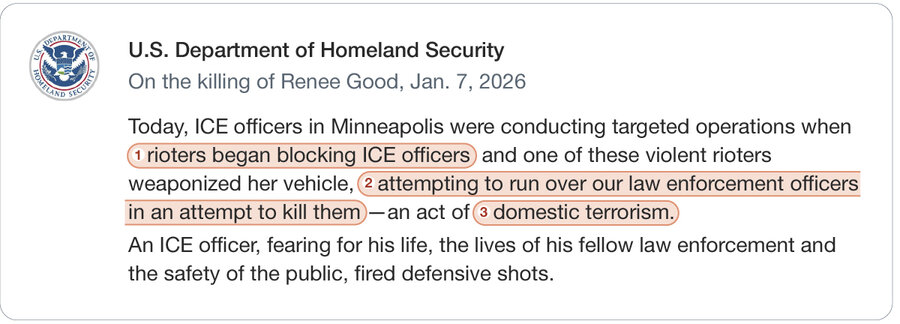
1. “Rioters began blocking ICE officers”
People blowing whistles had alerted neighbors to the presence of ICE officials, witnesses told CBS Minnesota. Bystander footage shows Ms. Good’s car sitting in the middle of a snowy street near at least one unmarked law enforcement vehicle. With her window down, she appears to wave cars on.
At least one person is heard saying, “Get out of the [expletive] car.” An officer yanks on Ms. Good’s driver’s-side door and reaches inside, but the door doesn’t open.
2. Good was “attempting to run over our law enforcement officers in an attempt to kill them”
After reversing her car briefly, Ms. Good starts to drive forward, appearing to veer slightly right – away from the officer. But another officer places himself in front of her car, and fires at her as he moves to her left. Both officers remain on their feet.
Pointing to a grainy, 13-second clip, President Trump claimed Ms. Good “viciously ran over the ICE Officer.” Clearer and longer footage shows that claim is false.
A witness named Betsy told MPR News: “I just can’t be more clear that she posed absolutely no threat at all. From what I could tell it looked like she was attempting to leave.”
3. Good’s actions amounted to “domestic terrorism”
Then-Secretary Noem repeated this claim, echoing a broader campaign by the White House to label left-wing opponents of the government as terrorists. Vice President JD Vance called Ms. Good’s killing a “tragedy of her own making.”
“On Wednesday, January 7th, we stopped to support our neighbors,” Ms. Good’s partner, Becca Good, said in a statement. “We had whistles. They had guns.”