
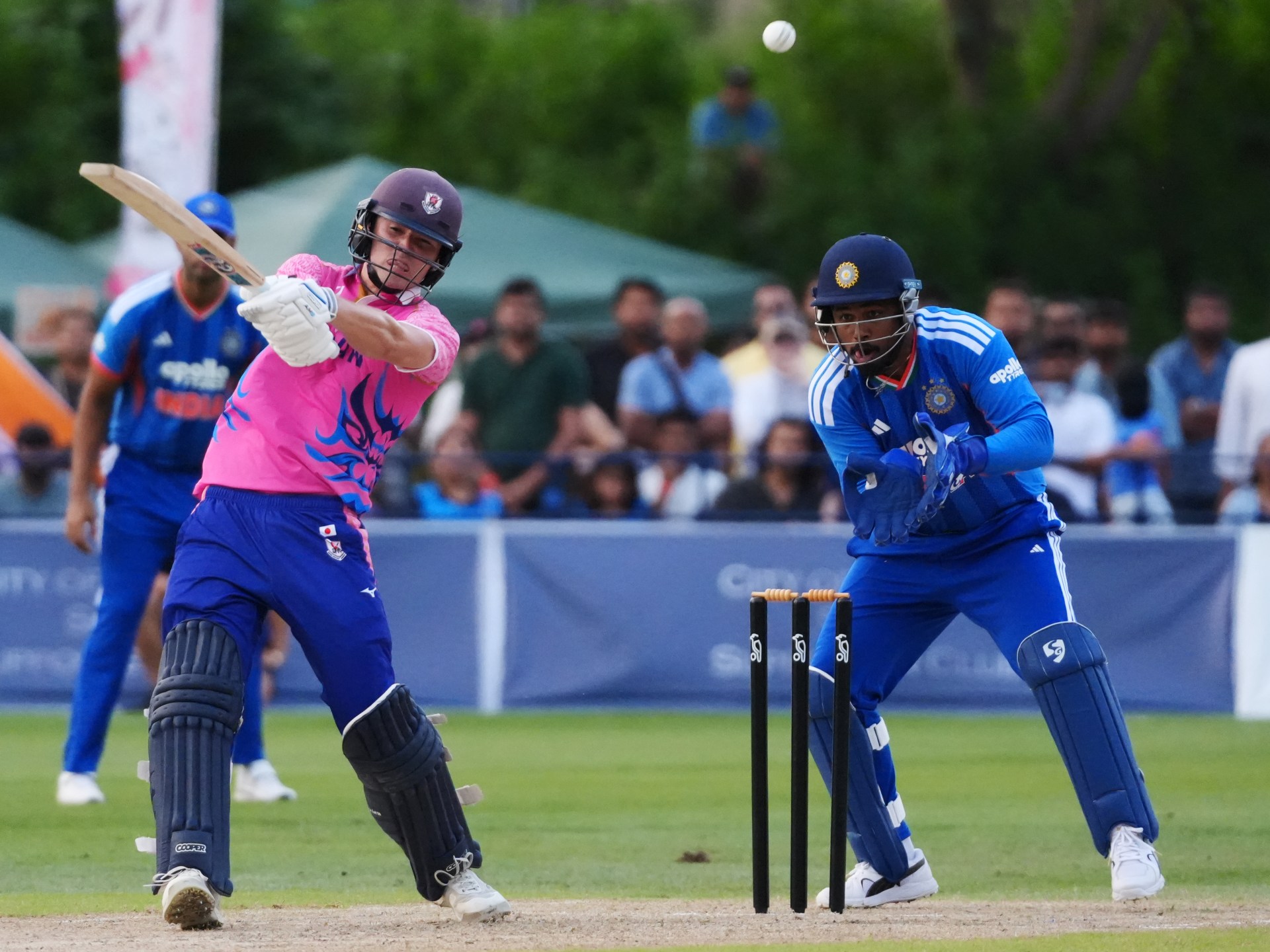
It was the thinnest of margins, and a wide controversy.
Cricket world champions India are being accused of bullying the umpires in a Twenty20 match against minnows Japan, who came very close to scripting a major upset but fell short by two runs in a one-off encounter before the Asian Games.
Set a modest target of 33 by the three-time T20 world champions in a rain-curtailed match, Japan ended their innings on 30-3, handing India a two-run win at the Sano International Cricket Ground on Tuesday.
However, the match took a controversial turn in the final over as the hosts inched closer to the target.
What happened in the India vs Japan match?
India’s captain Shreyas Iyer won the toss after rain shortened the match to five overs per side. In T20 cricket, each innings is normally 20 overs long.
Japan made a dream start when Charlie Hara-Hinze had star Indian opener Abhishek Sharma caught in the first over. He then dismissed Ishan Kishan with the second ball of his second over to give the hosts hope of restricting India to a low total.
Iyer’s 12-ball 16 resurrected India’s innings as they finished on 32-4.
The hosts began their run chase on the slow and low-scoring wicket with caution. Slow left-arm bowler Axar Patel opened for India and dismissed Lachlan Yamamoto-Lake off his fourth delivery.
Japan needed 31 runs off the remaining four overs but lost another wicket while scoring six runs in the second, bowled by off-spinner Washington Sundar.
India continued bowling spin and conceded 17 runs in the next two overs but dismissed Japan’s captain Kendel Kadowaki-Fleming for 12 runs.
When Patel returned to bowl the final over, the hosts needed eight runs off it with seven wickets in hand. Following a dot ball and a single, Patel bowled a wide.
This left Alexander Shirai-Patmore on strike with Japan requiring six runs to win off four balls, and that is when the controversial moment arrived.

What was the wide controversy in the last over?
Patel’s next delivery was also signalled as a wide by the umpire. The batter attempted a reverse-sweep shot, but the ball was still out of his arc, so the wide was called.
However, India’s captain Iyer and Patel were furious with the call and remonstrated with the umpires. After a brief consultation, the umpires revoked the wide, denying the home side a run and an extra ball.
Japan scored three singles off the last three balls, leaving them two runs short of India’s total. Had the umpires not overturned the wide, Japan would have come closer to what would have been one of the biggest upsets in the history of international cricket.
Why are India being accused of bullying?
When umpires’ decisions are reviewed – either through a Decision Review System (DRS) call by the players or an umpire review when the on-field officials are unsure about a call – the ball in question is usually replayed on the screen and the TV umpire’s review is audible on broadcast and inside the stadium.
However, in this instance, the umpires did not call for a review and simply overturned the decision on the field, without offering an explanation.
Traditionally, players quarrelling with umpires publicly has also been frowned upon in the sport.
But the Indian captain and bowler showed no such restraint. Subsequently, the umpire overturned his decision without seeing any evidence that suggested he had been wrong in calling a wide.
Cricket journalists, experts and fans from across the world were quick to criticise the umpires.
Ben Gardner, cricket writer at Wisden magazine, termed it a disgraceful decision.
“With five off four needed for the biggest upset in cricket history, India have just bullied the umpires into overturning a wide call against Japan,” he wrote on X.
Others, like social media user Abu Zaid Sarooji, were even more blunt.
“Japan were robbed here,” he said.
Even Indian cricket team supporters highlighted the controversy, saying it was clear that the batter did not change his stance before the ball was bowled and hence did not attempt to trick Patel.
What do the laws of cricket say about revoking a wide?
According to law number 22.3, which pertains to the revoking of a wide ball call in the Marylebone Cricket Club’s Laws of Cricket, an umpire can revoke a wide ball if:
- There is then any contact between the ball and the striker’s bat or person before the ball comes into contact with any fielder.
- A delivery is called a no ball.
However, neither of the above was applicable in this case.
Who were the match umpires?
The on-field umpires were Chris Brown of New Zealand and Chris Thurgate of Japan. Thurgate was the umpire at the bowler’s end and made the initial call to declare the ball a wide. After Iyer and Patel protested, Thurgate and Brown consulted with each other, before the decision was reversed.

Did the captains talk about the incident after the match?
Neither captain broached the topic, but the Japanese players looked gloomy and disappointed as they walked back after the match.
“Honestly speaking, it was a very difficult wicket to bat on,” Iyer said. “A five-over game, it can go anywhere. It doesn’t matter how good a team you are.”
“The attitude and approach the Japanese team showed today was impeccable, and kudos to them. Their approach was outstanding. I’m sure that they are on the right track.”
Why did Japan host a T20 match against India?
According to reports, the match was a result of diplomatic manoeuvring, corporate sponsorship and years of quiet groundwork by the Japan Cricket Association (JCA), which has been helping the sport take root in the country.
The JCA pulled off a major coup when it persuaded India to play the home side, the Reuters news agency said earlier this month.
The JCA had been working for more than a year to persuade its Indian counterpart, the BCCI, to play a T20 International in Sano. Those efforts gained momentum in recent months when the Japanese government got involved.
“One match or competition itself won’t change anything, and we are certainly not going to think that suddenly it’s going to be as popular as baseball or football in Japan,” JCA chief executive Naoki Alex Miyaji told Reuters.
“But the match against India is the first page of a new era.”
Kadowaki-Fleming said he was extremely proud of his team’s performance against such formidable opposition.
“Emotions are running pretty high in our group. But the fact that we’re able to run the best team in the world, in my opinion, to the last ball of a game is pretty special,” he said. “I think today was a really momentous occasion in that it was the first time we were able to face a full member.”
Was this Japan’s most high-profile cricket match?
It was the first time that Japan, an associate member of the International Cricket Council (ICC), faced a full member and that too a top T20 side.
Japan are 41st in the ICC T20 men’s rankings, while the women’s team is ranked 39th.
Japan has only 7,300 registered players and 16 cricket grounds.




Leave a Reply