
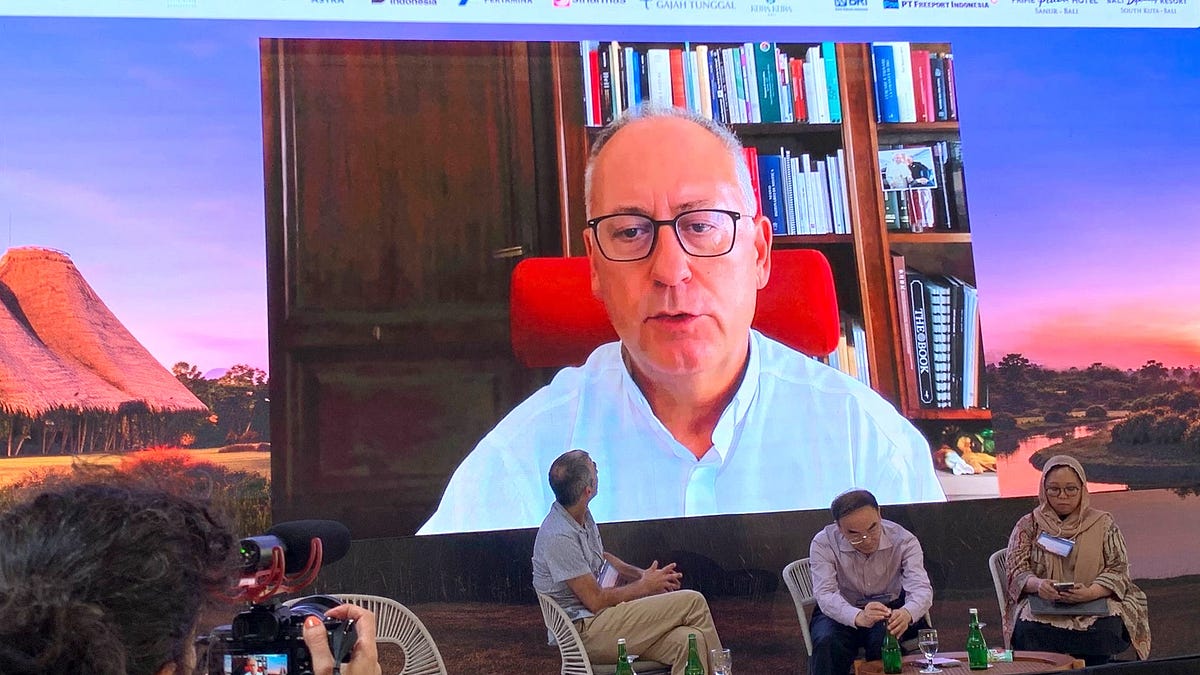
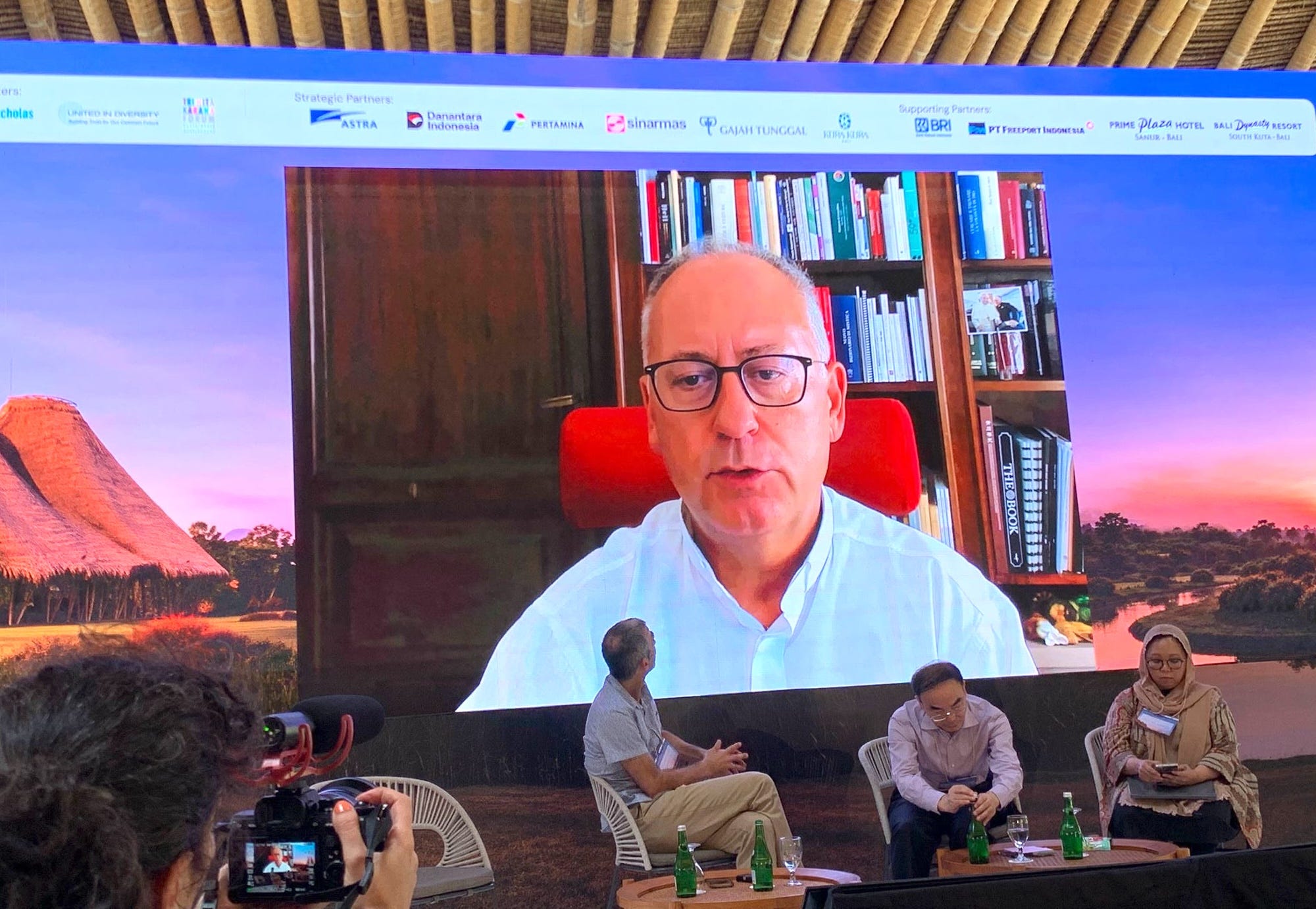
Dear friends, I greet you from Rome, and I am sorry I’m not in Bali with you.
Let me begin with an admission. I do not know the future we are creating. Neither do the engineers, nor the political leaders, nor the theologians. Anyone who claims to know is selling something. What we can know is something narrower and far more demanding: what kind of human beings we are becoming while we build it.
That is the displacement I want to leave you with before your conversation begins. The ordinary question is what artificial intelligence can do. The harder question is what it is doing to us while it does it. It is not enough to ask what technology does to human beings. We have to ask what it makes of them: how it changes the way we perceive reality, relate to one another, desire, and believe.
This displacement is not mine. Pope Francis opened it with great clarity.
In June 2024, at Borgo Egnazia in Puglia, Francis became the first pope to address a G7 session, and he chose artificial intelligence as his subject. The sentence I keep returning to is this: to speak of technology is to speak of what it means to be human. Six months earlier he had devoted his message for the World Day of Peace to artificial intelligence and peace, and his message for the World Day of Social Communications to what he called the wisdom of the heart. Notice that phrase. Not digital literacy, not competence, not fluency. Wisdom of the heart. He was already speaking about education, and he was speaking about it at the only level where education actually happens: the level of what we love and how we attend.
Francis did not stop at words. In 2019 he called for a Global Compact on Education, an alliance between generations rather than a curriculum reform. Many of his interventions have been educational before they were regulatory. Francis understood that you cannot legislate a desire.
Leo XIV has taken that intuition and given it the weight of an encyclical Magnifica humanitas. The subtitle speaks of artificial intelligence; the title speaks of a magnificent humanity. The hierarchy is clear. It is not a document about machines written for people who work with machines. It is a document about the human person, written from inside a revolution that is rewriting the coordinates of experience: how we work, how we know, how we love, how we pray.
And the Pope makes one move at the outset that changes everything. Before asking how artificial intelligence should be governed, he asks what it does to the heart of the person using it. Before ethics, spirituality. Before the norm, discernment. Before the regulation of power, the question of the quality of desire.
I want to give you three reasons why I think that order is right, and then leave you the question.
The first reason is that artificial intelligence is no longer a set of tools. It has become an environment. Leo XIV puts it plainly: it does not knock at the door, it is already inside the house. It is the air we breathe, the code that structures how we think and what we want. A tool is something you pick up and put down. An environment is something you live in, and it forms you whether or not you notice.
This changes the educational question at its root. To educate is no longer to transmit content or to train competences. It is to learn how to inhabit a cognitive ecosystem that we now share with artificial systems. And here is the difficulty for everyone in this room: no generation before yours has had to do this, so no generation before yours can simply tell you how.
The second reason is that an environment carries a measure with it, and the measure is spreading faster than we are examining it.
Francis gave this its name: the technocratic paradigm. Leo takes up the diagnosis and sharpens it. The danger arises when technology becomes the standard by which everything is judged, and so begins to dictate what matters and what can be discarded. Read that slowly. Technology ceases to be a means and becomes a measure. It is no longer the human person who judges technology; it is technology that judges the human person. That is a conversion in reverse: from wisdom to efficiency, from relationship to performance, from contemplation to calculation.
The Pope draws the consequence for each of us. The risk is that individuals will come to be evaluated principally according to the outcomes they produce. So let me put the question in the first person, because that is where it bites. Am I what I perform? What am I worth on a day when I produce nothing?
Modern men and women have not been trained to use power well. That training is not a technical matter. It is a matter of interior formation, and it takes time that no system will give us for free.
The third reason is the one I care about most, and it concerns the difference between combining and creating.
A machine produces combinations. A human being generates meaning. Leo XIV writes that artificial systems can simulate empathy or understanding, but they do not inhabit the affective, relational and spiritual horizon in which a human being becomes wise. The verb matters: to inhabit. Their learning is a statistical adaptation; it is not the experience of someone who is shaped by life through choices, mistakes, forgiveness and fidelity.
Whoever creates has an exposed body, a history, a wound from which the word pours out. The machine has no wounds. And a work of art is born from resistance: the verse from the struggle with language, the painting from the resistance of the material, the composition from the confrontation with silence. Removing the resistance does not liberate creativity. It abolishes it.
This is why the greatest danger of our moment is not error. It is the seduction of the plausible. We are learning to mistake fluency for depth, and correctness for truth. Generating endless variations is not the same as creating meaning. Creativity does not consist in accumulating alternatives, but in discerning what is worth keeping.
Pope Francis said this better than anyone, in Dilexit nos, and he said it by remembering a kitchen. In the age of artificial intelligence, he wrote, we cannot forget that poetry and love are necessary to save our humanity. No algorithm will ever capture the nostalgia we feel when we recall using a fork to seal the edges of the pies we helped our mothers or grandmothers to make. A smile drawn out by a joke. A flower pressed between the pages of a book. Small things, ordinary in themselves and extraordinary to us, kept deep in the heart.
That is not sentimentality. It is an anthropological argument, and it is precise.
Which brings me to limit, because that is where the deepest conflict is being fought today. The culture of enhancement reads every limit — incapacity, illness, old age, suffering, vulnerability — as a defect to be corrected. Leo XIV overturns the rhetoric with a principle that has the force of a spiritual rule: humanity flourishes not despite limitations, but often through them. It is in being limited that room is made for compassion, for the generosity that surprises us in failure, for the worship of God. Take away suffering altogether and you extinguish love and desire along with it.
Two further things, briefly, and then I will stop.
Artificial intelligence does not mean the same thing everywhere. In the West we instinctively reach for personal autonomy, individual freedom, rights. In Confucian cultures the person is a node in a web of relationships, and technology is judged by what it does to harmony. In Taoist thought the world is not made, it flows, and the human task is alignment rather than fabrication. Francis, with his integral ecology, had already refused the idea of a single homogenising progress, and he drew on Amazonian cosmologies to say so. If artificial intelligence is designed by a few and exported to everyone, the poverty will not only be economic. It will be imaginative.
And none of this is immaterial. Every instant answer depends on a human and material chain: millions of low-paid data labellers and content moderators in the global South, many of them young women, and adolescents mining the rare earths that power these systems. Magnifica humanitas names this reality and asks whether we can celebrate an advanced civilisation built on a new form of data colonialism.
So, what do we do with a question this large? Leo XIV proposes two gestures with very old names. To disarm, which means freeing artificial intelligence from the logic of armed competition — military, economic and now cognitive — and, first of all, disarming our own desire for power. And to fast: learning restraint, creating spaces of silence where thought can mature without the crutch of calculation. We fast in order to see more clearly, so as not to confuse the machine’s answer with truth, or speed with wisdom.
I said I would not give you answers, and I will keep my word. So let me hand back the question, sharpened.
The future you are creating in these days will have the shape of what you love. So the question that might serve as your compass is not whether artificial intelligence will become human. It is whether human intelligence will remain human.
And the test is simple enough to carry into every session of this Summit. Even where machines excel in efficiency, the center of history remains a human face asking to be looked at.
Thank you.



Leave a Reply