

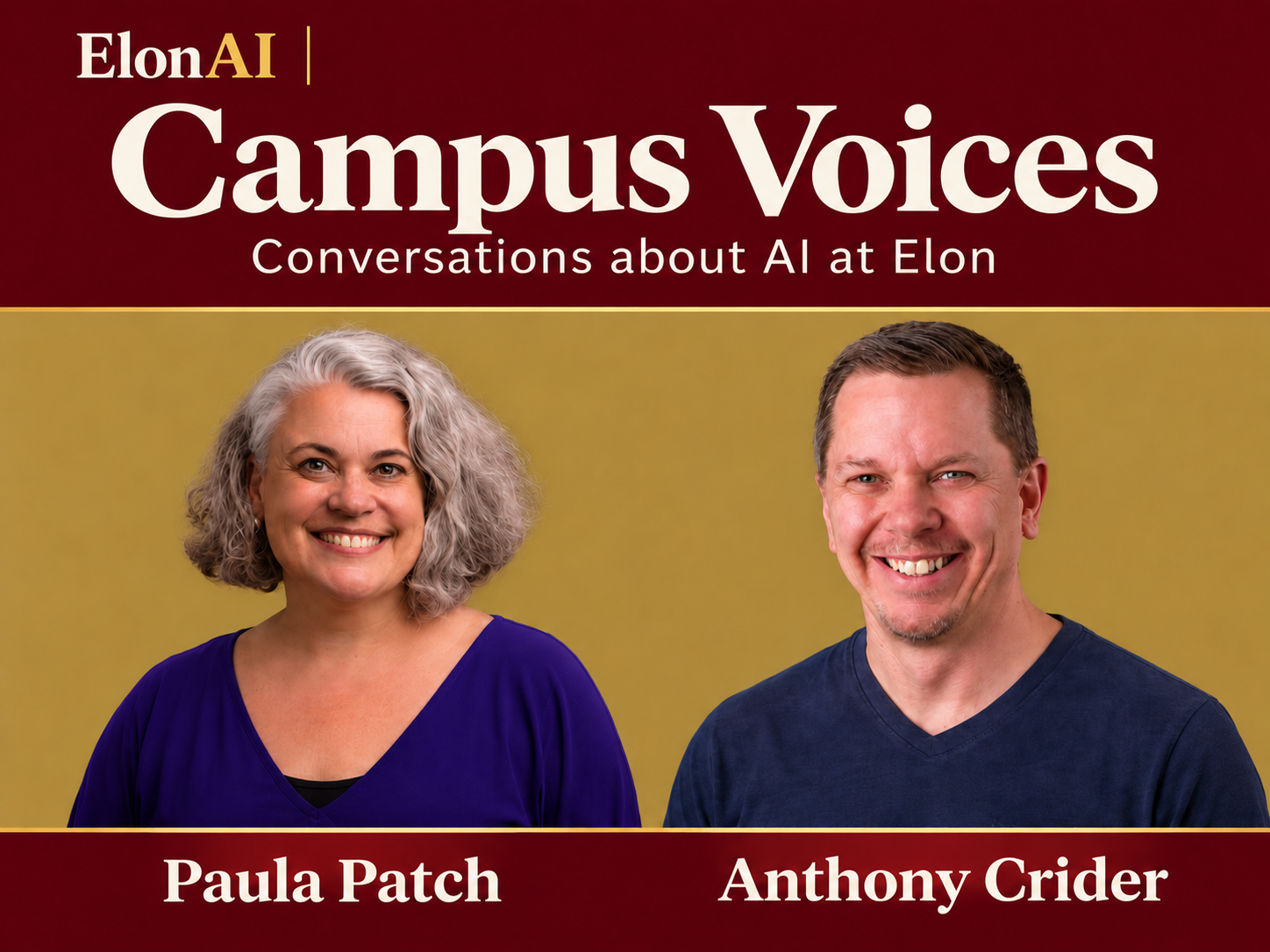
The Elon AI Hub’s “Campus Voices” series explores faculty experiences with artificial intelligence and its influence on teaching in their classrooms.
Share:
The Elon AI Hub has launched Campus Voices, a YouTube interview series in which Elon faculty and staff discuss how artificial intelligence is influencing teaching and learning. The first two episodes feature Paula Patch, teaching professor of English, and Anthony Crider, professor of astrophysics.
Hosted by Paul Nunno ’27, a student employee at the AI Hub, the series gives faculty members an opportunity to discuss the uses they have found for AI, where they see its limits or risks and what questions they are still working through.
“My goals and the AI Hub’s goals are very similar: to neutrally observe how AI has impacted student and faculty life on campus,” Nunno said.
In “AI as a Second Brain: Supporting Student Learning,” Patch describes using ChatGPT to record ideas for assignments, organize course planning and reflect on what worked in class.
“It’s absolutely made me more efficient by making me more creative,” Patch said.
Patch emphasizes the importance of preserving students’ own engagement with reading and writing. She expressed how AI can be used ethically to help students, saying that students can use AI to break a long reading into smaller sections and build a schedule for finishing it, without having AI do the reading itself and encouraging them to think. Her discussion also addresses how AI-generated text can obscure a writer’s individual voice and why students and faculty should talk openly about their expectations and boundaries for using the technology.
In “AI, Education, and the Future of Work,” Crider recounts how agentic AI, AI tools that can carry out multistep tasks with some independence, helped him when Elon switched learning systems from Moodle to Canvas and all his course software had to be rewritten.
Those courses also had to be updated to account for the ubiquity of AI; many of the coding exercises he once assigned students can now be completed almost instantly by AI. In response, Crider has students work through some problems by hand and examine AI-generated Python code for errors before using AI to develop code themselves. The goal is for students to understand the underlying concepts and learn to judge AI tools and their outputs in their field. Crider also discusses assessing students through what they can demonstrate through activities and experiences. His interview considers how educators can prepare students for changes in the workforce; he advises students to develop proficiency with AI tools and pursue coursework beyond their primary discipline.
Interviews with Jonathan Su, associate professor of engineering; Erin Hone, associate teaching professor of education; and Amanda Sturgill, associate professor of journalism, are upcoming.
Both episodes are available on the Elon University AI YouTube channel. Additionally, visit the Elon AI Hub website for information on campus AI resources, consultations and upcoming events.







Leave a Reply