

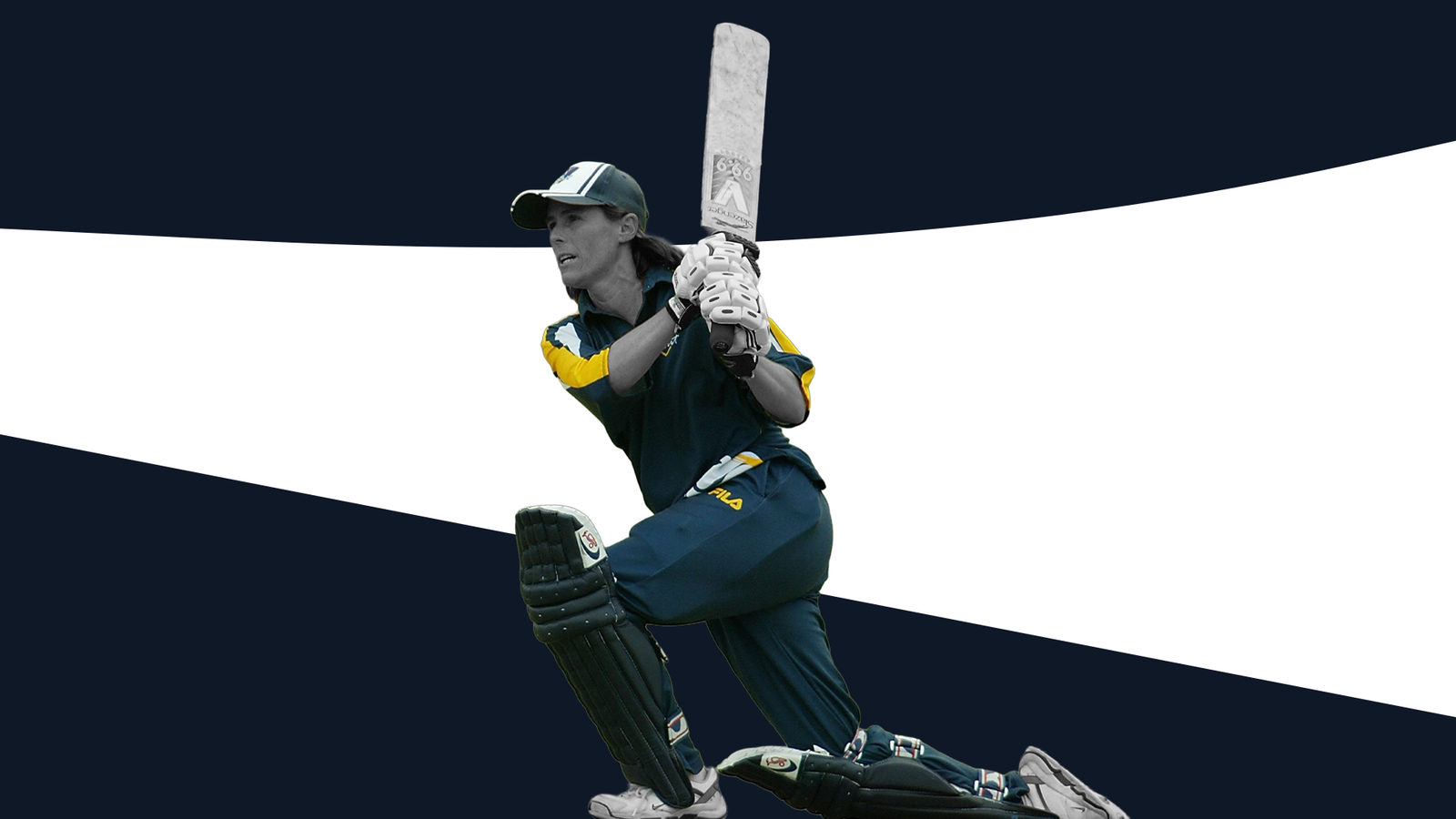
When Belinda Clark quietly relocated from Sydney to Melbourne for work in September 2000, she had hardly an inkling of the ripple effect it would create across the next six years in Australian cricket.
Clark, who turned 30 that month, was long settled in her position as national team captain. Off the field however, her professional life was in flux. While working as a game development manager at Cricket NSW, she emerged as the top choice from 55 applicants to be named executive director of Women’s Cricket Australia (WCA).
“I finished work in Sydney on the Friday, moved on the Saturday and started work on the Monday,” she said at the time. “It’s hard to make the transition to supposedly play for ‘the enemy’. When I was growing up as a junior player, Victoria certainly were the team to beat. They’ve won a lot more national titles than any other state.”
Clark rented in Ashburton, in Melbourne’s south-east, and caught the train each morning to Richmond Station, from where she walked to work in Jolimont, in the shadows of the Melbourne Cricket Ground.
Through that first summer, the Newcastle product went to considerable lengths to stay loyal to New South Wales Breakers, the team she had skippered to four straight national titles since the inception of the Women’s National Cricket League (WNCL) in 1996-97.
It meant regular interstate flights to join up with the squad on match weekends, and incredibly, it also meant training with the Breakers’ bitter rivals, Victoria, at the state’s Institute of Sport.
“It was an unusual circumstance, for sure,” Clark tells cricket.com.au. “Every time they were having a chat about their game plans, I just had to wander off to the side and ignore all of that – my team was 1000 kilometres up the highway.
“So it was very strange, but I was super grateful that I was able to train properly with them.”
The WNCL schedule that summer had the two states meeting in January. It was long enough for one unforeseen consequence of Clark’s move to begin bubbling to the surface.
Victoria hosted the Breakers on the state border on a cooler day in Albury, and as a typically heated contest unfolded, questions of loyalty were soon asked.
“It was actually a really fierce game,” recalls NSW legend Lisa Sthalekar, a budding 21-year-old allrounder at the time.
“There were certain players going hard at each other, and (Clark) stepped in and told our player to cool it. We were like, ‘Are you already a Victorian?'”
Clark of course was also managing her responsibility as national captain; the month prior she had led an Australian team stacked with players from both states to the World Cup final in New Zealand.
A fortnight later, the opening bat was leading NSW to a fifth-consecutive finals triumph – this one over Queensland – having scored 451 runs at 56.37 to be the WNCL’s second-highest scorer.
Victoria, historically the dominant force in domestic women’s cricket, finished last, and the balance of power within the new one-day competition was by then well established: it was New South Wales, daylight, and the rest. It was a trend that showed no signs of slowing down; a level below, the NSW youth side had at that point won 13 consecutive national titles.
After a season spent training alongside the Victorians, and even playing with many of them (Cathryn Fitzpatrick, Jane Franklin, Mel Jones, Kelly Applebee) at district firsts club Buckley Ridges, Clark’s position on her domestic future had changed. Logistically, the scale of her role with WCA and the challenges of living interstate from her Breakers side made her reevaluate her options.
“I was rusted on blue and blue – I didn’t think I’d ever play for anyone else,” she says. “But I’d found it difficult to lead a team when I wasn’t with them all the time. I think that was really what triggered me to say, ‘OK, I need a change here’.”
And so ahead of the 2001-02 season, Clark confirmed what by then was a rumour that had been swirling for a while: she would be switching allegiances.
The move was met with excitement by Victoria – “we were just pumped to have the Australian captain come and play for us” recalls Applebee – but in NSW, it struck a different chord.
“Yeah, we were not happy,” says Sthalekar today. “Because we hated Victoria – there was that much of a rivalry. And in those days, moving states just didn’t happen.”
There was little made of Clark’s move in the media, although one report in Melbourne’s Sunday Herald Sun newspaper picked up the tone, with journalist Jackie Epstein calling it “akin to a Collingwood player trading his stripes for the navy blue (of archrivals Carlton).”
In what was perhaps the most seismic move in domestic women’s cricket history, Clark was also set to don a navy-blue strip. And the aftershocks were about to be felt.
* * *
Salt had been rubbed into the wounds of Victoria’s 2000-01 wooden spoon by the exits of experienced pair Charmaine Mason and skipper Franklin ahead of the new season.
Since winning the final edition of the Australian Women’s Cricket Championships in 1996, the Vics had twice been runners-up to NSW in the WNCL but their win-loss record against the Breakers told the real story: from their past 12 matches, they had been beaten 11 times.
But the strength of Melbourne’s grade competition meant promising players were always coming through the ranks. The likes of Clea Smith, Shannon Young, Sarah Elliott, Louise Broadfoot and Applebee, coupled with experienced internationals Fitzpatrick and Jones, made for a solid nucleus.
“I thought they had some pretty good talent,” recalls Clark. “I felt like they weren’t that far off … they had a good pace attack, some good fielders, a couple of spinners – but they were just maybe one batter short.
“I probably just added a bit more grunt into the batting engine room, and that’s how I was viewing my arrival in the navy blue.”
Head coach Neil Barras said at the time that when Clark had trained with Victoria as a Breakers player, a number of the squad’s younger players had been “awe-inspired”. By season’s end however, they were “now realising they are capable of bowling tightly to a person of Belinda’s strength”.
Having been appointed captain, Clark led with her actions on debut, making 62 from 66 balls while sharing a century opening stand with Elliott in a five-wicket win over Queensland. A day later she topped that effort, making 116 from 112 in another victory.
By Christmas, Victoria were five wins from six and Clark had piled on 339 runs at 56.50. Within the state setup, however, the arrival of the biggest name in the game, and her forthrightness in immediately calling the shots, was – at least initially – cutting both ways.
Applebee, who had gotten to know Clark via Buckley Ridges, remembers being “nervous” when going out to bat with a living legend, and although that feeling was outweighed by the invaluable lessons she recalls learning along the way, it perhaps typified the sentiment of the youngsters in the group.
“Belinda played a pivotal role in that leadership … there was an elevated mindset,” recalls Jones. “But I think it probably took a season to get used to her, because – bless her – she’s one of the funniest women going around, but she can also be cranky, and there was a little bit of – I don’t know, not fear – but I think most people didn’t really say anything to her for the first year (laughs), just because it was ‘Belinda Clark’.
“So it probably took us a season to get used to the intensity of trainings and match play. Once everyone understood her a little bit more and where she was coming from, from a leadership side of things, people relaxed into their roles a bit more.”
Pipping the Victorians for top spot on the ladder at the end of 2001-02 was NSW, who had won six straight matches in a post-Clark era led by Julie Hayes.
“I remember it was a big thing for us, it was almost like: ‘If she’s going there (Clark to Victoria), we have to prove that we can win without her’,” says Sthalekar.
“We had the majority of the Australian squad members, and we had the next generation coming through, with the Blackwells (Alex and Kate) and a few others.”
The two sides seemed on a collision course for the best-of-three finals series, but before that, Clark had to face NSW – for the first time in her career – twice over a weekend in January.
“We know what a great player she is,” NSW skipper Hayes said at the time. “If we just worry about her someone else could creep up on us, but we have a plan to get her out.”
“I remember the game,” says Applebee. “It was at Melbourne Uni … and I mean yeah, we disliked (NSW) from a competitive point of view, and they disliked us a lot.”
The Breakers scraped together 9-122 from 50 overs before Clark and Elliott headed out to the middle. There the national skipper was warmly welcomed by her former state teammates.
“There was nothing polite,” smiles then NSW spearhead Bronwyn Calver, who had enjoyed many a run-in with Fitzpatrick in particular over the years.
“Everyone knows how good a player (Clark) was, so to lose her from our ranks and strengthen their ranks was not ideal.
“So it was a bit spicy, a bit fiery, but nothing that crossed the line.”
Clark remembers it similarly.
“There were a few things (said) where it was obvious that I was definitely in the other colours now,” she says. “A bit of banter, but nothing of any sort of substance.
“I think if you were 19 or 20, that could be destabilising. But I was 31, and I’d captained the national side for six or seven years by then, so I think that prepares you for those moments … I mean, you just ignore it and play.
“I actually enjoyed the challenge because they were by far the benchmark team. So I was up for the challenge, I’m sure they were up for the challenge, and it hopefully did a little bit to create more interest in the comp.”
Clark top-scored with a measured 40 but Victoria slipped to an agonising six-run defeat, and a day later they were more soundly beaten as the Breakers closed out the regular season with a perfect record.
Two weeks later the teams met in the finals at Bankstown Oval. By that point in the season, head coach Barras found himself marvelling at the way Clark had lifted the standards of the playing group.
“It wasn’t only her runs, but I think just her presence in the team, and her command on the field – the other players grew in confidence around her,” he says. “They became more self-assured and had the belief to take the game on more.”
Yet in the best-of-three finals, the Victorians found themselves still short of the benchmark set by NSW, and the home side needed only two matches to retain the Ruth Preddey Cup.
Clark made 18 and 34 to once again finish as the competition’s second-highest run-scorer (433 at 43.30), but runners-up was not a position she was accustomed to.
For the Breakers however, the wins – and a sixth consecutive WNCL title – were ones to savour.
“They were,” Sthalekar says, “the sweetest victories we ever had.”
* * *
Hurstville Oval in Sydney’s south was the quaint setting for phase one in Victoria’s Operation Payback the following summer.
With Clark settled and driving the standards alongside the evergreen Fitzpatrick, the leadership group was given another fresh jolt in the form of new head coach Ken Davis.
“I have a strong belief that the coach and the captain together, well, things either work or don’t work (for the team) on whether those two can find a way of working well together,” Clark says today. “And I felt like Ken and I did that really well.”
Davis, who hailed from Geelong, challenged his charges to get out of their comfort zone with regards to the brand of cricket they were playing.
“When I started, we were perennially beaten by New South Wales, and I found the (Victoria players) had a fairly negative attitude,” he tells cricket.com.au. “I felt they had to be more aggressive and take the game on more.
“In the early days, I watched the women’s district cricket, and they were very conservative in the way they played; they would sit and wait for the ball to hit, which was the traditional way of playing.
“But I wanted them to get on with the game, and take some risks.”
Clark quickly felt aligned with Davis and his ways of thinking about the game. Their unified leadership meant a clear approach filtered down through the group.
“Both Belinda and Fitz(patrick) were extremely mentally tough,” Davis says. “I was very fortunate to have those two as leaders.
“They expected high standards and drove that by their own example; they were super trainers, and super committed to skill development, probably more so than the men I had coached before that.”
The young group bought into the high-performance expectations.
“We had this thing we called ‘the bandwagon’, where everyone had to give up something they loved dearly,” Jones recalls. “So whether it was chocolate or chips – I think for a few of us it might’ve been alcohol – you had to give it up for the entire season, and everyone really lent into that.”
After two wins over WA to begin the 2002-03 season – highlighted by Jones’ 95 from 103 deliveries – the acid test against the Breakers arrived in early December.
In their first of two encounters across a weekend at Hurstville, Victoria posted a healthy 6-218, but were ultimately beaten by five wickets, with Alex Blackwell’s unbeaten 74 the difference.
“But in that game, Kelly Applebee, who was one of our younger players, made a great 70-odd (78 from 89),” Davis says. “It was a magnificent innings. She took the bowlers on, and I was just rapt with the way she’d embraced our philosophy.”
The winds of change were gently beginning to blow. A day later, after Clark’s 101 led the Vics to a similar total – 7-217 – Fitzpatrick and Smith struck with the new ball to leave NSW reeling at 3-10. The reigning champs recovered, but not quite enough, falling four runs short of their target.
For the first time in eight contests – and three years – Victoria had beaten NSW. And for Clark, it was a first major score against her former opponents.
“I’ve got a few 30s and 40s (against NSW),” she said, “but it was nice to go on with it today.”
It was a pivotal win in the context of the season. Underpinned by the deeds of champion allrounder Karen Rolton (who finished top run-scorer, with Clark again second), South Australia had made it a three-horse finals race, taking a game off both Victoria and NSW along the way.
To book top place on the ladder, Victoria needed two wins over Queensland on the competition’s last weekend. They got them courtesy of Jones’ clinical 94no on the Saturday, and Clark’s defiant unbeaten 69 on the Sunday.
The upshot was a finals series at an MCG that was undergoing renovations, which meant much of the ground’s concourse resembled a construction site. Yet the Victorians couldn’t have cared less; this was their shot at redemption, and after almost two seasons with Clark at the helm, it was one they felt ready to take.
“I certainly remember playing at the ‘G – you don’t forget those experiences,” Clark says. “The whole members’ area had been ripped down, there was construction going on in the background, and it was very noisy and very dusty. But we were taking it – we weren’t giving up the opportunity to play there.
“In those days, the best-of-three finals felt like a mini-international series. You turned up, and you knew you had to put in two good performances. You weren’t just going to strike it lucky with a good toss or a wet wicket. You had to win two games. It was great.”
On January 17 and 18, 2003, in the vast expanses of a dusty MCG, Victoria made history. Their quest to reignite their battle with NSW for domestic supremacy was realised in the form of consecutive wins – the first by three wickets, and the second by 40 runs.
Clark was the key contributor, making 83 and 63, but for the Victorians, it really was a collective effort, and Applebee’s catch off Clea in the second match to seal their first WNCL title perhaps illustrates that best.
“I remember Belinda running towards me – she was the closest fielder – and just the excitement,” she smiles. “As a young kid, I was like, ‘Oh my goodness!’ I didn’t quite realise how much it meant to those more mature players. That was, for me, the pinnacle.”
It was also a moment for Davis to take stock of the scale of the achievement in his maiden season in charge.
“I felt a real sense of pride that, as a unit, they’d been able to turn around their mindset in the first year,” he says. “They’d defeated a squad that was always very confident against us, that always thought they had our measure.
“To do that in one season was just so gratifying.”
Jones recalls seeing Clark’s fierce competitiveness coming to the fore across those two days.
“She was getting so much flak from New South Wales,” she grins. “I’ve never seen her so determined to score runs – and she did.”
Afterward, Applebee was soaking up the celebrations in the dressing room when one of Clark or Fitzpatrick – she can’t quite remember which – approached her.
“She came up to me and said, ‘You might want to keep this’,” she recalls. “It was the ball I’d caught, and then thrown up in the air.”
* * *
“We’ve won one premiership, but our aim is to establish ourselves as the power team of the competition. We want to achieve consistent success and be remembered as a significant team in Victoria’s cricket history.”
They were fighting words from Davis in early December, 2003, targeted squarely at the Breakers.
The coach wasn’t shy when it came to pushing his players, or experimenting with mind games. That season he also introduced a brief post-Saturday match training session, where for just 10-15 minutes immediately after play, the team would return to the field and work on an area in which he felt they’d been below par.
“I did it for not just their benefit, but to intimidate New South Wales a little bit, just to say: ‘Hey, we’re doing things that you’re not doing’,” Davis says. “I got feedback that the New South Wales girls thought that was stupid (laughs). I think it got them thinking, anyway.
“When I first went (to Victoria), I’d felt that we needed to turn our mental attitude around against New South Wales, and I think we did become mentally tougher in that period.”
The rivalry between the sides was also becoming fiercer and ever-more closely contested. On December 20 they played out a tie, and a day later, Victoria snuck home by four wickets with an over to spare.
That win ultimately earned Clark’s team top spot on the 2003-04 WNCL ladder, which meant another finals series at the MCG. This time around, all three matches were required after NSW fought back from defeat in the opener to level the series.
Clark again stood tall with 115 in the decider, but it wasn’t enough, as the Breakers chased down 218 with eight balls and three wickets in hand.
For Davis’s lofty ambitions to come to fruition, Victoria needed to hit back hard in 2004-05. As the two sides contested the finals for a fourth-straight season, that’s exactly what they did.
Unbeknownst to her teammates, Clark – who finished as the WNCL’s leading run-scorer for the second year on the trot – had decided it would be her final domestic campaign.
“There was a chance to go to Brisbane to run the Cricket Academy,” she says. “I thought: OK, this is a great transition plan. And I was ready for a new challenge.”
The Breakers hosted that summer’s finals at Bankstown Oval, and took a one-nil series lead with a 21-run win. Yet Victoria, drawing on the mental strength that had been instilled in them, bounced back with wins in games two and three to take the series.
Most promisingly for the state, those victories came without major contributions from Clark (20 and 26); the likes of Smith, Applebee and Franklin all stepped up to play vital roles in pressure moments.
Clark can still picture her little nephew riding his bike around Bankstown Oval that day. She remembers, too, the grinding nature of Victoria’s wins over a once untouchable rival.
Yet with two titles in three years, the ledger had tipped Victoria’s way. And the move of Clark – who averaged 51.45 and scored five hundreds and 13 fifties in her 42 matches for the state – had been the catalyst for that shift.
“Captaining Victoria, it revitalised me, really,” she reflects. “I’d played for New South Wales for so long. I knew all the players and I was seeing them all the time – both playing against them at club level and training with them.
“So I had to basically start again. I had to go and build different relationships with people, and I found that really invigorating.
“And then coming up against New South Wales, that’s another reason I loved it; I knew I was going to get tested, and it did feel like it was going to be international-quality cricket.”
This week marks 25 years since Clark’s debut for Victoria – a four-year stretch that took in two WNCL titles. And despite the glittering careers of Meg Lanning and Elyse Villani, the emergence of Sophie Molineux, Georgia Wareham, Annabel Sutherland, Alana King and Tayla Vlaeminck, and the recruitments of Nicole Bolton, Ellyse Perry and Kim Garth, the wait for another Ruth Preddey Cup goes on.
New South Wales, on the other hand, went on to win the next 10 WNCL titles, although since 2015-16, the spread has been far more even, with five states claiming at least one title.
“In those pre-integration years (before the ACB and WCA merged in 2001-03), New South Wales were possibly providing better organisational support for their state (women’s) team than what Victoria would have been,” Clark says. “I feel like there was a greater buy-in from (CNSW), and greater support.
“So they were building systems earlier than Victoria were, and I think they’re probably still dining out on that; I think those systems are still very much in play.”








Leave a Reply