
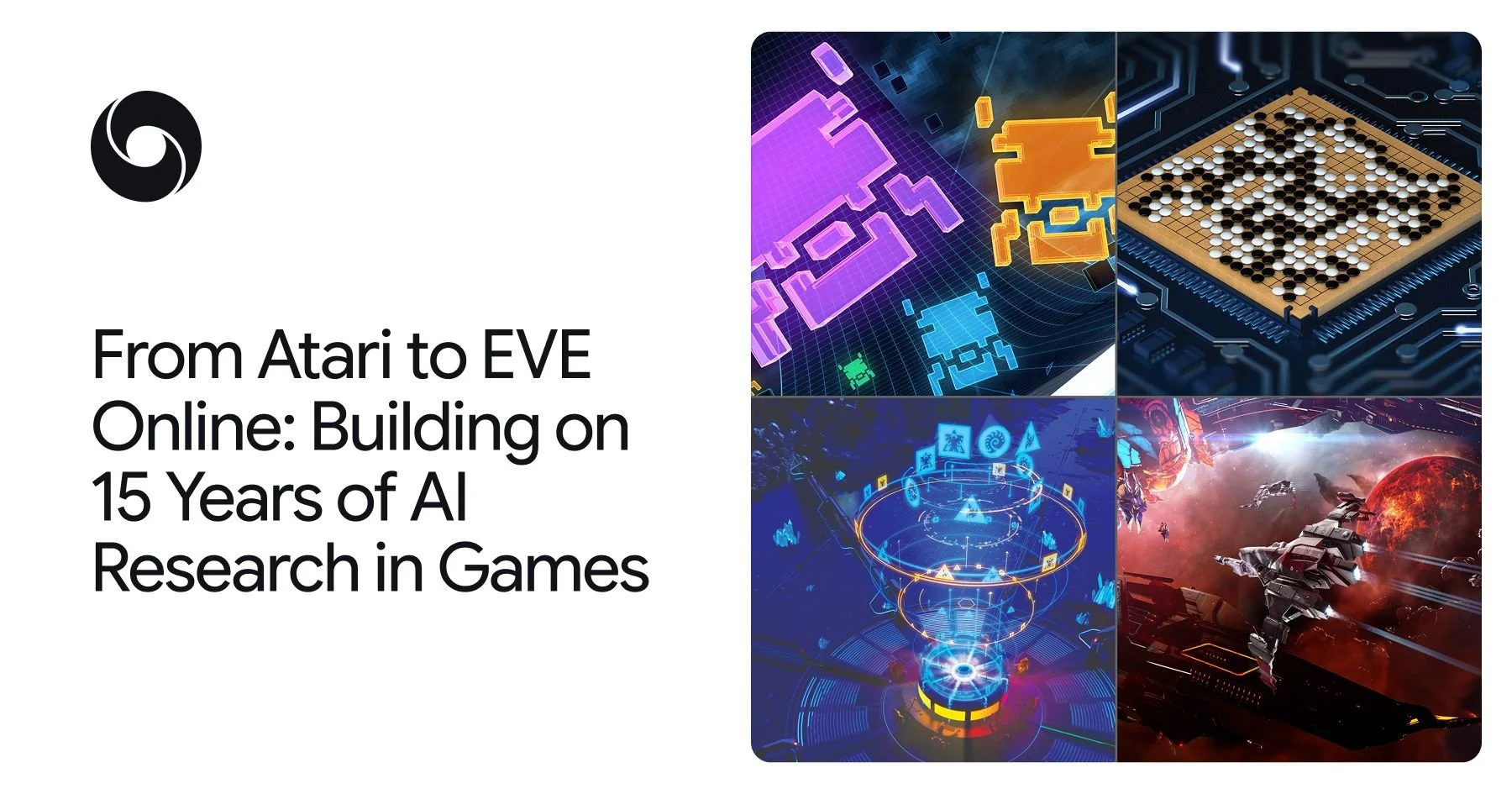
Google DeepMind is expanding its use of games as AI research environments through a partnership with Fenris Creations, using the EVE Universe to investigate some of the harder problems facing more capable AI agents.
The work moves beyond teaching AI to master a fixed game. DeepMind wants to explore systems that can learn continuously without forgetting earlier skills, retain information beyond current context windows, plan over weeks or months and operate in environments shaped by cooperation, competition, negotiation and economics.
EVE Online gives the researchers a particularly demanding setting. Launched in 2003, the massively multiplayer space simulation runs as a persistent universe shaped by its players, with alliances, conflicts, diplomacy and a player-driven economy spanning thousands of star systems.
DeepMind says those characteristics make it useful for studying AI that has to function inside a world that keeps changing rather than one built around a single score or objective.
The research will not begin by placing experimental agents alongside live EVE Online players. DeepMind says the program starts in an offline instance of the game, separate from the live environment, before progressing through EVE Frontier. Only once capabilities are mature would the partners consider bringing them into EVE Online and EVE Vanguard.
From beating games to living inside them
Games have been part of DeepMind’s AI research since the company’s early years, but the challenge has changed considerably.
Its Deep Q-Network learned to play 49 Atari 2600 games directly from pixels, leading to a 2015 Nature paper that helped establish deep reinforcement learning. AlphaGo then defeated Go world champion Lee Sae Dol in 2016, followed by AlphaGo Zero, AlphaZero and MuZero.
AlphaStar reached Grandmaster level in StarCraft II in 2019, taking on a game where decisions happen in real time and players operate with incomplete information.
That earlier research was largely about learning to succeed at increasingly difficult games. DeepMind’s more recent work asks whether AI can understand and act inside a virtual world in a way closer to a human player.
SIMA, its Scalable Instructable Multiworld Agent, was developed around that problem. Rather than being optimized for a high score, SIMA observes what is happening on screen, follows natural-language instructions and acts through ordinary keyboard and mouse controls without requiring access to a game’s API or source code.
Its successor, SIMA 2, is powered by Gemini and can reason and converse while operating across 3D research environments and games including No Man’s Sky, Valheim and Hydroneer.
The EVE partnership takes that line of research into a world where the challenge is not simply moving through a 3D environment. An agent may need to retain knowledge, adapt as the world changes and understand the actions of many other participants over much longer periods.
DeepMind has identified four areas it particularly wants to explore: continual learning, long-term memory, long-horizon planning and complex multi-agent dynamics.
That could mean learning a new skill without losing an old one, retrieving information accumulated over periods far beyond a model’s normal context window or planning toward an objective that unfolds over weeks, months or even years.
Multi-agent research brings another layer. EVE’s world involves cooperation and competition between people, along with negotiation, trade, economics and behavior that can emerge without being explicitly scripted.
Hilmar Pétursson, CEO of Fenris Creations, says: “EVE Online was envisioned from day one as a sandbox of lasting consequences, shaped by its players. This has driven countless stories of human growth for players and employees across the decades. Together with Google DeepMind, we’re pushing into uncharted territory where AI must learn, adapt and remember on timescales that no other game environment demands, while helping us understand how humans and AI can coexist in a virtual environment before we have to contend with the same questions in real life.”
EVE Frontier adds a world where the rules can change
The partnership extends beyond EVE Online.
EVE Vanguard introduces a first-person environment and faster tactical decision-making within the wider persistent universe, giving researchers another level at which to study AI behavior.
EVE Frontier creates a different problem. Its programmable “Smart Assemblies” and open architecture allow the rules of the environment itself to change, requiring an agent to adapt to new mechanics rather than simply becoming better at operating within a fixed system.
DeepMind says the combination gives its researchers environments ranging from immediate tactical decisions to strategy operating across much larger timescales.
The collaboration has already resulted in one live application. Aura Guidance uses Gemini to deliver player-generated knowledge based on questions and answers from EVE’s Rookie Help community, with the aim of helping new pilots.
The wider agent research, however, will remain separated from live EVE Online players during its initial stage.
DeepMind says it will begin with the offline EVE Online environment before moving into EVE Frontier to examine how people and AI agents could coexist inside a persistent, open-ended world. Live deployment in EVE Online or EVE Vanguard would only be considered later if the capabilities reach sufficient maturity.
Games remain a testing ground for wider AI research
DeepMind is also framing the EVE work as part of a longer research thread connecting advances made in games with problems outside them.
The company points to AlphaGo’s unexpected Move 37, which prompted professional Go players to explore new strategies, and AlphaZero’s influence on chess play.
It also links the exploratory methods developed through game research to later work on AlphaFold, which applied AI to protein structure prediction and was recognized through the 2024 Nobel Prize in Chemistry.
The current gaming research is being conducted with a wider group of developers. DeepMind names Coffee Stain, Hello Games, Foulball Hangover, Keen Software House, RubberbandGames, Strange Loop Games, Thunderful Games, Digixart, Tuxedo Labs and Saber Interactive among studios whose games have been used in its research.
For the Fenris partnership, the ambition is to use the research both to explore new forms of gameplay and to understand capabilities that could eventually transfer beyond games.
DeepMind says its long-term goal is to develop AI as “a catalyst, not a replacement,” with future work aimed at more accessible and personalized games alongside applications to real-world problems and scientific discovery.













Leave a Reply