
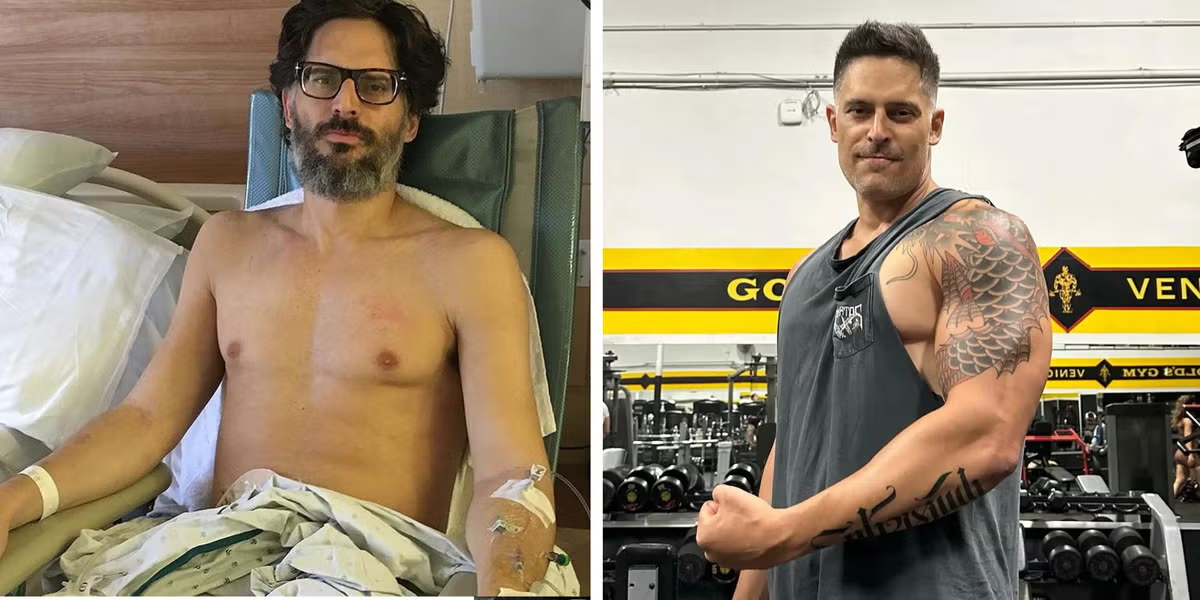
Joe Manganiello has spent much of his career looking like someone who clearly knows their way around the weights room. Between True Blood and Magic Mike, his physique has become just as recognisable as the roles themselves. But the 49-year-old has recently opened up about a period when even getting out of a chair was a challenge.
In his new memoir, Bloodlines, Manganiello describes a seven-year health ordeal involving what he calls a mystery autoimmune illness, major intestinal surgery, deadlifting with an ostomy bag and 30kg of weight loss. Speaking on The Rich Roll Podcast, he explained just how far he had to go to rebuild his body, beginning with basic movement.
These are different stages of his story, and certainly not a rehabilitation programme to copy. But, taken together, they offer some useful lessons, whether you’re rebuilding after illness, returning from a layoff or simply looking to get stronger later in life.
Start with What Your Body Can Currently Do
Manganiello told Roll that his early recovery involved working on ‘walking and sitting up and standing’. At this stage, those were meaningful challenges in their own right, long before there was any question of whacking plates on a barbell.
If you’ve spent years training, accepting that your starting point has changed can be one of the more frustrating parts of coming back. It’s very easy to let past PBs become the standard against which you judge everything you’re doing now.
There’s nothing wrong with wanting to get back there, but your first sessions need to reflect your current capacity. Following serious illness or surgery, that means agreeing with your clinical team what’s appropriate. After a straightforward layoff, it might simply mean doing considerably less than you feel you ought to, and giving yourself room to build from there.
Build Up Gradually, Seeking Feedback
In the Rich Roll conversation, Manganiello describes his appetite returning, eating more and cautiously resuming training. As the weeks and months passed, he tested whether he could tolerate more.
‘Increase the intensity. See what happens. So far so good.’
The useful part here is the ‘see what happens’. It’s tempting to judge a comeback session by whether you got through it, particularly if you’ve been itching to get back into the gym. But grinding through a workout and being ready to go again the next day are two very different things.
For someone returning from an ordinary break, keeping a simple record of what you did and how you felt afterwards can help make those decisions less haphazard. You have something to refer back to when deciding whether to add more work.
Remember, the key to training – wherever you are in that journey – isn’t how much work you can do, it’s how much work you can recover from.
Give Yourself Time to Warm Up Properly
Speaking to Men’s Journal in 2024 – when he would have been in the midst of his rebuild – Manganiello emphasised warming up and ‘ramping up intelligently’, acknowledging that your enthusiasm doesn’t necessarily reflect your body’s capabilities.
‘You have to kill your ego sometimes, which can be hard.’
Most of us know what that looks like in theory. But if you’ve decided what your biggest lift is going to be before you’ve even walked through the door, the warm-up can quickly become something to rush through on the way to greater glory.
Instead, ensure you attack those early sets with purpose. Use them to practise the movement, feel out slow or tight spots and build towards your working weight, assessing what might actually be on the cards for that day. If you need to adjust the plan, do it. Moving slightly slower in the right direction is better than moving too fast and ending up injured.
Set Goals That Actually Interest You
In that same interview, Manganiello reported breaking his lifting records the previous year, with a 400lb deadlift and 300lb squat – roughly 180kg and 135kg respectively.
He commented that not having a role that dictated how he needed to look gave him a chance to focus instead on his strength, something he found incredibly motivating.
That doesn’t mean your own return needs to culminate in a lifetime PB. It does suggest there’s value in leaving the door open to progress, rather than assuming that getting older means every session has to be about simply holding on to what you’ve got for dear life.
Pick something that makes sense for where you are. That might be rebuilding a comfortable set of squats, getting your first pull-up back or completing a month of consistent training. Having a goal you actually care about gives those sessions a direction, even when the weights are lighter than they used to be.
Pay Attention to What the Gym Gives You Beyond Muscle
Manganiello also spoke about the gym’s place in his happiness, describing it beautifully as one of the most dependable parts of his life: ‘It’s been my best friend.’
For most of us, looking better will probably remain somewhere on the list of reasons we train. Cool. But it’s worth noticing the other reasons you keep coming back, too: enjoying the feeling of the session itself (both during and after), spending time with your gym pals or simply having an hour a few times a week where you’re truly living in your body, away from distractions.
Focusing on those things can help to make training feel worthwhile, even if visible progress is slow. And if you’re rebuilding, that gives you more to appreciate about the process than how closely you resemble the version of yourself you’re trying to get back to.








Leave a Reply