

India Fashion Retail Market Outlook
This IMARC Group study provides a forecast of market size, share, and emerging trends for the India Fashion Retail Market for 2026-2034. The report covers segmentation by product type, price, distribution channel, and region, with regional coverage across North India, South India, East India, and West India.
Market Snapshot
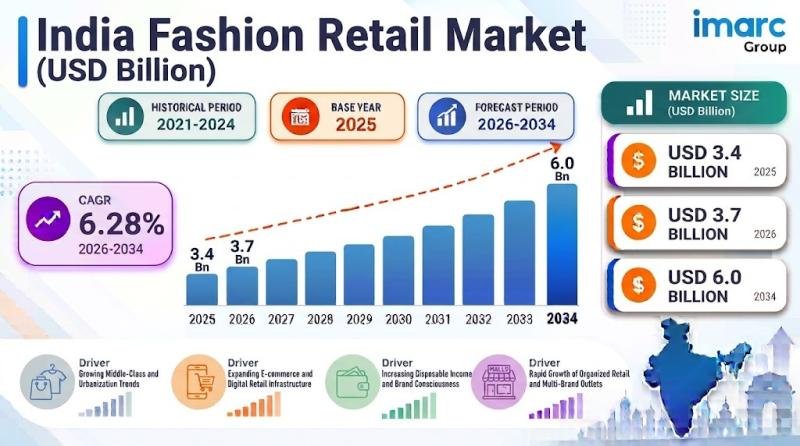
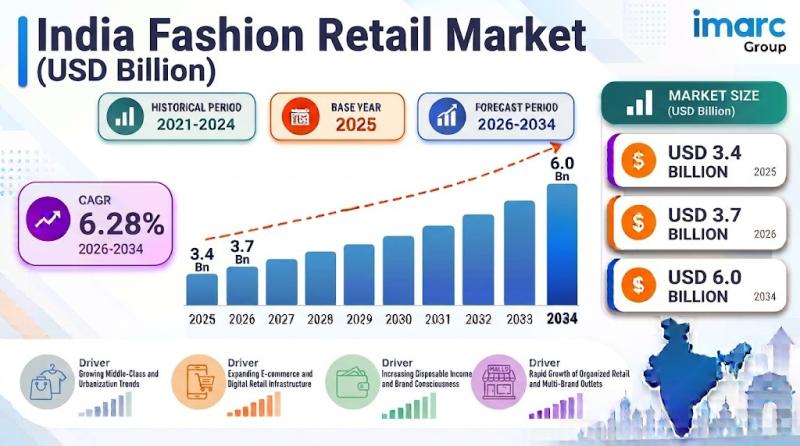
• Base Year Market Size (2025): USD 3.4 Billion
• Forecast Market Size (2034): USD 6.0 Billion
• CAGR (2026-2034): 6.28%
Current Size of the India Fashion Retail Market
The India Fashion Retail Market grew from USD 3.4 Billion in 2025 to USD 3.7 Billion in 2026 and is projected to reach USD 6.0 Billion by 2034, expanding at a CAGR of 6.28% during 2026-2034. This India fashion retail market report identifies growth resting on affordable premium demand growing at roughly 25% CAGR, Tier-2 and Tier-3 cities becoming the primary volume engine, quick commerce compressing impulse purchase cycles, and value formats expanding organized retail reach.
Emerging Trends in the India Fashion Retail Market
Affordable Premium Outpaces Mass Market Growth
Deloitte India’s January 2026 report identifies mid-premium apparel priced between INR 3,500 and 7,000 as one of the fastest-growing segments, expected to post roughly 25% CAGR, while premium apparel is projected at over 45% CAGR. About 40% of consumers tried new fashion brands in the past year, driven by trusted recommendations and accessible price points. This matters because the growth is not coming from the extremes. Consumers are trading up from mass but not leaping to luxury, creating a distinct tier where quality, fit, and experience justify a moderate price premium without the exclusivity of prestige labels.
Value Fashion and Tier-2 Cities Anchor Volume
Care Ratings projects India’s apparel retail market to reach USD 175.8 billion by FY30, with Tier-2 and Tier-3 cities emerging as major growth hubs driven by higher disposable incomes, digital adoption, and evolving preferences. Brands including Zudio, Max Fashions, and Reliance’s Yousta are expanding presence in smaller cities, while value fashion is estimated to expand at 7% CAGR to reach INR 5 trillion by FY30. This matters because the largest untapped buyer pool sits where organized retail is still thin. A first-time organized retail consumer in Indore or Lucknow forms brand loyalties that persist, and value formats capture them before premium brands can justify the price gap.
Quick Commerce Compresses the Impulse Purchase Cycle
Quick-commerce platforms built on groceries are adding apparel with delivery in minutes rather than days, shifting impulse buying from physical stores to apps. Brands that integrate inventory with these platforms gain visibility among buyers who would not otherwise browse their catalogues. This matters because fashion retail has historically depended on planned visits and trial. When a consumer can order a t-shirt for delivery within an hour, the decision threshold drops sharply, and the distinction between browsing and buying collapses.
Functionality and Fabric Innovation Drive Purchase Decisions
At India Fashion Forum 2026, industry leaders noted that 34% of Indian consumers now buy based on functionality rather than design alone, with fabric innovation emerging as a key differentiator. Post-pandemic demand for comfort-led categories has accelerated knitted fabric growth globally, and consumers increasingly evaluate garments on performance and longevity rather than trend alone. This matters because it shifts the basis of competition. A brand that competes only on design and price faces pressure from both ends, while one that delivers measurable functional benefits can justify premium pricing without relying on discount cycles.
Request Sample Report with Datasheet: https://www.imarcgroup.com/india-fashion-retail-market/requestsample
Factors Driving the Growth of the India Fashion Retail Market
Rising Disposable Income Among Young Consumers
India’s median age remains below 30, and a large share of the population is entering peak earning years. This cohort spends a higher proportion of income on apparel and footwear than older generations and treats fashion as self-expression rather than pure utility. As incomes rise, spending shifts from unbranded to branded and from need-based to aspiration-driven. This matters because the effect compounds: younger consumers adopt online shopping earlier and influence household purchase decisions across categories, expanding the market from both directions.
E-Commerce and Quick Commerce Expand Reach
Online platforms have removed the physical distribution barrier that once limited fashion retail to cities with malls and brand stores. Quick-commerce platforms have extended this by promising delivery within hours rather than days, and each new logistics node expands the addressable market without requiring brands to open physical stores. This matters because the capital cost of reaching new customers falls. A brand that once needed a store in every city to serve demand can now reach those buyers through a warehouse and a delivery partner, shortening the path from awareness to purchase.
Organized Retail Penetration Rises in Smaller Cities
Mall development and brand store expansion have moved beyond the top eight cities into Tier-2 markets including Indore, Coimbatore, Lucknow, and Jaipur. These cities have growing middle-class populations, rising aspirations, and limited existing organized retail supply. When a brand opens its first store in such a market, it captures pent-up demand previously served by unbranded local retailers or online purchases. This matters because it converts latent demand into organized channel revenue, and early entrants establish presence before competition intensifies.
Premiumization Across Urban Buying Patterns
Urban consumers are trading up in categories where quality, fit, and brand signal matter. Deloitte notes that most premium purchases remain planned around discounts or special occasions, underscoring a cautious but deliberate approach to spending. Consumers increasingly justify higher spending with tangible value in craftsmanship, durability, or authenticity rather than impulsive consumption. This matters because premiumization is not a blanket shift toward luxury; it is selective. A consumer may pay premium for footwear but stay value-conscious in everyday apparel, creating category-specific opportunities.
Opportunities in the India Fashion Retail Market
Value Format Expansion in Tier-2 and Tier-3 Cities
The largest untapped pool of fashion buyers sits in cities where organized retail is still thin. Value formats that offer branded products at accessible price points can capture first-time organized retail consumers before they form brand loyalties. The opportunity lies in store formats sized for smaller markets, with product mixes tailored to local preferences rather than metro trends. Retailers that build supply chains capable of serving these stores profitably can establish presence ahead of larger competitors.
Online-First Brands Opening Physical Touchpoints
Digital-native fashion brands have built audiences through e-commerce but face limits on conversion because buyers cannot touch fabric or check fit. Opening experience stores or shop-in-shop counters allows trial without the cost of a full retail rollout. The opportunity lies in using physical presence as a conversion tool rather than a primary sales channel. About 30% of shoppers cite sensory and in-store experience as a key influence on purchase decisions, particularly for higher-value apparel.
Footwear Replacement and Refresh Cycles
Footwear has shorter replacement cycles than apparel because soles wear out regardless of style trends. The opportunity lies in building subscription-style or loyalty programs around footwear replacement, particularly in the value segment where buyers replace shoes frequently. Brands that own the replacement relationship can capture spending that would otherwise go to unbranded local retailers.
Challenges in the India Fashion Retail Market
High Return Rates Erode Small Seller Margins
Industry observations indicate that 25% to 30% of apparel bought online may be returned during festive seasons, according to Grant Thornton Bharat. Small sellers report losing ₹100-120 on every returned order, and some ethnic wear sellers have exited online channels entirely after return-related losses. This matters because online growth depends on seller viability. When returns consume the profit from multiple successful sales, smaller sellers withdraw from the channel, reducing the assortment and competition that benefits consumers.
Discount Cycles Compress Industry Profitability
Average listed discounting in Indian apparel increased from 28% to 43% over a five-year period, pushing industry-level profit margins toward 5%, according to Wazir Advisors assessments cited by DFU Publications. This matters because deep discounting trains consumers to wait for sales rather than buy at full price, which erodes the premium positioning that brands need to justify investment in quality and design. Breaking the cycle requires differentiation strong enough that buyers will pay full price, which few brands have achieved consistently.
Mid-Market Brands Face Pressure from Both Ends
India’s fashion market is splitting into expanding value and premium ends rather than converging on the middle. Value formats expand as organized retail reaches smaller cities, while premium segments grow as metro incomes rise. This matters because mid-market brands face pressure from both sides: they lack the cost structure to compete with value players and the differentiation to justify premium pricing. Retailers must decide which end to serve rather than trying to cover the full spectrum, which stretches supply chains and dilutes positioning.
Key Market Segments in the India Fashion Retail Market
The India Fashion Retail Market is segmented by product type, price, distribution channel, and region.
Apparel Leads the India Fashion Retail Market by Product Type
• Apparel
• Footwear
• Bags
• Others
Apparel leads because it covers the widest range of use cases, from everyday wear to occasion dressing, and benefits from frequent fashion cycles that drive repeat purchases. Footwear follows as the second-largest category, supported by shorter replacement cycles and growing branded footwear penetration in Tier-2 cities. Bags and accessories follow as smaller but higher-margin categories that benefit from gifting demand and impulse purchase behavior.
Mass Market Leads the India Fashion Retail Market by Price
• Premium/Luxury Mid-Range
• Mass Market
Mass market leads by volume because the majority of Indian fashion buyers remain price-sensitive, and organized retail expansion into smaller cities serves this base. Premium and luxury mid-range is the faster-growing segment, with Deloitte projecting mid-premium apparel at roughly 25% CAGR and premium apparel at over 45% CAGR, driven by rising aspirations and improving disposable incomes.
Offline Leads the India Fashion Retail Market by Distribution Channel
• Online
• Offline
Offline channels lead because fashion remains a trial-driven category where buyers want to touch fabric, check fit, and see color before purchasing, and about 30% of shoppers cite in-store experience as a key purchase influence. Online is the faster-growing channel as e-commerce and quick-commerce platforms expand reach into smaller cities and reduce delivery times, though high return rates in fashion categories constrain profitability for sellers.
North India Leads the India Fashion Retail Market by Region
• North India
• South India
• East India
• West India
North India leads because Delhi-NCR concentrates mall development, brand store presence, and a large base of young consumers with rising disposable incomes. West India is the significant secondary region, supported by Mumbai’s retail density and Pune’s growing middle-class consumer base. South India follows closely, with Bengaluru and Hyderabad’s technology workforce driving premium and functional apparel demand.
Key Players in the India Fashion Retail Market
Covering an in-depth analysis of the competitive landscape, market structure, key player positioning, competitive dashboards, top winning strategies, and detailed profiles of all major industry participants you will gain access to all these exclusive insights within the full research report.
Latest Recent Developments in the India Fashion Retail Market
In January 2026, Deloitte India released a report identifying “affordable premium” as the defining trend reshaping India’s fashion market, with mid-premium apparel priced between INR 3,500 and 7,000 expected to grow at roughly 25% CAGR and premium apparel at over 45% CAGR. The report, based on a nationwide survey of over 600 respondents across metros, Tier-1, and Tier-2 cities, found that about 40% of consumers tried new fashion brands in the past year, driven by trusted recommendations and accessible price points.
Customization Note: If you require any specific information not covered within this report’s scope, we will provide it as part of the customization.
Request Report Customization: https://www.imarcgroup.com/request?type=report&id=30687&flag=E
Frequently Asked Questions (FAQs)
Q1. What is the current size of the India Fashion Retail Market?
The market grew from USD 3.4 Billion in 2025 to USD 3.7 Billion in 2026. It is forecast to reach USD 6.0 Billion by 2034, growing at a CAGR of 6.28% during 2026-2034.
Q2. What are the key factors driving the India Fashion Retail Market?
Rising disposable income among young consumers, e-commerce and quick commerce expanding reach, organized retail penetration in Tier-2 and Tier-3 cities, and premiumization across urban buying patterns are the primary growth drivers.
Q3. What are the key segments in the India Fashion Retail Market?
Apparel leads by product type, mass market leads by price segment, offline leads by distribution channel, and North India leads by region. The market is segmented by product type, price, distribution channel, and region.
Q4. Which region leads the India Fashion Retail Market and why?
North India leads because Delhi-NCR concentrates mall development, brand store presence, and a large base of young consumers with rising disposable incomes and strong fashion awareness.
Q5. What are the emerging trends in the India Fashion Retail Market?
Affordable premium outpacing mass market growth, value fashion and Tier-2 cities anchoring volume, quick commerce compressing impulse purchase cycles, and functionality and fabric innovation driving purchase decisions are the key trends.
Read Our Related Market Research Reports:
• India Luggage and Suitcases Market: https://www.imarcgroup.com/india-luggage-suitcases-market
• India Innerwear Market: https://www.imarcgroup.com/india-innerwear-market
• India Online Gifting Market: https://www.imarcgroup.com/india-online-gifting-market
• India Decorative Lighting Market: https://www.imarcgroup.com/india-decorative-lighting-market
• India Secondhand Luxury Goods Market: https://www.imarcgroup.com/india-secondhand-luxury-goods-market
IMARC Group
134 N 4th St. Brooklyn, NY 11249, USA
Email: sales@imarcgroup.com
Tel No:(D) +91 120 433 0800
United States: +1-201971-6302
IMARC Group is a global management consulting firm that helps the world’s most ambitious changemakers to create a lasting impact. The company provide a comprehensive suite of market entry and expansion services.
IMARC offerings include thorough market assessment, feasibility studies, company incorporation assistance, factory setup support, regulatory approvals and licensing navigation, branding, marketing and sales strategies, competitive landscape and benchmarking analyses, pricing and cost research, and procurement research.
This release was published on openPR.
Start Selling Online with ShopOpen24
Are you a small business owner or entrepreneur? Discover seller opportunities and connect with customers through ShopOpen24.
Explore ShopOpen24 →ShopOpen24 | Local Products. Global Reach.

Leave a Reply