
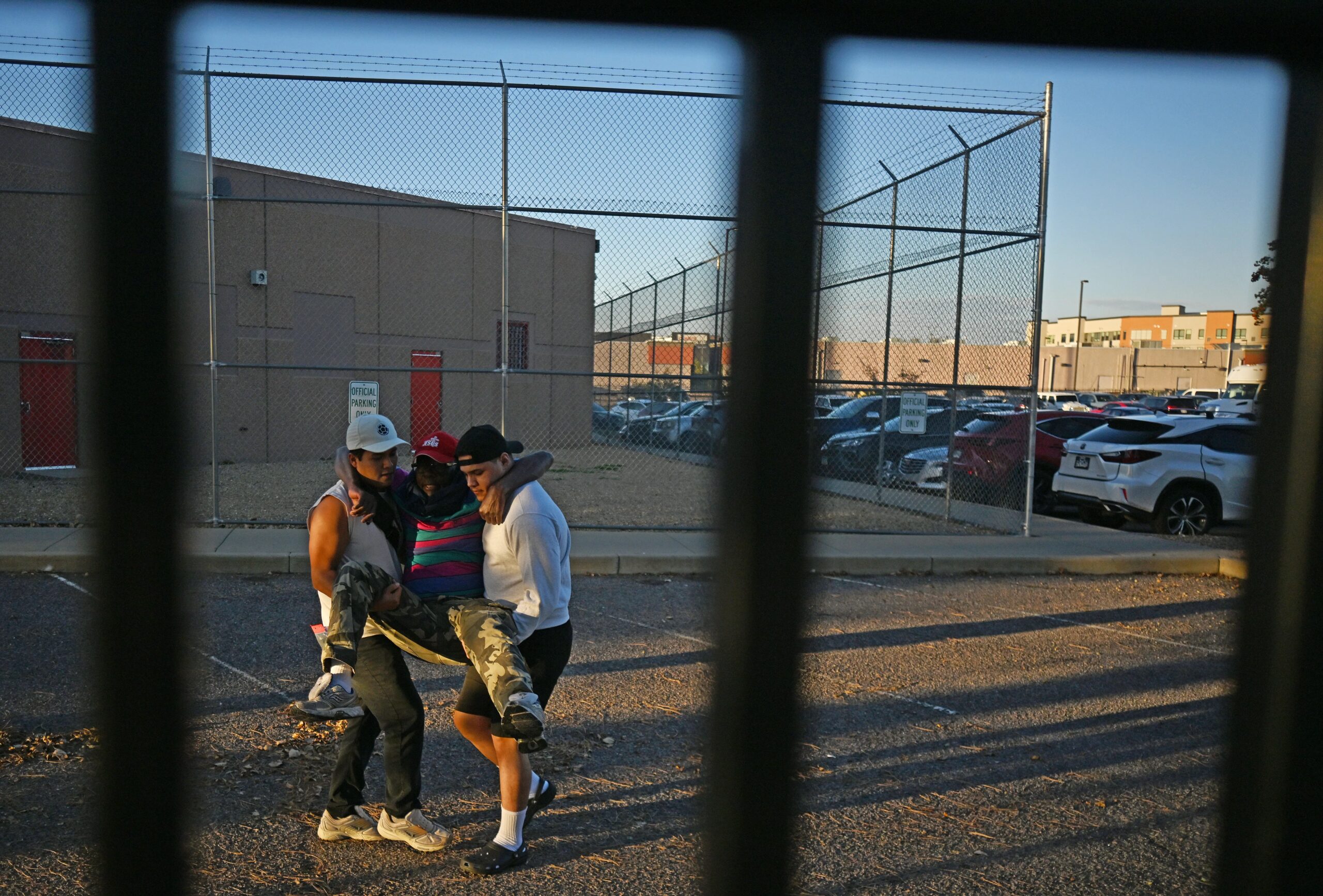
Last year, the Rev. Edward Nalwamba walked into an Aurora detention facility. On Tuesday evening, unable to stand on his own after being detained for 13 months, he was carried out in the arms of two men released alongside him. Guards had taken away his wheelchair.

Sitting in the passenger seat of a friend’s truck, the 79-year-old Ugandan said he had learned Monday that a federal judge ordered his release. But he had been told that he would be released before, only for federal authorities to try to deport him. This time, Nalwamba didn’t believe it until he received formal paperwork from Immigration and Customs Enforcement agents.
“They told me they are getting to keep me in prison forever,” the retired Anglican priest said. “So, I was ready for whatever.”
As Nalwamba spoke to reporters, his lawyer and friends who had come to see him released seethed about the wheelchair. But they celebrated, too, hugging him and each other. It had been a long road: They had held prayer services, visited Nalwamba weekly and strategized ways to contact the White House to plead for his release.
And finally, on Monday, U.S. Magistrate Judge Cyrus Y. Chung ordered the retired priest be freed, finding that federal officials had not provided any certainty that they could remove him to his East African home country, from which he fled more than two decades ago.
Known to friends and congregants as Father Edward, Nalwamba came to the U.S. for a religious conference in 2002 and then stayed, fearing retaliation if he returned to Uganda. He had publicly opposed the country’s government and had been targeted by government officials before he left.
“Obviously, we’re so thrilled and relieved that he’s being released,” his attorney, Joy Athanasiou, said earlier Tuesday. But she criticized ICE’s decision to arrest and detain Nalwamba at all.
Nalwamba didn’t understand why he was detained, either. He had been arrested and released in 2010 under a supervision order, and he had kept up with regular immigration check-ins in the years since.
“Anytime they called me, I went to them,” he said of immigration authorities, who arrested him in September 2025. “What was the need for them to shackle me on my hands, feet, waist? What was the need?
“Even in the Third World, we don’t do that to people,” Nalwamba continued. “And the leader of the world does that to human beings?”
Despite his attorney’s warnings that he would be persecuted if he returned to Uganda, ICE officials repeatedly attempted to deport Nalwamba. In June, the agency’s attorneys told a federal judge that Nalwamba’s deportation was imminent. Soon after, he was told he was being released, which prompted cheers from other detainees, Athanasiou said.
Instead, she said, he was taken to a room and pressured to sign a document that ICE agents would not let him or his attorney review. She added that agents threatened to deport him in shackles if he refused. They tried the same tactic in late July, and they later told the federal magistrate that his deportation was again imminent.
The repeated delays prompted Chung, the federal magistrate, to order Nalwamba’s immediate release.
“Today, there is still no removal,” he wrote. “There is not even a concrete plan for one. Instead, (ICE officials) present a declaration that ‘ICE is working on scheduling’ the charter flight that it had previously said was imminent. That will not do.”
While his release is a relief to his attorneys and friends, Nalwamba still doesn’t have legal status and his immigration case remains ongoing.
His time in detention came at a cost. His health has deteriorated, and he can no longer stand or walk on his own. He used to exercise and play ping pong, he said, giving lessons to younger players.
“Now, I watch them play,” he said.

During his 13 months in Aurora, he developed pneumonia and lost more than 30 pounds in two-and-a-half weeks, Athanasiou said. He remains ill with an undiagnosed respiratory illness, and Athanasiou said he has shown early signs of prostate cancer.
He tested positive for tuberculosis last year, she said, but a subsequent X-ray in the spring showed no active infection; she said positive skin tests were common for people previously vaccinated against the illness. His latest respiratory issue began just as another detainee tested positive for tuberculosis in June.
Nalwamba said he had been taken to see doctors three times, and each time he was shackled at the feet, hands and waist. He didn’t understand why any of it was necessary.
“But I am a person of faith,” he said. “I don’t fight evil. I thought, ‘Jesus, if they do that to me, you will be with me, and I will just be praying for them.’ ”
Get more Colorado news by signing up for our daily Your Morning Dozen email newsletter.









Leave a Reply