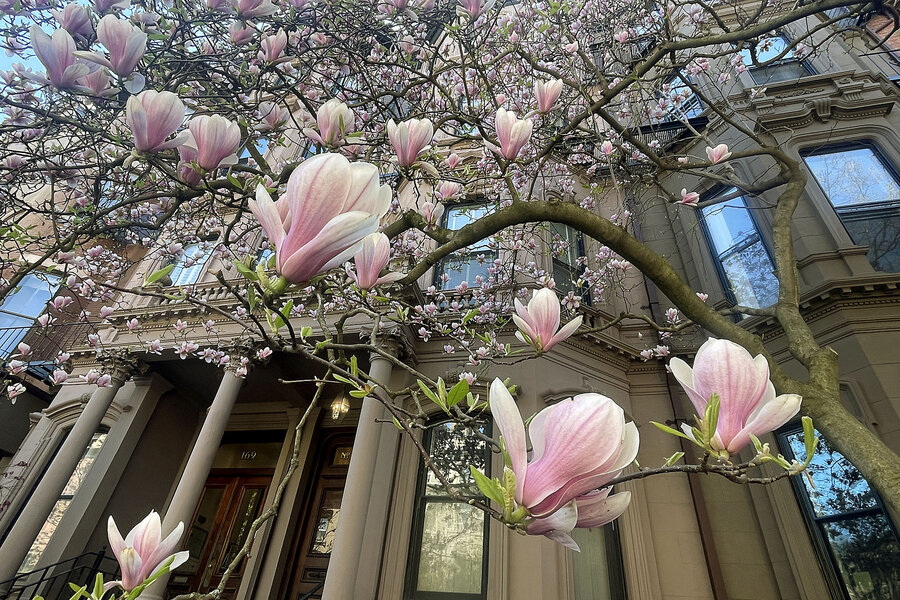
In Boston, there are three signs that winter has finally lost its grip: The appearance of marathon runners, the cheerful yellow daffodils that line its streets, and the fleshy, pink and white blooms of magnolia trees whose branches sway against a backdrop of stately brownstone homes in the Back Bay neighborhood.
Spring has arrived.
The extensive canopy of 300 or so magnolias in Boston’s Back Bay neighborhood is the result of one visionary resident, Laura Dwight, a woman who wanted to address signs of urban decay prevalent across the city in the 1960s. Today, the trees are under the stewardship of residents and the watchful eyes of members of the Garden Club of the Back Bay.
Why We Wrote This
April in Boston is known for daffodils, the Boston Marathon, and the Back Bay’s blooming magnolia trees. It was one woman’s vision for planting magnolias in the 1960s that transformed the neighborhood into the spring stunner it is today.
“Laura Dwight lived in the Back Bay when the Back Bay was sort of a fading rose. A lot of the buildings were not being maintained, and the neighborhood really was looking a little shabby,” says Claire Corcoran, a garden club member and certified arborist.
The large Victorian brownstones in the Back Bay, built on filled-in marshland between 1860 and 1900 to mimic the grand promenades of Europe, became a mecca for the city’s wealthiest residents seeking a planned neighborhood. But by the mid-1900s, the large buildings had been divided into apartments and rooming houses. Many had fallen into disrepair.
Miss Dwight, as she was known, had been inspired by the cherry blossoms that ring the Tidal Basin every spring in Washington, D.C. In Boston, she had long admired the few established and blooming Yulan magnolias with large saucer flowers in the neighborhood. So she took an idea to the Neighborhood Association of the Back Bay: Why not plant magnolia trees in front of every house in the area? With support for her idea, she set out on foot to rally the neighborhood.
“She went and literally knocked on every door, no matter what walk of life was living there, and managed to convince everyone that it was worth their time and a little bit of money to have these trees planted,” says Stephanie Fletcher, a Garden Club of the Back Bay member since 2011. Miss Dwight bulk-ordered a northern variety of magnolia saplings at $8 to $10 each, established relationships and deals with landscapers, and found free labor from young men in local fraternities, says Ms. Fletcher. Soon after, she established the garden club to maintain the trees, then served as its first president.
“I’m just so inspired by the idea of creating a campaign to create something that’s really of a public good and a public benefit,” says Ms. Corcoran. At the time, she notes, convincing people to pour hard-earned money into beautification projects was a challenge. Now, even with research showing the many health benefits of urban trees, such a project would still require tremendous vision and effort.
While magnolias may evoke images of more southern climes, the sturdy group in Boston – which includes Saucer magnolia (sometimes called tulip trees) and Star magnolia varieties – are stalwart sentinels for this historic city. Magnolias are among the world’s oldest organisms, dating back at least 95 million years. They are so old, in fact, that they evolved before flying bees and depended on foraging beetles for pollination. Its fleshy flowers open in the morning and close at night, trapping snacking insects to ensure thorough pollination.

Courtesy of Stephanie Fletcher
There is even a magnolia native to Massachusetts. A large Sweetbay magnolia swamp was discovered in Gloucester, Massachusetts, in 1806. The botanical wonder inspired New England naturalists and botanists like Henry David Thoreau and Asa Gray to make pilgrimages to whiff its scent, says Ms. Fletcher. The local residents were so impressed with the southern tree thriving so far north that they renamed their village from Kettle Grove to Magnolia.
In the Back Bay, Commonwealth Avenue and nearby streets of Marlborough and Beacon run east to west, and the buildings face south, ensuring more hours of intense direct sunlight. In the evenings, radiant heat from the buildings adds an extra buffer for the trees against cold nights, more so than if they were growing in the wild.
“It’s a perfect sheltered environment for magnolia trees,” says Ms. Corcoran, adding that their creamy smooth, pink and white cup-shaped petals belie their toughness. “The wonderful thing about the magnolias, aside from their beautiful visual impact, is that they’re really resilient trees, and so once they’re established, they can take the tough urban conditions like extra hot temperatures in the summer and droughts.”
Kerry Preston, president of landscaping business Wisteria & Rose, has one word to describe the sight. “They are beautiful!” she says, her head tilted back to take in the sight of branches reaching for the sky 60 feet above the sidewalk on a sunny but brisk morning this week.
She’s here checking in on the health of a magnolia on Commonwealth Avenue in Boston. This one is doing well. Its large blooms still bounce full and lush in the breeze, thanks to cool temperatures that have refused to rise much above 58 degrees for weeks. If the tree needs pruning, she’ll call an arborist who can reach the upper branches.
“Magnolias spread as they get older, so they need professional care,” says Ms. Preston, who services homes in the area.

Kendra Nordin Beato/The Christian Science Monitor
The Garden Club of the Back Bay’s 200 members (anyone can join for a fee) see it as their duty to continue Miss Dwight’s mission of tree care. In 1995, they planted 40 more Leonard Messel magnolias, and in 2010, to mark the club’s 50th anniversary, they planted 50 Moonglow magnolias, a cultivar of the Sweetbay variety. Both are cold-hardy varieties that can thrive in both the North and South.
The stunning peak of most of the Saucer magnolias, a popular hybrid created in France in the early 19th century, has passed, heralding the arrival of delicate green leaves, but it’s not the end of the show. Moonglow magnolias, with fewer blossoms amid shiny leaves, will bloom in June.
And then in the fall, as the sun sets earlier in Boston, the magnolias take on a new duty.
“The tree branching is so interesting. A lot of trees don’t have the same beautiful, intricately laced branches that the magnolias do,” says Ms. Fletcher. “At Christmas time, if people have lights on their trees, 99% of the time it’s a magnolia.”