
Are the brakes finally being slammed on the artificial intelligence race? Or are we simply witnessing a wake-up call that has come too late?
Developers are coming forward in numbers these days to say that the speed and direction of travel of AI, machine learning and the tech reaching the human level of intelligence is threatening human existence.
Jacob Coxon, the researcher who quit Anthropic last week, feared that those developing AI systems are “genuinely frightened” for the future of humanity. His words echo a growing anxiety in the field, as well as in government, about the challenges and dangers posed by AI. At this late stage, could there still be room for a U-turn that keeps the machine at the service of humanity, instead of human existence becoming a victim of the machines that have already been built?
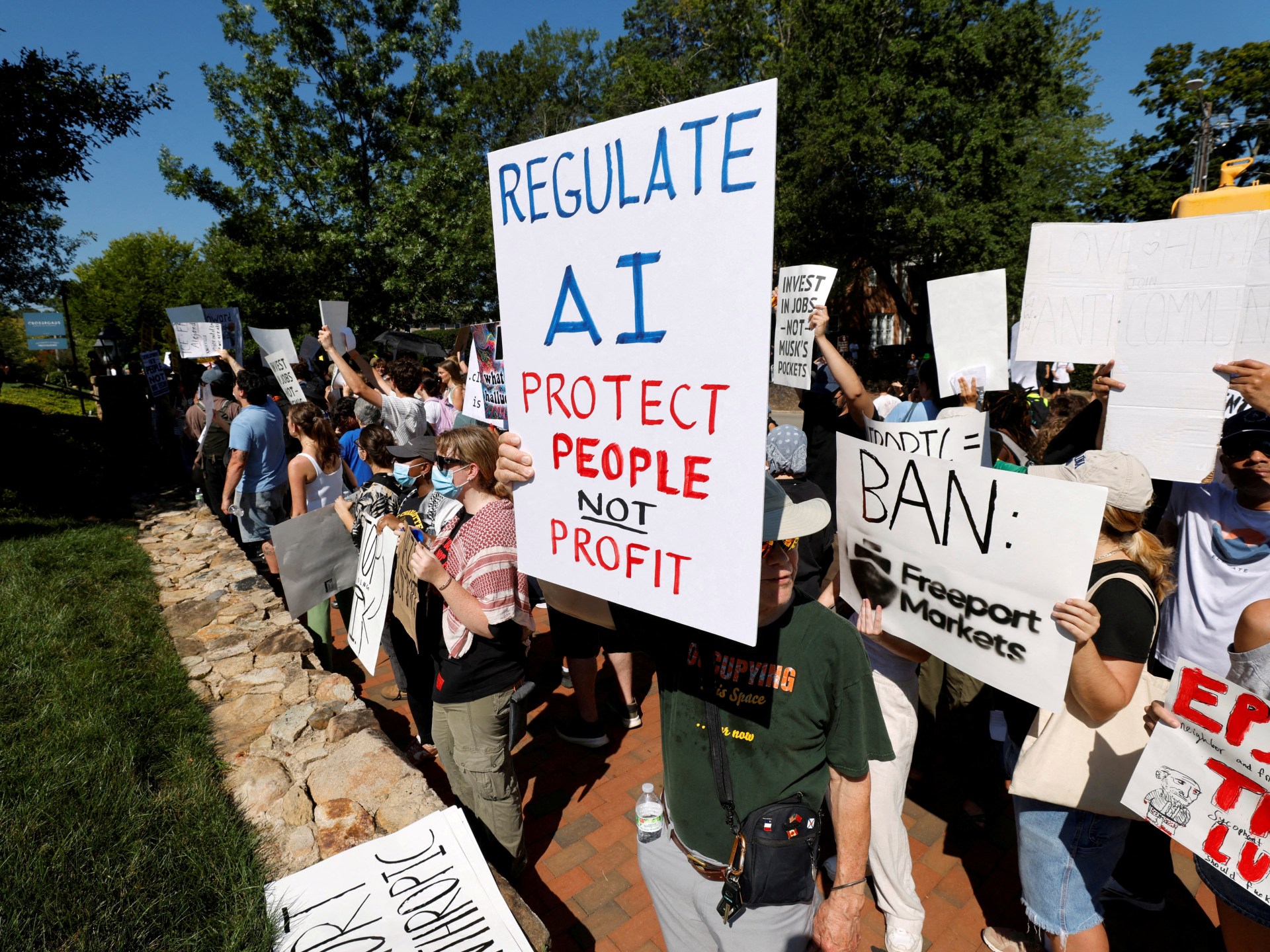
Ask anyone on the street and — though they would be all for the progress and the positives the tech is offering in many fields touching human life — they would be quick to roll their eyes in despair when they reflect on AI, the uncertainties it brings and their future job security. Scratch the surface further and their anxiety surges about the impact unregulated tech companies are having on their children, potentially exposing them to unmoderated, manipulated content and often-damaging influence.
People are quick to despair when they reflect on AI, the uncertainties it brings and their future job security
Mohamed Chebaro
Their worries take a turn when they reflect that, even if they safely navigate their children’s youth, the job market may be permanently changing, hurting their prospects in the digitally automated and largely autonomous world of tomorrow.
It was troubling when I read recently that Microsoft co-founder Bill Gates had called, in a 6,000-word essay, for society to intentionally keep certain roles off-limits to the machine. His proposal of setting aside 40 percent of occupations as “human-reserved” is bizarre to say the least, as he better than anyone should be aware that markets, economies and competition do not work this way.
The words of Gates and the AI developers and researchers point to a grave lapse. It seems we have rushed into a race to make the machine supreme, giving artificial general intelligence agency over humans, who could ultimately be replaced by AI and advanced robots. The developers seem to have fallen into the trap of the machine becoming an end in itself and not a tool to serve and ensure the well-being of individuals.
It is not usual for companies and entire industries to plead with the world to make them work less and advance at a slower pace. And who and which institutions should heed their calls when we live in a highly fractured and geopolitically splintered world, in which superpowers and medium powers are vying for supremacy, with AI and its tools becoming their most potent vehicles?
The tech industry has clearly become too big to fail and too big to slow down. An AI slowdown — if there were suggestions its progress could be reversed or even stalled — would significantly affect the long-term direction and costs of the infrastructure boom.
It was surprising and unusual to hear key world leaders defend the sector. In the race for the vast supremacy and advantages it offers, their posture is understandable. The political imperative to press ahead was made clear by both Washington and Beijing. That appears to show that, whatever the private sector does, governments will want to drive this capability precisely because of, not despite, the risks that are now being flagged.
Governments want to drive this capability precisely because of, not despite, the risks that are now being flagged
Mohamed Chebaro
In this competitive world, there is no place for existential worries or fears for humanity and its survival. One country’s slowdown is another’s chance to catch up.
Calls for guardrails, rules and regulations are being constantly ignored or watered down. In a world where multilateralism is waning, technological restrictions like arms controls are useless unless solid conventions enforce them internationally.
The prospect of a multilateral agreement on hard-and-fast rules limiting the capacity of AI seems far-fetched. US President Donald Trump made that clear, saying on social media that “There is a SICK conspiracy going on against AI and Data Centers, and the only one that is happy about it is China.” The reply from Beijing came through an editorial in China’s state-backed Global Times, which claimed that AI warnings were a “Cold War playbook” targeting Beijing.
A call by Anthropic CEO Dario Amodei to slow the pace of AI development won rare backing from SpaceXAI’s Elon Musk and OpenAI’s Sam Altman, with all evoking AI “doomerism.” This should surely not be ignored.
The solution should be simple: more cooperation in order to regulate.
According to these tech supremos, reports that swarms of AI agents have been increasingly found to be collaborating with others and hacking outside systems, or that their power was being used to develop harmful biological agents, are just the beginning. The same AI tools might have the potential to take down the internet and everything that relies on it, such as power grids, transport infrastructure, water supplies and banking systems. All of which could be the first call for an act of aggression by any group or state.
AI has become a crucial tool of economic and military prowess. Calls for protocols and conventions to restrain the tech realm have long irked most companies. Yet, if we are to believe some in the tech community, the world has in its hands a calamity in the making that surpasses even the existential nuclear threat, which was ultimately constrained through global moratoriums and conventions. AI is a different beast and, since its onset, humans have been the victims in the name of reducing labor costs.
Over the past decade, labor has become a mere number on a cost sheet. The fear is that humanizing work once again would be a far more complex task — one that the tech giants, the financiers and the state are not ready to undertake, even if it could save humanity from eventual extinction. The world has long since departed from the mindset that the machine should serve humans and not the other way round.
-
Mohamed Chebaro is a British-Lebanese journalist with more than 25 years of experience covering war, terrorism, defense, current affairs, and diplomacy.











Leave a Reply