

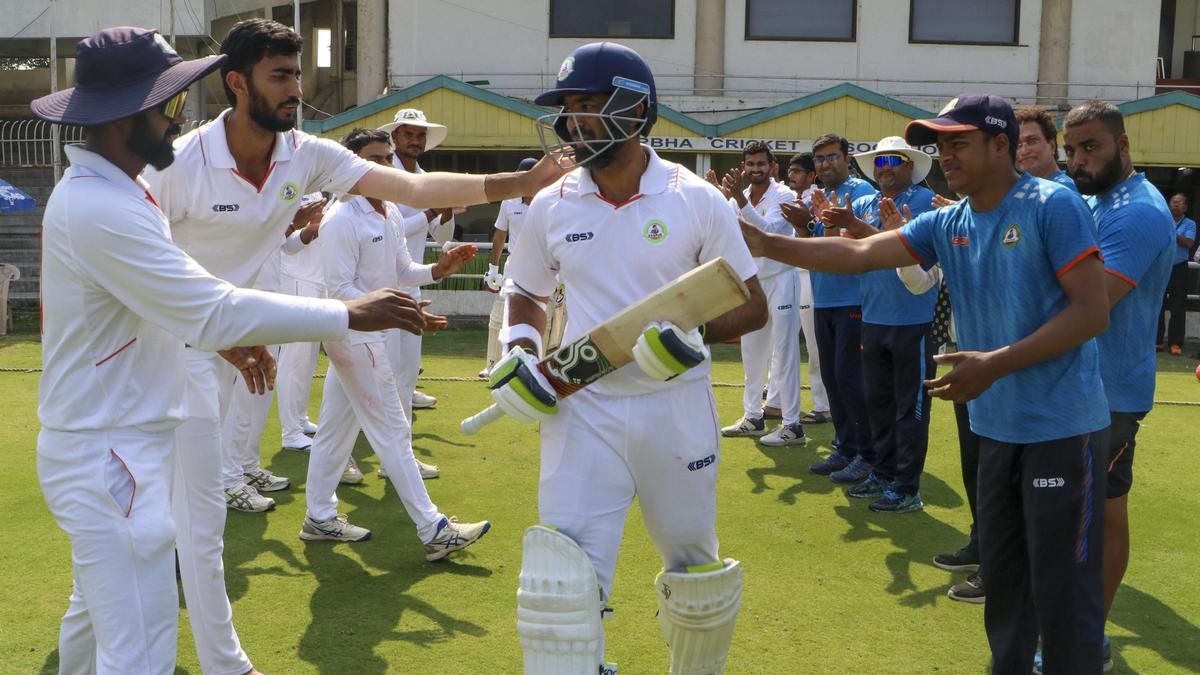
Few can say that they have been there and done that in domestic cricket quite like Faiz Fazal.
Across a 21-year career for Vidarbha and Railways, the southpaw played 138 First-Class (FC) matches, scored 9184 runs at an average of 41 with 24 centuries, and travailed pretty much every path that one can through the domestic game.
A Nagpur native, Fazal started playing for Vidarbha when it was a relative lightweight in the domestic scene, and captained it to back-to-back Ranji Trophy and Irani Cup wins in 2017-18 and 2018-19, winning its maiden title in the process.
Sportstar recently caught up with Fazal on the sidelines of Vidarbha’s Ranji Trophy match against Madhya Pradesh in Nagpur. As the now three-time champion stormed to an innings victory in a little over three days to complete four outright wins from four matches, it was an instructive sign of just how far Fazal has seen Vidarbha grow.
“I’ve seen the transition phase for Vidarbha. When I started, things were completely different,” he reflected. “I made my debut in 2003, and Vidarbha was just a participant back then. There were a couple of guys who aimed to play cricket at a higher level, but winning a Ranji Trophy and being the Vidarbha that we see now was not even in our wildest of dreams.”
Breaking the title drought
Vidarbha is now a bona fide domestic heavyweight, with three Ranji Trophy and Irani Cup titles, as well as a Vijay Hazare Trophy to its name. Fazal pinpoints the first Ranji Trophy title in 2017-18 as a turning point in inspiring belief among cricketers within the system that it could compete at the highest level.
“It’s a long process, but when you win something, that’s when the belief that you can do what you are aiming to do comes in. Some of the players also started playing at a higher level for India and India A, and that inspires cricketers in the region,” he reflected.
“When you see someone from your state playing at the highest level, you don’t need motivation because you just see the players in front of you and believe that you can also do it.”
As the captain of that 2017-18 side, Fazal pointed to a selfless, team-oriented mindset from the senior players, including the likes of Wasim Jaffer, Ganesh Satish, and Akshay Wakhare as being crucial to its success.
“Our goal was very simple; we were always playing for the team. The team was always the priority. There was no compromise on that, whether it was a youngster or me. If the team wins, individuals will also grow,” the former skipper said.

Faiz Fazal captained Vidarbha to back-to-back Ranji Trophy and Irani Cup wins in 2017-18 and 2018-19.
| Photo Credit:
The Hindu Photo Library

Faiz Fazal captained Vidarbha to back-to-back Ranji Trophy and Irani Cup wins in 2017-18 and 2018-19.
| Photo Credit:
The Hindu Photo Library
Fazal also took it upon himself to lead by example. “I always believed that working hard was the only thing that was in my hands, which was controllable. Everything else was out of my control,” he explained.
“I used to push myself, even my fitness. I just wanted to set an example. If I was there I was going to be a role model, and that spread.”
The changing face of domestic cricket
Having been an active part of the domestic landscape since 2003, Fazal is perhaps uniquely placed to identify that the nature of the Ranji Trophy has slowly started to evolve. He notes the more urgent need for an aggressive mindset to survive in the modern game, among both batters and bowlers.
“The game itself has changed a lot. The mindset of players these days has become so aggressive, especially the batters. If you want to be a good batter, if you want to play Test cricket, you still need a strike-rate of 80+. You can’t just be defending, the mindset of just leaving the ball, playing out a session, has all started moving out. I used to love that,,” he reflected.
The prevalence of white-ball cricket has also caused a change in bowlers’ lengths as well, he explained, saying, “There’s so much white-ball cricket now, so the lengths have become a little shorter. Everyone wants to come and hit the deck.”
He also identified a notable change in the pipeline from the Ranji Trophy to the national side, a journey that increasingly includes India-A tours as an intermediary step. It is a step he views favourably.
“I don’t think there were this many India A tours (when I was playing), especially during the season. Everyone was playing FC cricket during the months when the Ranji Trophy was happening; it never clashed with A tours. But now there are a lot more A tours, which is a fantastic opportunity for FC cricketers.
It is a great opportunity for the players playing, and it has become the pipeline. You perform here (domestic cricket), play India A, and then India,” he said.
The journey from domestic cricket to the national side is one that is particularly poignant for Fazal. Despite his years of consistent domestic performance, he was only ever able to make a single appearance for India, scoring 55 in an ODI against Zimbabwe in 2016. While the absence of more regular national team opportunities remains a disappointment, he maintained that it did not change his relationship with the game.

Faiz played a solitary ODI for India scoring 55 against Zimbabwe in 2016
| Photo Credit:
AFP
Faiz played a solitary ODI for India scoring 55 against Zimbabwe in 2016
| Photo Credit:
AFP
“Playing for India was the high point of my career,” he said. “But I started playing cricket as a hobby. The game itself, till now, has been the biggest motivation for me. I didn’t see if I was playing in a gully, for Vidarbha, for India, my mindset never changed. I just wanted to enjoy being there. Pressure comes, but we’re fortunate to have it. How many people get this pressure?”
“I always wanted to play Test cricket, which was an unfulfilled dream, and I won’t say that’s not a regret because I thought that was the best format for me, but you can’t be negative about it.
“How many players get to play for India? How many people have played an ODI for India? Not more than 300. So I’m blessed, and I’m thankful to the almighty that I got that opportunity. Of course in any profession, if you don’t go higher and higher you feel disappointed, but disappointments are valid,” he reflected.
Fazal also warned against making presumptions about FC regulars’ suitability for the international game, noting that exposure to a vast array of situations can make a player much stronger.
“Sometimes we feel that if someone is a good, consistent performer in domestic cricket, he can’t go there (higher) and perform. And sometimes we can feel if a player is doing well (in domestic cricket), we should pick him suddenly and put him in the national team. I can understand this for seamers, but for batters and spinners, especially in Test cricket, going through all situations, performing, not performing and coming back again, you develop your character, mind, skills, you see all aspects of the game.
For batters and spinners, we should give more time to play domestic cricket when selecting,” he explained.
Life on the other side
Fazal announced his professional retirement in 2024 after a final Ranji season in which he made just three appearances. He was candid about his dissatisfaction about his final season, describing it as “a little toxic” and saying he “didn’t want to be in the position” he found himself in.
However, he retains a strong desire to see Vidarbha cricket flourish. “I want more and more players from Vidarbha to play for the country, no doubt about it. I want Vidarbha to win everything it plays in. It’s in my DNA and it will never change.
“I have given 25 years to Vidarbha cricket including three or four years in age-group cricket. So that will always be there.”
Cricket has not entirely drifted out of his life either, as he appeared for India Capitals in the Legends League Cricket, an experience he characterised as enjoyable.
“It’s very nostalgic. I got to meet all the players I played with: Suresh (Raina), Robin (Uthappa), Shikhar (Dhawan), and even Shane Watson (at Rajasthan Royals). We all met up in Goa and had too much fun, although I don’t think I’ll be doing it again.”
He has also continued his association with Lisburn Cricket Club, a cricket club in Northern Ireland who he first joined in 2018, and home to several Ireland internationals.
Fazal had been playing club cricket in England for several years prior to going to Northern Ireland, with stints in places including Yorkshire, Lancashire, and Cornwall, but his association with Lisburn has stood the test of time and has even opened up newer coaching avenues for him with FC side Northern Knights and the Ireland national team on the odd occasion.
“My first consideration was always that if I was going somewhere for five months of off-season, the quality of cricket should be good. When I came back, I had to play FC cricket, so my priority was always a good standard of cricket,” Fazal explained.
“My agent had been telling me to go to Northern Ireland for two years, that the standard of cricket was really high there. I was a little skeptical, but then I finally went and my eyes were opened. There are quite a few Irish internationals there, like Mark and Ross Adair, Matthew Humphreys, Ben Calitz.”
“It’s become like my second home now. I’ve made such good relationships there; I’m still in touch almost every day. Even my family actually has.”
His stint in Lisburn was also responsible for his introduction to his latest love: golf. The craze was kick-started by a chance to watch The Open Championship at the Royal Portrush Golf Club, and now a 12 handicap, he has not looked back.
“It tests you completely, inside and outside. When I left the game, the one thing I thought would be lacking was the competitiveness, that I wouldn’t know where to use it. For the first couple of months of retirement I was lost, I was just lost. But in this sport, you’re competing with yourself everyday.
There are quite a few cricketers who play it, and recently I saw Michael Jordan saying that it is the toughest sport on the planet. What else do you need?”
In the world of scouting and coaching
Fazal has also moved into the world of talent identification and coaching. He was a scout with Indian Premier League (IPL) Delhi Capitals for two seasons, and along with his Irish coaching stint, he has spent time with the Singapore national team and is a coach with Rajasthan Royals at its high-performance centre in Talegaon.
For the 41-year-old, perhaps the most important piece of evaluation he does with any young player is to judge their reactions to different situations.
“The situations that a player is in, and how he reacts. That is the thing I am watching the most,” he explained. “You have to see how tough the situation is, how strong the competition is. It’s possible that a batter might hit fairly weak bowling attacks, but you have to look beyond that.”
The IPL, he noted, has become aspirational for younger cricketers. “Everyone’s aim has become the IPL now, so you play with that mindset. And I don’t think there is anything wrong with that, because ultimately you are developing your game for what is required to play at the highest level.
“My only personal view is that you shouldn’t always be thinking about the result. Playing the IPL is a result. Keep working on your skills, and you will get what you deserve. Playing for the country should still be the ultimate goal,” he elaborated.
That predominance of short-form cricket has also resulted in a key technical change in search of power.
“Everyone has become open-chested because of white-ball cricket. No one is side-on anymore,” he noted. “I would suggest the opposite, If I’m coaching T20s, the most consistent batters are all side-on, even the biggest six-hitters. If you look at Travis Head, who makes runs across all formats, he’s so side-on.
“Even guys who hit big sixes like Shivam Dube, Yuvraj Singh, Abhishek Sharma, and Vaibhav Sooryavanshi are all side-on batters. Cricket as a game has always been side-on, in batting, bowling, and fielding.”

Faiz is now a coach with Rajasthan Royals at its high-performance centre in Talegaon.
| Photo Credit:
RV MOORTHY
Faiz is now a coach with Rajasthan Royals at its high-performance centre in Talegaon.
| Photo Credit:
RV MOORTHY
To Fazal, the product of that change is that batters are more susceptible to tough conditions.
“What happens is that if there is even a little bit in the wicket, it gets tough. They haven’t developed the skills to adapt to the situation.”
That is in part the challenge that he faces as a young coach in the game, and it is one he is more than game for.
“I’m loving it, to be honest,” he says with a smile.
He even has a goal in mind. “My aim is to become the Indian Test team coach. Why not? Unfulfilled dream, maybe a Test team coach in the future.”
Published on Nov 07, 2026





Leave a Reply