
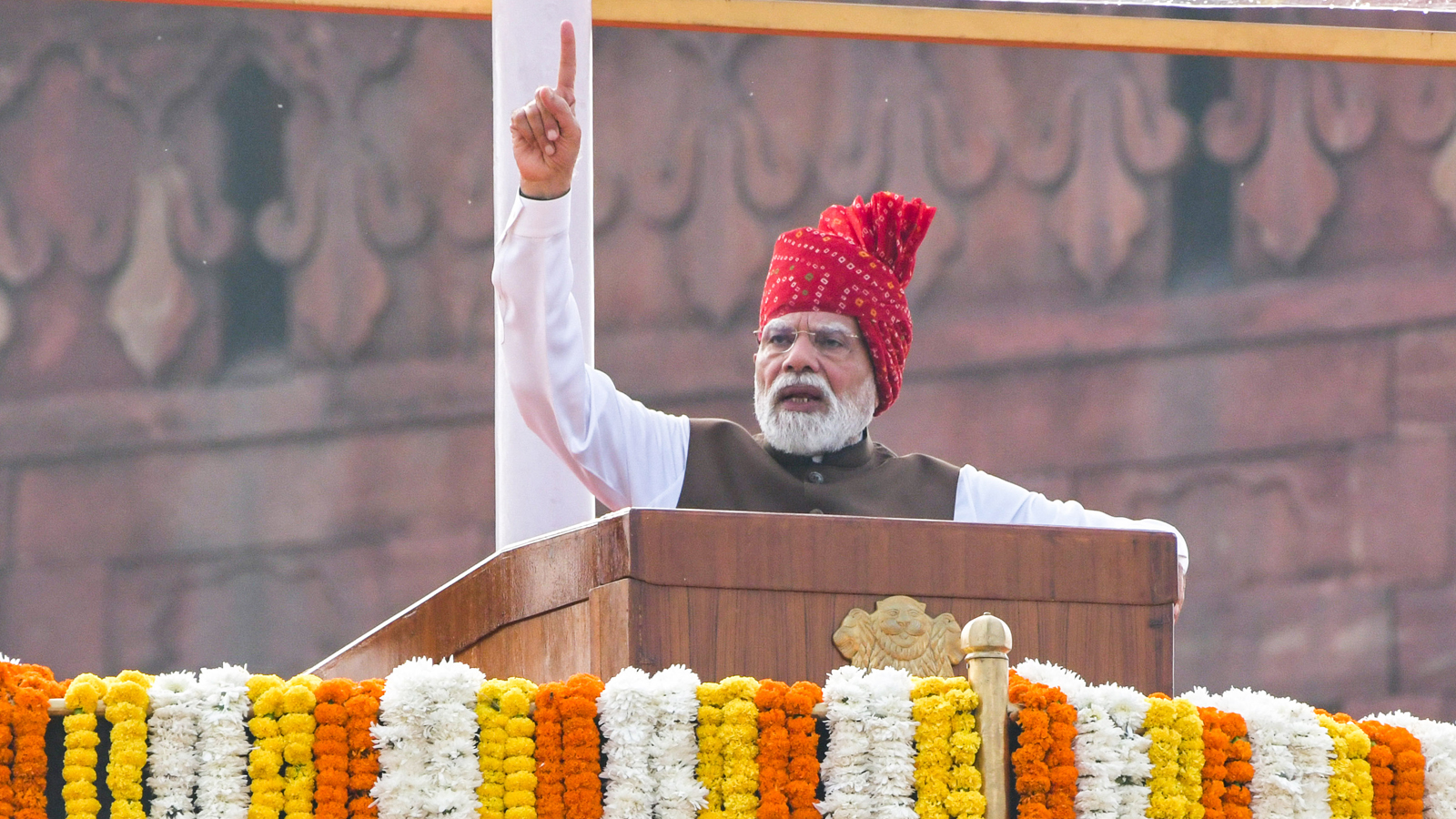
Prime Minister Narendra Modi on Saturday announced a series of major initiatives and ambitious targets spanning artificial intelligence, education, sports, civil defence, semiconductor manufacturing, nuclear energy and women-led development in his Independence Day address from the ramparts of the Red Fort.
Addressing the nation on the occasion of the 80th Independence Day, PM Modi announced that one crore young Indians would be trained in AI skills over the next one year, while a nationwide talent hunt would be launched to identify sporting talent among children aged between five and 15 years.
The Prime Minister also announced a free online coaching network for competitive examinations, a vibrant Civil Defence network to deal with modern security challenges, and a new target of creating six crore Lakhpati Didis.
On energy security, PM Modi said India would work towards achieving 100 GW of nuclear power capacity by 2047 and would aim to start five new nuclear reactors within the current decade. He also announced that several more semiconductor manufacturing plants would be established in the coming years to strengthen India’s drive towards self-reliance.
One crore youth to receive AI training
Highlighting the rapid expansion of Artificial Intelligence and its growing importance across sectors, PM Modi announced that the government would train one crore youth in AI skills within the next one year.
“Today, there are more than 2.5 lakh registered startups. We organised the AI Impact Summit recently. The expansion of AI is taking place at a very rapid pace,” the Prime Minister said.
“From the ramparts of the Red Fort, I want to make an announcement for the young people of the country. We have decided that, in the next one year, we will train one crore young people in AI skills, so that the youth of our country have the capability to lead in the world of AI as well,” he said.
The announcement comes against the backdrop of the government’s emphasis on developing India’s technology and innovation ecosystem and positioning the country’s youth to take advantage of emerging technologies.
Free online coaching for competitive examinations
Addressing the financial burden of coaching classes on poor and middle-class families, PM Modi announced the creation of a nationwide free online coaching network for young people preparing for various examinations.
“The pressure of coaching classes has become a major burden for our middle-class families,” he said, noting that parents often feel compelled to send their children to coaching centres because of social expectations.
The Prime Minister said the government would bring together India’s Digital Public Infrastructure, teachers and available talent to create an extensive network for free online coaching.
“We are going to build an extensive network to provide free coaching to the young people of the country,” PM Modi said.
He said the initiative would help families save the thousands of crores of rupees they spend on coaching and allow students to prepare for examinations while remaining closer to their homes.
Nationwide sports talent hunt for children aged 5-15
The Prime Minister also announced a nationwide sports talent identification campaign covering villages, cities and schools to identify promising athletes between the ages of five and 15.
He said the identified children would be assessed and provided specialised training to help them develop into athletes capable of representing India at the highest level.
PM Modi pointed out that the Olympic Games feature around 40 sports and hundreds of events, but India does not currently participate in or qualify for nearly two-thirds of those events.
“We have decided that we want the 2036 Olympics to be held in Bharat,” he said, adding that India needed to prepare well in advance for the Games.
“For this purpose, we also want to launch a talent-hunt campaign,” PM Modi said. He called for identifying children between five and 15 years of age with sporting potential and nurturing them through specialised training.
He also stressed the need to focus on girls and expand India’s presence across sporting disciplines in which the country currently has limited participation.
Vibrant Civil Defence network for modern threats
In a major announcement on national preparedness, PM Modi said India would create a vibrant Civil Defence network capable of responding to modern security and emergency challenges.
He said the nature of warfare had changed and conflicts were no longer necessarily restricted to conventional battles along national borders. Refineries, banking systems, data centres, factories and other critical infrastructure could also become targets.
“We announced ‘Mission Sudarshan Chakra’ some years ago, and work on it is progressing rapidly,” PM Modi said while highlighting the changing nature of warfare.
He said India’s existing civil defence systems had largely been designed according to the wars of the previous century and therefore needed to be modernised.
“The civil defence systems that have developed in our country in accordance with the wars of the last century have become outdated,” he said.
“I am announcing today from the Red Fort that, in the coming days, we will create a vibrant network of civil defence. We will familiarise them with modern systems,” PM Modi said.
He added that the government would create a large voluntary Civil Defence force to help citizens deal with modern crises.
More semiconductor plants to strengthen self-reliance
PM Modi placed strong emphasis on building India’s domestic semiconductor manufacturing capabilities, describing self-reliance in chips as an important component of the country’s journey towards a developed economy.
He said three major semiconductor plants had already been started and that production had begun to be exported.
“Over the coming seven to eight years, another five, seven, or even eight semiconductor plants are expected to begin operations very soon,” the Prime Minister said.
Explaining the strategic importance of semiconductors, PM Modi said chips had become indispensable for electronic goods, medical equipment, transportation systems and virtually every part of the modern digital economy.
“The world has reached a point where the entire system could come to a standstill without chips,” he said.
“That is why, Bharat has begun establishing its own semiconductor manufacturing capacity in the direction of becoming self-reliant,” PM Modi said, describing the semiconductor push as a “great highway” towards a Viksit Bharat.
India targets 100 GW nuclear power capacity by 2047
With rising electricity demand from emerging technologies such as AI, semiconductors and data centres, PM Modi underlined the importance of energy security and announced an ambitious target of 100 GW of nuclear power capacity by 2047.
“Whether it is chips, AI or data centres, we will need electricity in very large quantities. Energy security is the need of the hour,” he said.
The Prime Minister said the government had paved the way for a new phase of nuclear energy development through the SHANTI Act.
“By 2047, we are working towards a target of 100 gigawatts of nuclear power,” he said.
He further announced that India had set a target of starting five new nuclear reactors within this decade.
“This year, Bharat crossed an important milestone by mastering fast breeder nuclear technology, and as a result, we have taken a major step towards becoming self-reliant in nuclear fuel,” PM Modi said.
The Prime Minister linked the expansion of nuclear energy with India’s broader objective of achieving energy security and reducing dependence on external sources.
New target of six crore Lakhpati Didis
Highlighting women’s contribution to India’s economic and social transformation, PM Modi announced that the government would now work towards creating six crore Lakhpati Didis.
He said the earlier target of creating three crore Lakhpati Didis had already been surpassed.
“We had set a target of making 3 crore sisters ‘Lakhpati Didis’ and have already surpassed that goal. Now, we are moving forward with the aim of creating 6 crore Lakhpati Didis,” he said.
The Prime Minister said creating another three crore Lakhpati Didis would represent a major transformation of the rural economy driven by women’s economic participation.
“The creation of 3 crore new Lakhpati Didis signifies a massive transformation in the rural economy driven by the power of women,” PM Modi said.
He also highlighted the growing participation of women in sectors ranging from aviation and sports to STEM education, semiconductor manufacturing and the armed forces.
Announcements part of larger Viksit Bharat vision
The announcements formed part of PM Modi’s broader Independence Day message on accelerating India’s journey towards becoming a Viksit Bharat by 2047.
The Prime Minister called for a transformation in India’s work culture, thinking and scale of ambition, while emphasising that the government alone could not achieve the country’s development goals.
He called for collective action by citizens, governments, industry, farmers, youth and other sections of society.
Earlier in his address, PM Modi unveiled his vision of ‘Sapt Dhara’, or seven streams of national strength, covering manufacturing, agriculture and food production, technology and innovation, Gati Shakti, defence, the green and blue economies, and India’s soft power.
He also called for India to develop global leadership in areas ranging from technology and manufacturing to pharmaceuticals, banking, creative industries and professional services.
Concluding his address, PM Modi called upon citizens to transform aspirations into concrete action.
“Let us transform dreams into resolve, resolve into capability, and capability into success,” he said, urging citizens to move together towards the goal of building a developed India.











Leave a Reply