
Let’s be clear: the title of this article is slightly misleading; your brand narrative was never fully yours to control. That being said, the gap between who you say you are, and what the internet says about you, has never been wider.
A few things happened more or less simultaneously that changed what it means to build a brand on social. The creator economy exploded, putting a microphone in the hands of millions of people whose voices are now actively influencing your brand perception. Trust in brand communications eroded, shifting the credibility weight from institutional voices to individual ones. Then AI search arrived, meaning the synthesis of everything people say about your brand now surfaces as a clean, authoritative summary before a potential customer ever lands on your website.
Any one of those shifts would have been significant on its own. Together, they’ve fundamentally changed the relationship between what a brand says about itself and what actually sticks. The earned narrative has always existed, but what’s new is that it’s being cited as fact, repeated at scale, and increasingly encountered before your owned content ever gets a chance to make its case.
Building a brand on social in this environment means accepting that your owned channels are one input among many, and often not the most trusted one.
In short: accept that total brand control is an illusion, and build the infrastructure to foster the narrative you want to exist.
The Illusion of an Owned Brand Narrative
Your website is not your brand. Your social content, your carefully crafted and absolutely unique tone of voice, even the carefully worded “About Us” story highlight that took three rounds of revisions to finalize… they’re all just inputs into a much larger system.
Think about everything else that your brand cannot directly control. Earned media, Reddit threads, TikTok comments, review aggregators, and random quote-tweets are all feeding the same perception engine.
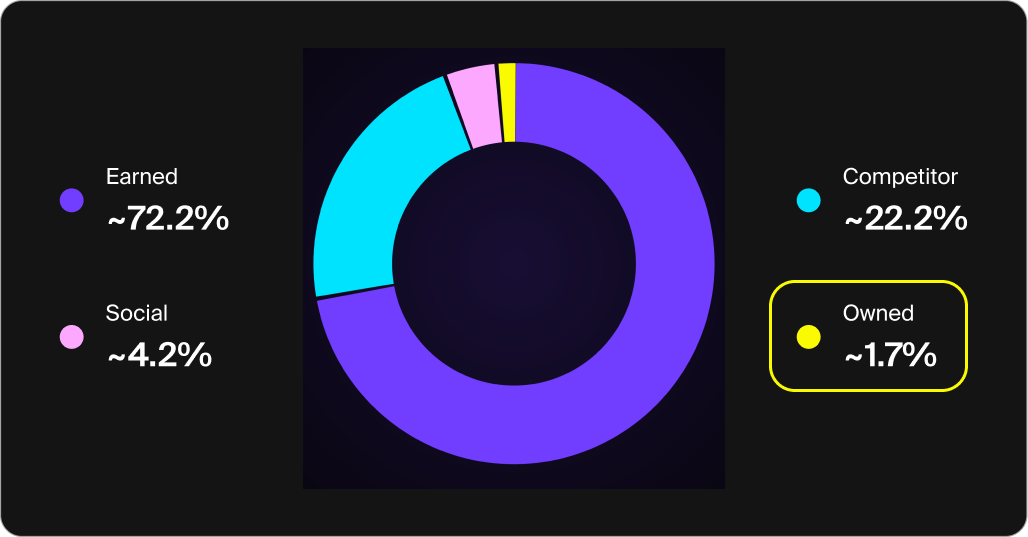
According to a Goodie Study on AI visibility, owned content only makes up approximately 1.7% of your brand’s overall citation ecosystem. The brand narrative that exists in the world is the composite of every mention, review, and comment that exists whether you published it or not. Your owned channels are actually, and somewhat unnervingly, a minority voice in your own story.
This has always been true to some degree. Brand reputation is by nature the sum of many different opinions, owned and earned. That said, two things have raised the stakes considerably in the last few years:
- The speed at which unsanctioned narratives calcify
- The surface area where they now appear
Let’s start with speed. Social media algorithms are extraordinarily efficient at surfacing and amplifying content that generates strong reactions, which means a critical Reddit thread, a viral call-out post, or a creator’s unflattering review can reach more people in 48 hours than your content team will in a quarter. The creator economy has added another layer to this: there are now millions of people with real audiences whose entire value proposition is their unfiltered opinion, and your brand is fair game. A customer’s disappointing unboxing video or a frustrated comment that gets 10,000 likes carries algorithmic weight because the platforms are designed to reward emotional resonance over brand safety.
Then comes the surface area amplification. A negative brand narrative might previously live in a niche corner of the internet you could reasonably ignore or frame as “not part of our target audience”. Now it gets cited by AI. AI search engines like ChatGPT, Gemini, and Google’s AI Overviews are synthesizing brand perception from whatever has been indexed and deemed credible and presenting it as a clean, authoritative summary to someone who just wanted a quick answer about your product. At the same time, Instagram, TikTok, and YouTube are building their own native AI summary features that surface what people are saying about you inside the platform itself. This means that anything that’s said about your brand, whether it be accurate or inaccurate, praising or scathing, will be cited as fact and repeated at scale by AI answer engines.
Optimizing Social for AI Search Is Now Table Stakes
When someone searches your brand name in ChatGPT, or reads the AI Overview that appears before the link to your homepage does, they’re encountering your brand narrative as a synthesis of everything the internet has decided to say about you. AI answer engines pull from whatever they’ve determined to be credible: Reddit threads, press coverage, social posts, third-party commentary. Your owned content participates in that process, but it doesn’t lead it.
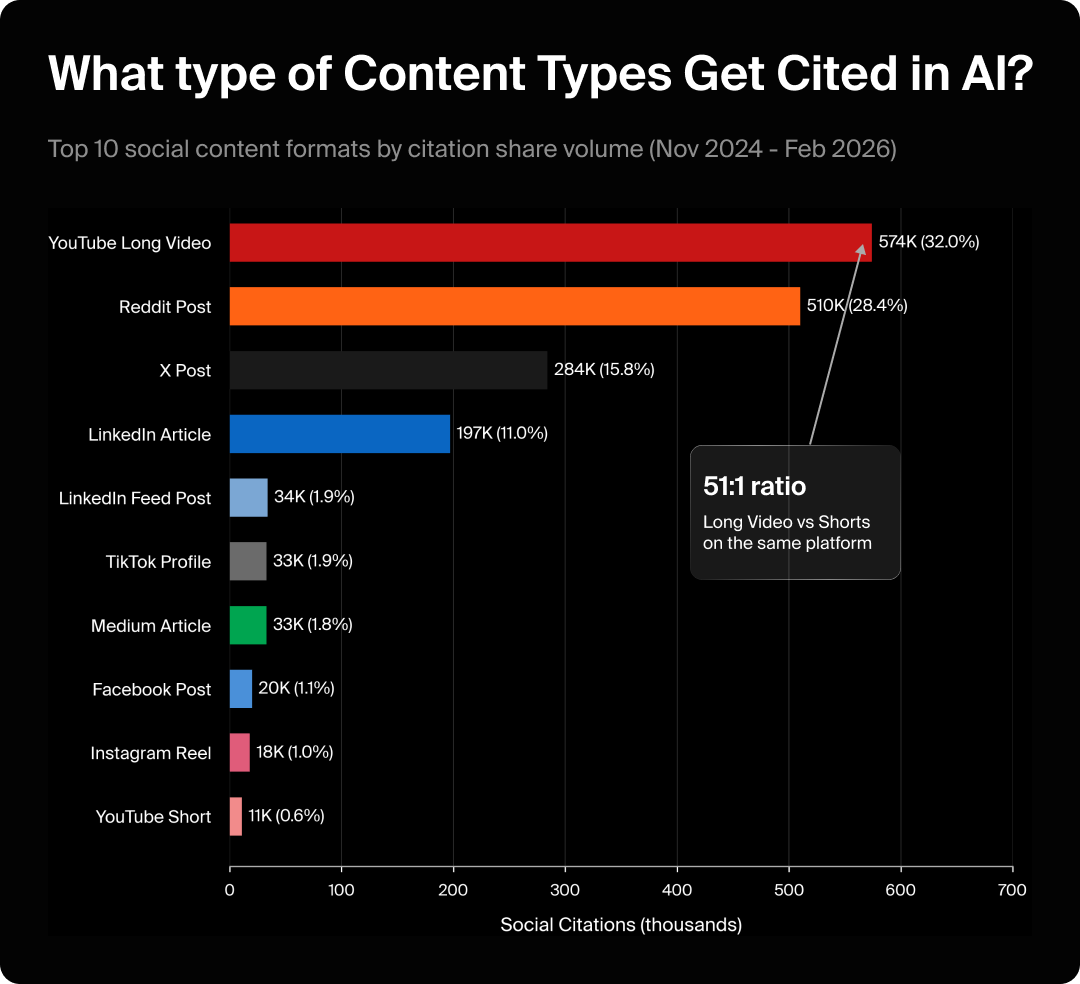
Social content is a growing part of that citation ecosystem. According to Goodie’s social citation study, which tracked 1.8 million social citations across 45.2 million total citations and 10 AI surfaces, social represents approximately 4.2% of all AI citations, already 2.5 times the share of owned brand pages, and climbing.
Within social, three formats dominate:
- YouTube long-form videos (32% of social citations)
- Reddit posts (28.4%)
- LinkedIn articles (11%)
The content types that get cited share the same properties: high text density, stable URLs, and structured information that maps cleanly to the queries people are actually asking.
For organic social and brand teams, this adds another layer to what it means to build on social. Publishing content that performs in the feed has always been the primary mandate. That doesn’t change, and good content will always be human-first.
Now, there’s a second audience to build for: the AI engines synthesizing your brand’s reputation every time someone searches for it. That means thinking about social content not just as something that earns likes and reach in the moment, but as a body of evidence that accumulates over time. The brands that treat their social presence as a citation asset will build durability that outlasts virality.
For now, this looks like publishing substantive long-form content on YouTube, maintaining a credible presence in relevant Reddit conversations, or building a LinkedIn article archive that reflects an actual point of view.
The Credibility Problem With Paid Influence
Consumers are smart. They’re developed a reasonably sophisticated radar for what’s a genuine endorsement and what’s a paid placement dressed up as one. Content from micro-influencers will often outperform those from creators with huge followings because the relationship between creator and audience still feels unmediated. The moment that relationship is visibly monetized, the trust calculation changes. What started as a way to borrow credibility from trusted voices has become, in many cases, a credibility tax.
This matters for brand narrative in a specific way. Paid influence was supposed to be a shortcut to earned credibility: tap into someone else’s audience, borrow their trust. But when the audience no longer extends that trust unconditionally, the content produced under those arrangements feeds into audience skepticism rather than trust and advocacy.
The more durable play is building influence over time via accumulated exposure and consistency. Audiences then form an opinion on your brand through pattern recognition:
- What does this brand consistently say?
- Where does it show up?
- What does it actually stand for?
Paid influence can introduce you to a new audience, then organic social is what that audience finds when they go looking for evidence that the introduction was worth their attention.
Community Management as Brand Architecture
Since so much of your brand narrative comes from what other people are saying about your brand, community management becomes as much a customer service problem as it is a brand building and organic social initiative. The comment sections where your audience is discussing and forming opinions about your brand are narrative touchpoints whether you leverage the opportunity to respond to it or not.
Treating community management as a cumulative brand building exercise means showing up in conversations that are relevant to your brand and industry, even if you’re not directly mentioned. For example: contributing something genuinely useful in Reddit threads where your product category is being debated, or engaging with trending content in your audience’s orbit.
Reddit is the clearest example of where this plays out at scale. Threads discussing your product category and the problems your brand exists to solve are opportunities for your brand to show up with a genuinely useful perspective (without a sales agenda).
The same logic applies to commenting as a social strategy more broadly. Well-placed comments on relevant posts are small actions that compound into brand recognition over time. Platforms reward meaningful engagement algorithmically, which means consistent, intentional commenting keeps a brand’s profile warm and active in ways that posting alone doesn’t.

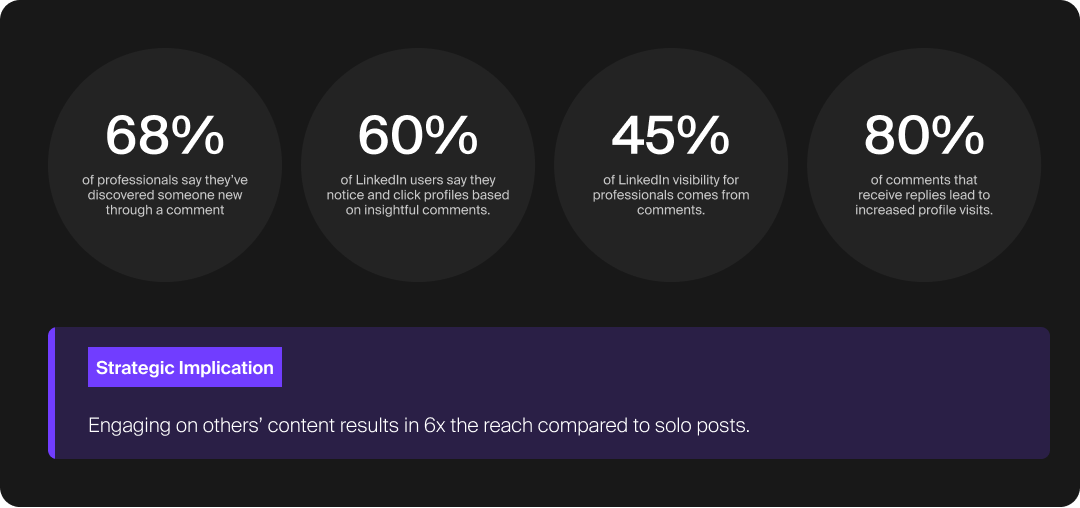
On LinkedIn specifically, visibility is driven both by what a brand publishes and also by how actively it participates; comments on other people’s content generate reach that feed posts frequently don’t.
According to LinkedIn data, comment activity is up 37% year-over-year, and some users report that comments receive 30 to 75 times more views than likes. 68% of professionals say they’ve discovered someone new through a comment, not a post, and 60% of LinkedIn users say they notice and click profiles based on meaningful comments.
One founder tracked his LinkedIn analytics and found that 35% of his profile appearances came from comments, nearly matching the 37% driven by his posts.
Community management also means knowing when to get out of the way and let your customers do the talking. Great content can come out of a Reddit thread where someone describes exactly why they love your product in language your marketing team never would have written. Brands that treat this material as a content source rather than background noise have a significant advantage.
Answering a TikTok comment with a net new video addresses the concern that that one person had, but it also signals to everyone watching that the brand is actually paying attention. Reposting a Reddit thread where your community is having a genuine conversation about your product shows social proof in its most unfiltered form.
Oura Ring does this consistently, regularly surfacing Reddit posts about their product on their own channels. That’s a different kind of credibility than anything a brand can manufacture. Show your consumers you see them, and they’ll keep generating the content that makes your brand worth seeing.

Employee Advocacy is Your Trust Distribution Network
Let’s start with defining what employee advocacy is not. There’s a version of employee advocacy that many brands do badly: the company posts something, sends it to the team in Slack, and asks everyone to reshare it. The post collects a handful of obligatory likes from people who clearly didn’t read it, and the whole exercise disappears into the feed within hours. That’s not advocacy.
Real employee advocacy works because it solves the same problem that’s eroding paid influence: audiences trust people more than they trust brands. A founder, a senior hire, or even a junior team member posting their genuine perspective on an industry conversation carries more weight than the same opinion published from a brand account. LinkedIn’s algorithm in particular is known to prioritize content from individuals above content from company accounts, likely because it creates a more engaging ecosystem of voices. Impressions on personal profiles run 2.75-5x higher for identical content on company accounts, and engagement rates frequently exceed company pages by 300 to 500%. The personal account has a face, a history, a point of view that exists independent of the company. The brand account is, by definition, institutional.
This is why the most effective version of employee advocacy requires a more effortful endeavor of building a culture where people across the organization are active, visible participants in the conversations that matter to your brand’s space.
Slate is a good example of how this plays out on LinkedIn, where they treat LinkedIn as one big ecosystem instead of just an isolated brand channel. Christina Le, Head of Marketing at Slate, describes their approach as thinking less about growing the Slate page and more about increasing Slate’s surface area on LinkedIn. The brand page is one node. The founder, the practitioners, the subject matter experts; those are all nodes too, each one extending the brand’s reach into corners of the feed the company page was never going to touch on its own.
Operationally, Slate runs this through clear swim lanes: one person owns community and engagement, one owns content output, one owns external partnerships and creator relationships.

The caveat is that it has to be genuine. Coordinated talking points and templated posts read as exactly what they are, and audiences have become efficient at identifying them. The brands that do this well give their people something worth saying, create the conditions for them to develop their own voices, and then get out of the way.
What This Looks Like in Practice
The through-line across everything in this piece is that brand narrative on social is built through accumulation. There’s no single viral post that defines how your brand is perceived. It’s the sum of everything: what gets published, what gets said in response, who shows up in which conversations, and how consistently all of it reflects something coherent about who the brand actually is.
In practice, that means a few things need to be true simultaneously.
- Your content needs to be worth citing. That means publishing substantive long-form content on YouTube, maintaining a credible presence in relevant Reddit threads, and building a LinkedIn article archive that reflects a genuine point of view.
- Your community management needs to be proactive. Someone should own the responsibility of showing up in conversations your brand wasn’t tagged in: Reddit threads, LinkedIn comment sections, TikTok replies, the spaces where your audience is forming opinions in real time.
- Your people need to be part of the strategy. The surface area of a brand on social is the sum of its people’s presence in tandem with the company page. Your customers need to be treated as collaborators. Amplifying content from your audience signals that real people, without incentive, think your brand is worth talking about.
None of this is a campaign with a start date, end date or wrap report. Think of it as an operating model for what it means to build a brand narrative on social. This requires consistent investment, clear ownership, and the discipline to treat social as the brand-building infrastructure it actually is, rather than a distribution channel you check in on when something goes wrong.