
Name-calling isn’t just for President Donald Trump anymore.
In high-profile races across the country, candidates are embracing personal insults in a bid to define their opponents and break through in an increasingly competitive attention economy. The barbs have been slung on the campaign trail and during debates, where policy discussions have frequently taken a backseat to more attention-grabbing bickering.
An insult-heavy style can serve multiple purposes for candidates, strategists told USA TODAY. An aggressive approach could signal a candidate is willing to fight their political opponents on behalf of voters. It might project a level of authenticity. And, if done right, a well-deployed broadside could define a political opponent or dismantle an attempt to highlight their own vulnerabilities.
At an Oct. 8 Georgia U.S. Senate debate, Republican Rep. Mike Collins dubbed Democratic Sen. Jon Ossoff a “trust-fund kid,” while Ossoff labeled Collins a “bigot.”
That same night, Abdul El-Sayed, Michigan Democrats’ U.S. Senate nominee, called his Republican opponent, former Rep. Mike Rogers, a “sock puppet” for Trump, while Rogers called him a “con man” and a “glitchy AI chatbot.” During one of the most heated moments of the debate, while discussing Flock cameras, Rogers said that one might not like surveillance if they have family members on a “watch list.” El-Sayed suggested Rogers wanted to call him a terrorist.
“Go ahead and say it,” El-Sayed said. “You’ve been tiptoeing around it the whole time.”
Sparring with opponents can often appear unscripted and suggest a candidate is able to engage in real talk, which campaigns likely see as a way to appeal particularly to independent and moderate male voters, Democratic strategist Caitlin Legacki told USA TODAY. But there’s also a risk of coming off as forced or turning off some voters, specifically Democratic women, she said.
“I generally hate it,” said Legacki, who previously worked with the campaign of one of El-Sayed’s primary opponents, Rep. Haley Stevens. “But part of what’s tough about our industry is understanding when you’re the target audience and when you’re not.”
A political shorthand
The use of insults in politics predates Trump, but his opponents in both parties experienced firsthand the power of a nickname that sticks.
During the 2016 presidential election, former Florida Gov. Jeb Bush was “Low Energy” Jeb, a moniker that brought to mind his struggles to excite voters. Marco Rubio, then a Florida senator, was “Little Marco,” both a jab at their height difference and an attempt to paint the younger candidate as lacking political heft. Former Secretary of State Hillary Clinton’s nickname – “Crooked Hillary” – fed into decades of anti-Clinton attacks.

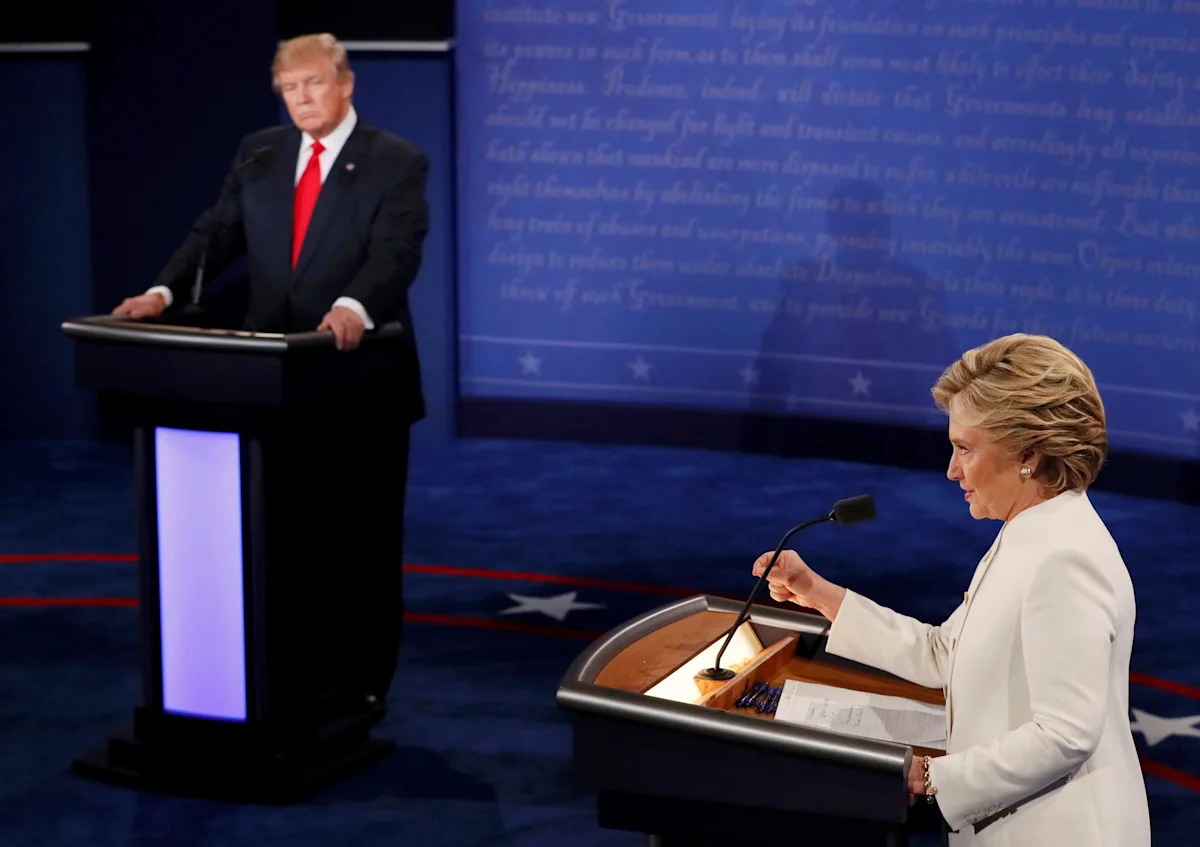
Republican U.S. presidential nominee Donald Trump listens as Democratic U.S. presidential nominee Hillary Clinton speaks during their third and final 2016 presidential campaign debate at UNLV in Las Vegas, Nevada, U.S., October 19, 2016.
“If you brand your opponent, you have a huge advantage,” said Alex Conant, a Republican strategist who worked on Rubio’s 2016 campaign. “Voters get so much information. It’s hard for anything to stick.”
Ahead of the November midterm election, Trump has targeted Democrats in close races with increasingly disparaging language. The president called South Carolina Democratic U.S. Senate nominee Annie Andrews an anti-transgender slur and has leveled several Islamophobic attacks at El-Sayed, calling him a “jihadist” and referring to him as “Mohammed.” (Andrews is not trans but is being attacked by Republicans over trans rights.)
Name-calling has become a test of political toughness and a proxy for a candidate’s willingness to engage in political battle with opponents, said Brandon Rottinghaus, a political science professor at the University of Houston who studies political communication. It’s also a shortcut to defining those opponents, he told USA TODAY.
“The goal is, with these insults, to compress an entire political argument into a few memorable words,” he said.
He pointed to Collins’ “trust-fund kid” jab during the Oct. 8 Georgia Senate debate, noting he didn’t know Ossoff came from a wealthy background. Ossoff, who received a large inheritance from his grandfather and has reported a blind trust valued between $1 million and $5 million, has faced attacks over his family wealth since his first Senate run.
Ossoff, meanwhile, has frequently referred to Collins as a “bigot” to draw attention to his ties to people who’ve shared Nazi or white supremacist content. Slate reported in May that Collins’ former chief of staff was on a group chat with Nick Fuentes, a prominent white supremacist. In July, CNN reported that Collins’ son-in-law, who lives in a property owned by the congressman, is a white nationalist influencer who has posted antisemitic and Nazi content online.
“If John Lewis were marching today from Selma to Montgomery, Mike Collins would be grabbing a billy club,” Ossoff said during the debate, referring to the civil rights activist and Georgia congressman who served as Ossoff’s mentor. “His office has been in cahoots with some of the most notorious white supremacists in the country.”
Collins said that he condemns antisemitism, racism and hate. “I don’t care where the source is,” he said.

US Senator Jon Ossoff (D-GA), Georgia’s Democratic candidate for US Senate, and US Representative Mike Collins (R-GA), Georgia’s Republican candidate for US Senate, attend a debate at the Georgia Public Broadcasting studio in Atlanta, Georgia, US, October 13, 2026.
Hitting back
Countering the attacks is just as important for candidates as leveling them.
In Texas, Democratic Senate nominee James Talarico has faced a barrage of hits from Republican Attorney General Ken Paxton and his allies aimed at attacking his masculinity and portraying him as misaligned with Texan values. Republicans have falsely claimed he’s a vegan and called him “Talafreako.” Vice President JD Vance has made comments questioning Talarico’s sexuality.
Talarico has made light of the smears by embracing the nickname and pivoting to some of Paxton’s own political weaknesses.
His campaign has started selling “I’m a Talafreako” shirts. During a May stop on his “The People vs. Ken Paxton” tour, Talarico said he’s an eighth-generation Texan who’s been eating barbecue since “before Ken Paxton’s first indictment.” The attorney general has faced a series of controversies during his time in office, including a 2015 indictment for felony securities fraud that ended in a pretrial agreement and a 2023 impeachment that ended in acquittal.
“The thrust from Republicans, in terms of their attacks, is that James Talarico has made these outrageous comments during Woke 1.0, and they are problematic for a general election audience in Texas,” Rottinghaus said. “I do think that the impact could have been pretty strong if the Talarico campaign hadn’t been so adept at the political jujitsu of turning this attack into a success.”
Some candidates, particularly younger men in both parties, have built their political brands around being pugnacious at a time when voters are looking for fighters. In August, after Rogers released a campaign ad on his personal history with football that highlighted El-Sayed’s past remarks criticizing aspects of American football culture, El-Sayed said Rogers had “beta energy” and challenged him to a tackle football match.
A month later, El-Sayed and Vance mocked each other’s beards – the vice president called El-Sayed’s beard “patchy.” El-Sayed questioned whether Vance’s was real and challenged the vice president to meet him in a weight room.
“I’d like to see if he’s as strong as he likes to pretend he is,” El-Sayed told TMZ DC.
This article originally appeared on USA TODAY: The Trump effect? Name-calling and insults surge in midterm elections




Leave a Reply