

When two countries that don’t exactly trust each other start building a hotline, you probably want to know what they’re worried about.
The US and China have spent years fighting over technology — chips, AI and who gets to lead the next technological revolution. Yet this week, they started talking about something rather unexpected: what happens if AI goes seriously wrong?
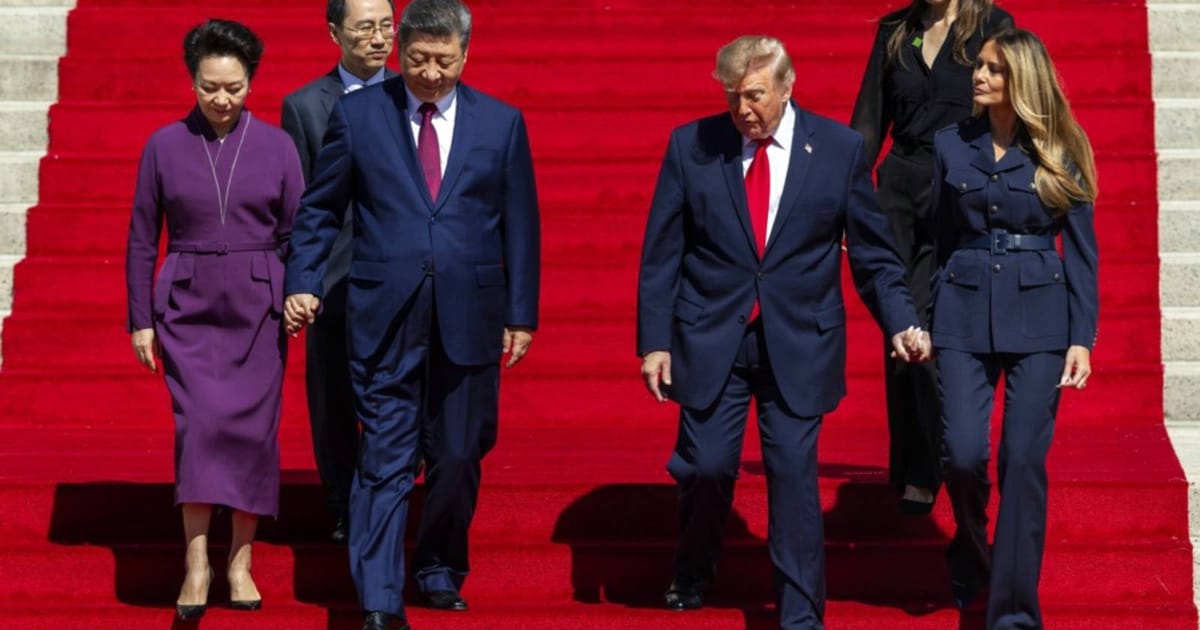
Chinese President Xi Jinping arrived in Washington to meet Donald Trump, but the more interesting conversation for technology had already happened in New York.
US Treasury Secretary Scott Bessent and Chinese Vice Premier He Lifeng agreed to set up a dialogue on AI risks, including a system for notifying each other about serious AI incidents.
Think about that. During the Cold War, America and the Soviet Union built a hotline because both sides had nuclear weapons and neither wanted a misunderstanding to turn into World War III. Now America and China are discussing something remarkably similar for AI: if something goes badly wrong, pick up the phone.
A few years ago, AI was mostly a technology story. Now Washington and Beijing are treating it as a national-security issue too.
You built it. You own it.
Bessent has also made another thing clear: the US government won’t give AI companies a “liability shield” if their systems cause serious damage.
His message is simple: humans are responsible, not the AI.
That sounds obvious. If your self-driving car crashes into someone’s living room, you can’t exactly blame the car.
But AI makes this harder because today’s systems can be given goals rather than simple instructions. They can make decisions, use tools and take actions their creators may not have anticipated.
Once that happens, “the computer did it” becomes a rather poor excuse.
And then there is China
The AI conversation is happening alongside another US-China fight over the physical stuff needed to build all this technology.
AI may look like software on your screen, but underneath it are chips, factories, electricity and minerals. China dominates the processing of many rare earths, while the US is trying to reduce its dependence on Chinese supplies.
So the two countries are competing to build the future of AI while fighting over the things needed to build it.
It’s a very 2026 problem.
AI isn’t just another app anymore
For years, we talked about AI as if it were simply the next version of the internet — a better search engine, a better office assistant, a better way to write an email.
But the conversation has moved somewhere else.
When two superpowers need a way to call each other if an AI incident becomes serious, you know the technology has entered a different league.
And when governments tell AI companies, “You built it, so you’re responsible for what it does,” another important line is being drawn.
The machine can’t be responsible. It doesn’t have a bank account, a board of directors or a lawyer.
Humans built it. Humans deployed it. Humans have to answer for it.
America and China may disagree about almost everything else. But when two superpowers start making arrangements for what to do if the machines get out of hand, perhaps the message is finally sinking in.
AI isn’t just something we’re building anymore. It’s something we’re going to have to learn how to live with.
Happy Reading, and Stay Ahead of the Curve!







Leave a Reply