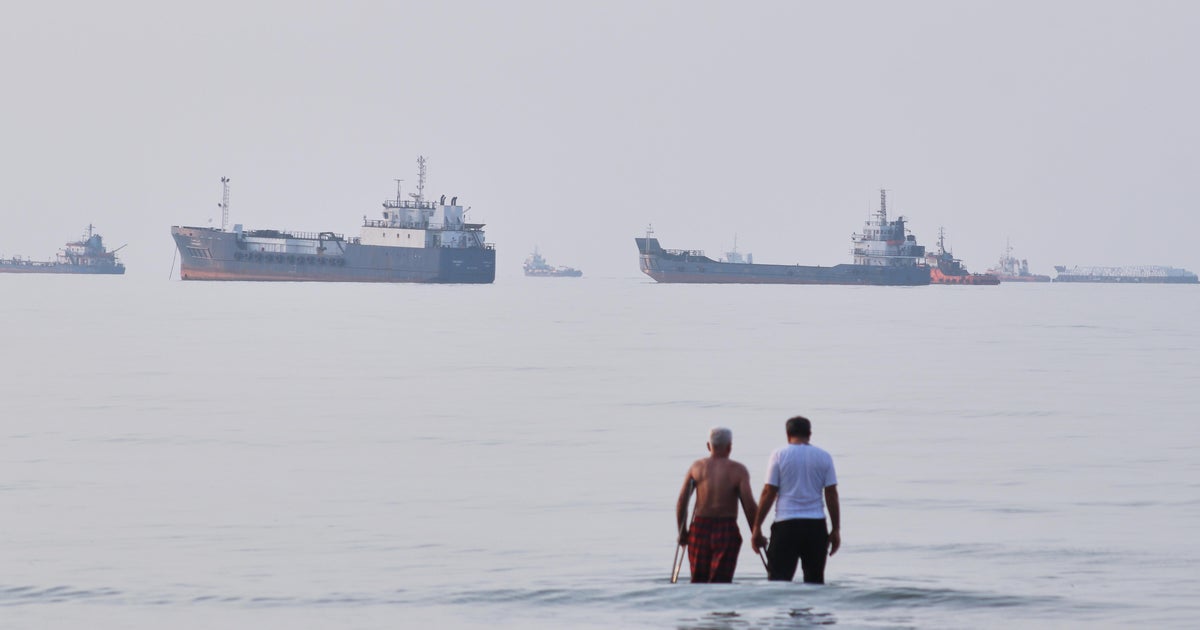
If President Trump were to make good on his declaration that the U.S. will impose a 20% fee on cargo transiting the Strait of Hormuz it could cost the largest vessels over $30 million per shipment, industry experts say, while logistics companies have called the concept illegal.
It is not clear how the Trump administration would impose such a levy, but Lloyd’s List estimates that a 20% fee would amount to roughly $17 million for a fully laden large natural gas carrier.
At current Brent crude prices, which are hovering around $80 a barrel, about $16 per barrel “will go to Trump,” said Amena Bakr, head of Middle East and OPEC+ at the Kpler shipping industry intelligence firm, in a social media post Monday.
Even if Brent drops to $60 a barrel, the fee for a fully laden, very large crude carrier, which can carry around 2 million barrels, would come to $24 million per shipment, Petras Katinas, a research fellow in climate, energy and defense at the RUSI Europe think tank, told CBS News on Tuesday.
Iranian tolls imposed at the start of the conflict, in contrast, reportedly amounted to around $2 million, or about 1.2% of the value of the oil on board on a very large crude carrier, and unofficial payments made quietly between governments were as low as $120,000, Lloyd’s said.
The U.S. imposing a fee would be “opening a very dangerous Pandora’s Box,” Katinas said, “because in other parts of the world, other countries will decide they want to impose tolls as well. So, we are totally undermining international maritime law, which is already in a fragile situation.”
Other industry groups and shippers said it would be an illegal move.
Razieh Poudat/ISNA/AP
“Whether the going rate is $200 or $20m, there is no legal basis for charging vessels to exercise their right of transit passage through an international strait,” Lloyd’s List editor Richard Meade wrote Monday. “Whether such demands originate in Tehran or Washington is largely beside the point. The danger lies in normalising the idea that access to one of the world’s most important maritime arteries can be subject to politically conditioned payments.”
Any imposition of fees on the transport of cargo through the Strait of Hormuz would be “fundamentally wrong,” German logistics company Hapag-Lloyd told CBS News on Tuesday.
“It would be fundamentally wrong to charge tolls for passage through international waters,” a spokesperson for the shipping giant told CBS News. “Tolls for infrastructure such as the Suez Canal or Panama Canal are different, because they reflect major infrastructure investments. That is not the case in the Strait of Hormuz.”
Mr. Trump said Monday the U.S. would be the “guardian” of the strait, which is the only route for cargo ships and tankers to access the ports of major energy producers in the Persian Gulf. About 20% of the world’s oil and natural gas shipments transited through the Strait of Hormuz before the war began.
He also said the U.S. was reinstating its naval blockade of Iranian ports and associated vessels, and that the U.S. would be “reimbursed” for costs associated with providing security in the strait by imposing a 20% fee on all cargo shipped through the narrow passage.
The U.S. has repeatedly condemned Iran for saying it could impose fees on commercial vessels using the strait after Washington and Tehran signed a memorandum of understanding intended to reopen the passage to all ships.
“No country is allowed to charge tolls or fees on an international waterway,” Secretary of State Marco Rubio said last month. “That’s existing international law.”
The strait was always free and open to commercial traffic before the U.S. and Israel launched their joint war with Iran on Feb. 28. Iran responded to the assault by attacking ships and Gulf states, effectively deterring most shippers from using the waterway.
The United Nations’ International Maritime Organization said Tuesday it was “firmly against charging fees for passage through straits used for international navigation.”
“There is no legal basis through which to introduce mandatory tolls simply to transit through a strait,” an IMO spokesperson told CBS News.
As recently as June 25, Rubio told a Gulf Cooperation Council meeting in Bahrain that Iranian tolls in the strait would risk “total chaos” as a precedent for international shipping.
“International waterways do not belong to any nation state. This is a foundational principle in the world today, without which the world would be in total chaos,” Rubio said. “If, in fact, we accepted that you can charge money to use an international waterway because it happens to be near your territorial space, well then this will spread throughout the world like a contagion.”
Oil prices climbed to about $87 a barrel Tuesday after surging almost 10% Monday when Mr. Trump declared the 20% security fee plan in a Truth Social post.
“Snapping an immediate 20% transit fee on cargo ships already underway would prolong adverse cost impacts on global supply chains; though it seems that President Trump’s social media announcement is bluster, his principle and logic are sound: security has a price,” energy and security consultant Myles B. Caggins III told CBS News on Tuesday.
Iran agreed with that assessment, but the Islamic Republic’s foreign minister, Abbas Araghchi, mocked President Trump’s declaration of a 20% fee, saying in a social media post that was “too much” for future tolls.
“POTUS is absolutely right. Whoever provides secure and safe passage of commercial vessels through the Strait of Hormuz should be compensated for this service,” Araghchi wrote. “Iran has always been the GUARDIAN of the Strait and will remain so FOREVER. 20% is of course too much. We will be fair.”
Caggins, a retired U.S. Army colonel who has led operations in Iraq and Syria, said Gulf oil and gas producers were “already implementing alternate routes to get supplies to market” due to the impact of the Iran war on traffic through the strait. He said specifically that Iraq had moved to prioritize oil shipments via pipelines to Turkey, and by truck to Syria.
Mr. Trump’s comments on Monday came after the United Arab Emirates’ defense ministry said Iranian cruise missiles struck two oil tankers using a southern shipping route through the strait, along the coast of Oman, which Tehran does not accept.
The U.S. has continued to encourage commercial ships to use the southern route despite repeated attacks by Iran.