

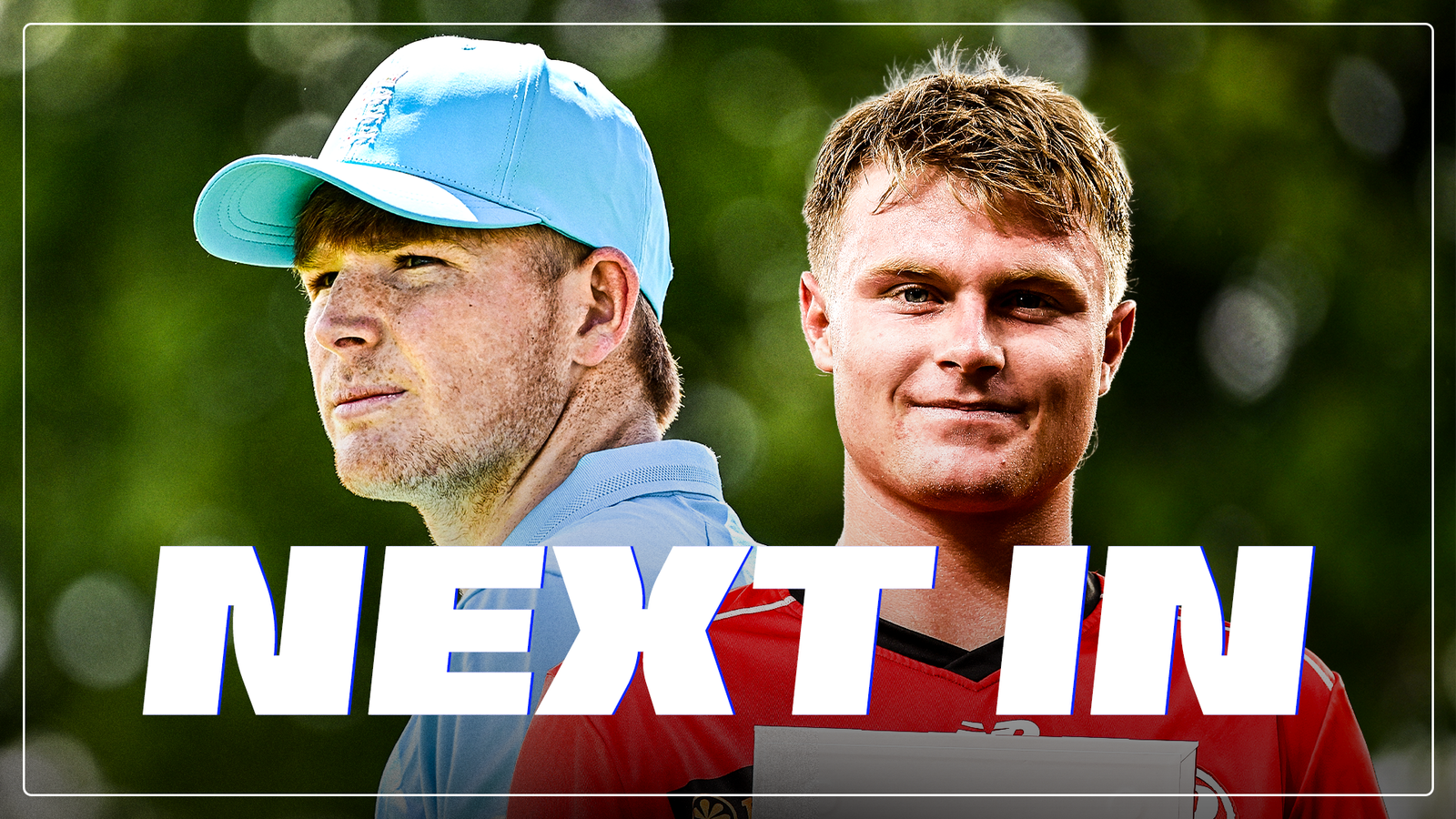
Rew v Peake: the future of Ashes battles
In the midst of an action-packed period for Australian cricket, attention now turns to a white-ball series against England at home. When the visitors submitted their T20 squad in October, one name in particular jumped off the page: Thomas Rew.
The 18-year-old ‘keeper-batter and his 22-year-old brother James have been two of the most hyped prospects to come out of England in recent years. The pair got a taste of an Australian Ashes summer last year to gave fans a glimpse of their talent.
James scored an unbeaten 92 against the Prime Minister’s XI and hit the winning runs in November.
Both were then named in the England Lions team that took on Australia A little later on at Allan Border Field.
You may recall Nathan McSweeney making an unbeaten 226 as Australia A won that match by an innings and 127 runs. And while older brother James struggled with seven runs in the first innings and a duck in the second, Thomas looked a bit more assured in what was his first-class debut.
He chipped in with 19 in the first innings but managed seven fours and a six in the second knock, to put on 47 from 61 balls.
Rew built his way towards a potential T20I cap with some strong form for Somerset in the Vitality Blast earlier this year.
Ironically, it was against McSweeney’s Northamptonshire where the younger Rew looked best, blasting 57 from 30 balls in the first head-to-head and then 46 off 20 in the second.
He showed dominance against the spinners, sweeping and reverse sweeping well. He even stepped down the pitch easily to launch a six over long off in the first showing.
His cut shot might be the most aesthetically pleasing regular boundary option at this stage. Even without too much room he’s managing to pierce through gaps with that against pace bowlers.
Rew showcased a destructive leg-side game in the second outing against Northamptonshire. He stepped across his wicket and dropped to one knee against skipper David Willey in a pre-meditated rocket well over deep fine leg and out of the ground. This was not long after he sent one over deep mid-wicket and high up into the pavilion.
England’s T20I squad is certainly leaning younger, but there’s no guarantee Rew will make his debut.
Jofra Archer, Joe Root, Josh Tongue, Ben Duckett and Gus Atkinson will only play in the ODI series. However the T20I squad still boasts the likes of Harry Brook, Jamie Overton, Jacob Bethell, Will Jacks and Sam Curran.
If Rew is the big drawcard for English fans, then the same can be said with Australian fans and Ollie Peake.
The two are progressing at a similar pace since going head-to-head as captains of their respective countries earlier this year in the U19 ICC ODI World Cup.
Peake began to build momentum by delivering some stunning performances for the Melbourne Renegades. In fact, he and Rew share the same top score of 57 at List A T20 level.
Peake then managed eight ODIs for Australia so far this year, with his 41 off just 18 balls against Zimbabwe a clear sign of what he can do at the death.
If you missed that game, 24 runs came from the last over. Peake hit three sixes with arguably the best shot being a controlled effort over long off.
Peake knows there is a perception about his lack of power as a smaller framed player, but he’s shown some serious shot-making in his recent outings.
If we compare the two at Big Bash and Vitality Blast level (List A T20), Rew has been the more destructive player.
With a strike rate in the 150s and a 24 per cent boundary rate, Rew is getting his work done quickly as an opener.
Both have fared better against spinners than they have against pace, but Peake has shown his ability against some high-quality quicks.
He has flung the star Pakistani duo of Haris Rauf and Shaheen Shah Afridi for six before. And who could forget his match-winning shot against the Scorchers, where he dispatched Aaron Hardie in a final-ball thriller.
With Peake named on Monday in Australia’s ODI squad and Rew only in the shortest format for England, it seems unlikely that we will see these two head-to-head in an international this summer, but any glimpse at two of the better prospects of the next generation is going to capture attention.
Who should we watch in WBBL|12?
With Weber WBBL|12 underway, the young breakout contenders field looks to be a pretty wide one.
Caoimhe Bray feels like she has been around forever but is still just 17-years-old. The Sixers prodigy has shown the ability to step up with both bat and ball in key moments.
Tess Flintoff (Melbourne Renegades) ascended to become one of the best players in the WNCL last season, but we haven’t seen the best of her in the WBBL yet.
Eleanor Larosa (20) from Strikers has shown flashes of becoming a genuine allrounder for the future, with her left-arm pace the hallmark of her game currently.
Then there’s a quartet of bowlers who are on the precipice of the next level. Chloe Ainsworth (Perth Scorchers) has shown the most so far. But Milly Illingworth (Melbourne Renegades) and Lily Bassingthwaite (Brisbane Heat) are pressing.
Spinner Hasrat Gill looks to have taken a step for Sydney Thunder, taking a bundle of wickets in the Spring Challenge, including a player-of-the-match worthy 3-21 against the Scorchers.
Lastly, it is cheating to put 26-year-old Maddie Penna in a column focused on those 25 and under, but she was named player of the tournament for the Spring Challenge. And Molly Strano recently pegged her as someone who could push for Australian selection soon on The Scoop.
What’s changed in Konstas’ game?
Sam Konstas kicked off his summer with a bang, but things are looking a little different compared to his barnstorming Test start two years ago against Jasprit Bumrah.
The pair of four-day Australia A appearances in India at the end of September will serve as valuable learning experiences. And whilst he never dominated over there, he managed to build three starts in four innings (25, 20, 2 and 40). Of those 87 runs, just 20 came from boundaries.
But the emphatic reminder of his talent came in a double demolition of Western Australia in late October.
It started in round two of the Sheffield Shield, where he returned and dominated in front of Australian selector Tony Dodemaide. He was happy to take a backseat in terms of his aggression in the first innings. His 71 off 142 contrasted sharply with fellow opener Ollie Davies’ 52 who went at around 90 in terms of strike rate.
Then there was the reminder of the dominance in the second innings. With New South Wales in a commanding position, Konstas pulled out an unbeaten 151 from 167 balls. His teammates had consistent starts around him, but he did a lion’s share of the work.
And despite the uptick in tempo, Konstas’ shot selection was more orthodox than what he’d shown in previous years. He punished width well and looked assured with some free-flowing off-drives.
By the 14th over, Konstas was in a near run-a-ball groove and pre-meditated a dance down the pitch to launch a Joel Paris delivery back over his head. The dare revealed itself again 10 overs later as he stepped away to guide a shot over first slip for another boundary, in what was perhaps his cheekiest shot of the day.
Once he was past the ton, Konstas looked to push the pace against spinner Corey Rocchiccioli with three consecutive boundaries in the 47th over.
Just four days later, Konstas ripped off 149 from 131 balls in a One-Day Cup win, also against Western Australia.
The shot-making held a similar approach to his Sheffield Shield ton. Like Paris earlier in the week, WA quick Albert Esterhuysen will not soon forget how Konstas punished him back over his head time and time again.
Fellow quick Mahli Beardman conceded 18 runs to Konstas in the 44th over, with the final ball guided over slip calmly with a flourish.
Beardman got his revenge a few overs later when he had Konstas caught in the deep, but the damage was well and truly done.
Perhaps the most pleasing sign after this purple patch was the post-Shield game quote on where his headspace lies.
“I’m feeling very good, like I have a lot of clarity in the way I am batting,” Konstas said.
A glimmer from Plimmer
New Zealand captain Amelia Kerr said it best after the October T20I series against Australia.
“I’d love to see more Kiwis get a shot (in the Weber WBBL).
“Six years ago, we had a lot of Kiwis playing in the Big Bash. That would be awesome.”
Kerr went on to highlight veteran Maddy Green’s innings in the first T20I against Australia as an eye-catching moment that should have put her on the watch list for Big Bash teams.
Hobart heeded the call, adding Green as an international replacement for Linsey Smith on the eve of the season, but what about the 22-year-old opener Georgia Plimmer?
The 85 not out Plimmer piled on at North Sydney Oval at the start of the series was her career-best T20I score and vastly different to her last few months. She struggled to get going in the World Cup earlier this year. Prior to that were two golden ducks against England in May, with a chop on to Lauren Bell and a regrettably casual chip straight back to Linsey Smith sure to have caused nightmares.
CricViz’s player ratings show her as a player that is well balanced in different moments and situations. However, their skill scales show her as a batter with a good mix of control and aggression, but lacking a touch in innovation and power. They also label her as a slower starter.
Indeed, it wasn’t until the 12th ball that she showed off some footwork and strength to go down the ground against Lucy Hamilton.
The class, footwork and dare to show her stumps held her in great stead as stepped away and delivered time and time again through point and cover. A slashing shot against Ash Gardner was the pick of the bunch.
And while the innings wasn’t filled with huge hoists, Plimmer did sweetly time a pull off Nic Carey for six to showcase some force and eclipse her previous high score of 63.
Plimmer was fortunate on multiple occasions with Beth Mooney missing some chances behind the stumps, but perhaps this will be a building block for her ahead of New Zealand’s home series against Bangladesh in December.
By the time the Kiwis return for the ODI series in March, we may have to have further discussions about the opener.







Leave a Reply