
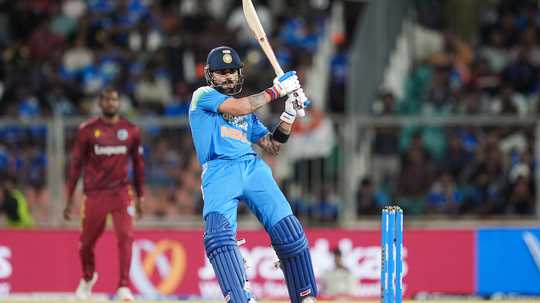
“I’ve got a challenge at this stage of my career to kind of up the ante and play a gear or two higher.”
Virat Kohli said this after the first ODI against West Indies in Thiruvananthapuram, a game in which he became only the second batter to scale the peak of 15,000 ODI runs. The remarkable part was not the milestone. It was the admission that there was still another version of Kohli to unlock. The change is not in what Kohli can do, but in how early, how often and how fearlessly he is now willing to do it.
That version had not been immediately apparent when he became a one-format player. After retiring from Tests in May 2025, Kohli began his new phase with successive ducks in Australia in October, the first time in his ODI career he had been dismissed for zero in consecutive innings. He salvaged something from the series in the final game.
Something changed between that tour and the home series against South Africa.
Since the start of that series, Kohli has scored 854 runs in 12 innings at a strike rate of 117.63. After the unbeaten 139 in the first ODI against West Indies in Trivandrum. his last ten innings accounted for 825 runs. Only six ten-innings sequences in ODI history have aggregated more runs. Two of those sequences belong to Kohli himself, from 2012 and 2018 respectively.
Best 10-innings sequences in ODIs
| Batter | Runs | Period | Career inngs | Avg | SR | 100s/50s |
|---|---|---|---|---|---|---|
| V Kohli | 995 | Feb-Oct 2018 | 197-206 | 142.14 | 103.97 | 5/3 |
| S Gill | 894 | Jan-Sep 2026 | 59-68 | 127.71 | 119.52 | 3/5 |
| D Warner | 857 | Oct 2016 – June 2017 | 83-92 | 85.70 | 114.42 | 5/0 |
| V Kohli | 850 | Feb-Jul 2012 | 77-86 | 106.25 | 100.24 | 5/2 |
| Babar Azam | 837 | Jul 2021 – Aug 2022 | 81-90 | 93.00 | 94.36 | 4/5 |
| R Taylor | 834 | Jan 2018 – Jan 2019 | 187-196 | 104.25 | 91.85 | 3/5 |
| V Kohli | 825 | Nov 2025 – Sep 2026 | 294-303 | 103.13 | 116.86 | 4/4 |
After winning the Player of the Series against South Africa last November, Kohli spoke about taking more risks.
“When I play freely, then I know I can hit sixes. So, I just wanted to have some fun because I was batting well, just take a bit more risk. Just push my own boundaries and see where we go.”
He described his hundred in Ranchi as particularly significant because it “opened me up” in a way he had not felt for a while.
So what exactly has opened up?
To understand the change, it helps to divide Kohli’s ODI batting in the 2020s into three phases: 2021-22, when he went two calendar years at his lowest ebb; the period beginning with the 2023 World Cup and ending with last year’s Australia tour, when the runs returned with Kohli’s trademark consistency; and the period beginning with the South Africa ODIs last November, when the consistency has remained but the tempo has changed dramatically.
Kohli across three phases
| Period | Inngs | Runs | Avg | SR | 100s | 50s |
|---|---|---|---|---|---|---|
| 2021-22 | 14 | 431 | 30.79 | 86.9 | 1 | 4 |
| Oct 23 – Aus tour | 24 | 1172 | 61.68 | 87.79 | 4 | 9 |
| Since Nov 2025 | 12 | 854 | 85.40 | 117.63 | 4 | 4 |
The first phase was a genuine low point. Kohli averaged 30.79 in 2021-22 and struggled against both pace and spin.
When the runs returned from 2023 onwards, pace became an area of renewed strength. Against spin, however, he made a different trade-off: he was more consistent (higher average), but less efficient (lower strike rate). With Rohit Sharma and Shreyas Iyer around him as aggressive spin hitters, Kohli’s role was often to bat deep and provide the innings with its foundation.
That compromise has largely disappeared.
Since the South Africa series, Kohli’s numbers against both pace and spin have moved into elite territory. He is striking at 123.54 against pace, compared with 94.78 in the 2023-25 period, his average has dipped from 63.60 to 50.90, still an exceptional return for that tempo. Against spin, he has not been dismissed and is striking at 109.87, compared with 80.82 in 2023-25 and 84.15 in 2021-22.
The simplest explanation is also the most visible one: Kohli is hitting more boundaries, and many more sixes.
In 2021-22, he found a boundary once every 10.2 balls. In the last 11 months, that has come down to once every 7.3 balls. The change in six-hitting is even more dramatic: one every 173.5 balls in 2021-22, one every 133.5 balls in 2023-25, and one every 25 balls since the South Africa series.

How Kohli moved the needle of strike rates ©Cricbuzz

The big boundary-hitting shift in Kohli’s game ©Cricbuzz
That does not mean Kohli has suddenly become a slogger. In fact, much of what is new about his batting is how controlled the aggression remains.
After his Ranchi hundred last year, Zaheer Khan noted on Cricbuzz Live that Kohli was “constantly making an effort to get in positions early” and taking the bowling on while still holding his shape. Dinesh Karthik, his batting coach at RCB, pointed to the same foundation: a stable base that allows Kohli to generate the power and balance required to clear the infield and play aerial shots.
He adds, “I don’t think Kohli has changed technically. His increased IPL tempo and appetite for risk have given him the confidence to attack earlier in ODIs. He has developed clear patterns for when and how to take risks, and repeated success with those shots in the IPL has made them almost second nature. He is now able to transfer that confidence and intent into ODI cricket.”
Kohli has always been one of the best players of pace bowling. What has changed is how quickly he is willing to attack it.
Against full and short-pitched deliveries, he has long had scoring options. The more interesting development has come against the good-length ball, traditionally the area in which a batter has to decide whether to attack, defend or simply wait.
In 2023-25, Kohli struck at 79.20 against good-length deliveries. Since last November, that figure is 111.95.
Interestingly, the proportion of good-length balls he attacks has barely changed: 48.4% then, 48.6% now. What has changed is what happens when he chooses to attack. His strike rate on those attacking shots has risen from 121.95 to 168.88.
The other half of the equation is what he is no longer doing.
In 2023-25, Kohli defended or left alone 27.9% of good-length deliveries. That figure has fallen to 11%. The balls he does not hit to the boundary are increasingly being used to rotate the strike.
It is a small change in intent with a large effect. Kohli is creating more scoring opportunities without needing to manufacture a boundary every other ball.
He is also taking more balls in the air. Against seamers, the proportion of deliveries he hits aerially has risen from 2.8% in 2021-22 to 17.2% in the most recent phase. Against good-length balls specifically, it has increased from 3.6% to 13%.
And then there is his use of the crease.
After Kohli’s match-winning 93 against New Zealand in Vadodara earlier this year, Ajinkya Rahane on Cricbuzz Live observed that stepping down the pitch was not something Kohli had traditionally done often. Now he was doing it consistently, including in domestic cricket, with the specific aim of making bowlers change their lengths.
Kohli stepped down the pitch against pacers on 4.2% of deliveries in 2023-25. Since November 2025, that has more than doubled to 10.1%. This was reminiscent of the younger Kohli from the 2012-13 period, where he would often step down the wicket against pacers to find boundaries during an era where he would score quick fire hundreds. (Kohli used the feet to 34.2% of the balls against Australia pacers in Jaipur in 2013 when he scored a 52-ball 100).
The tactic may also resemble something Rohit Sharma has used to disrupt fast bowlers, but Kohli’s execution is different. Rather than routinely slogging across the line, he tends to come down and play orthodox drives. A significant number of those boundaries have gone between extra cover and long-on.
Karthik explained the value of the tactic: if a bowler is repeatedly hitting a good length, a batter who can use his feet and still maneuver the ball into gaps can put the bowler in an uncomfortable position.
That discomfort is now appearing much earlier in Kohli’s innings.
He is striking at 109.48 against pace in his first 20 balls, up from 80 in 2023-25. His Powerplay strike rate has similarly jumped from 75.34 in that period to 110 in his most recent outings.
Vadodara was the clearest example. Chasing 301 against New Zealand, Kohli walked in at 39 for 1 in the ninth over and immediately attacked, racing to 27 off 20 balls with six boundaries while Shubman Gill took time to settle. Kohli eventually made 93, and India chased the target with an over to spare.
On a difficult Cardiff pitch against a menacing England attack in July, he again went quickly, reaching 23 off 20 balls either side of the Powerplay while Rohit struggled to time the ball at the other end.
Kohli’s explanation after the Vadodara innings was revealing.
“If the situation is tricky, I back myself to counterattack rather than just waiting around. Any ball can have your name on it, so there’s no point being passive.”
There is the new version in one sentence. Not reckless aggression. Not the abandonment of risk management. Just a refusal to let the possibility of dismissal dictate the first 20 balls of an innings.
The change against pace is more obvious, but Kohli’s evolution against spin may be just as important.
Teams have often resorted spin against him, particularly left-arm spin and leg spin that turns the ball away from him. The response now is more proactive.
His share of attacking shots against spin has risen from 49.3% to 57%. In his first 20 balls against spin, he is striking at 103.64, compared with 80.12 in 2023-25.
Again, the numbers reflect a change in method, alike his numbers against pace.
Only 2.1% of the balls he faced from spinners in 2023-25 were hit aerially. That has risen to 10.5%. His use of his feet has gone from almost non-existent – 0.2% – to 6.8%.
The six off Gudakesh Motie that took him to his century in Thiruvananthapuram was a neat illustration: Kohli came down the pitch, met the ball on the move and cleared the boundary.
What makes Kohli take the extra gear?
There are several possible answers, and none needs to be exclusive.
Kohli has spoken at length about being in a better mental space and how that has affected his batting. There have also been structural changes around him.
Rohit is no longer the same kind of Powerplay aggressor he was during the 2023-25 period. Some of the responsibility for setting the tempo may therefore have shifted to Kohli, albeit at a different point in the innings.
There is also a tactical reason to value early acceleration. Under the new playing conditions, the fielding side continues with just one of its two balls after the 34th over, so batting can become harder later in the innings with the softer ball and the possibility of reverse swing give bowlers greater influence. Scoring earlier therefore has an obvious value while batting first, particularly in day-night matches in India, where dew can make chasing easier later under lights.
And then there is the most obvious change in Kohli’s career: Test cricket is no longer competing for space in his batting mind.
Rahane pointed to this after the Thiruvananthapuram game. Before retiring from Tests, Kohli had to preserve a batting method that could serve him across formats. Since retirement, Rahane felt that what Kohli had been doing in the IPL over the previous two or three years had begun to transfer more directly into his ODI batting.
There is evidence that this was already a consideration when Kohli was still an all-format player. During IPL 2023 after a century in Hyderabad, with a World Test Championship final looming immediately after the tournament, he said: “I’ve never been a guy who plays so many fancy shots… We’ve got Test cricket coming up after the IPL, have to stay true to my technique.”
That constraint no longer exists.
What we are seeing may therefore be less a reinvention than a release.
Kohli’s technique has not changed beyond recognition. His willingness to use it aggressively has.

The six-hitting contrast ©Cricbuzz
Does it hold him in good stead for South Africa 2027?
The next test of this version will come in conditions very different from those in which much of this transformation has taken place.
India’s home ODIs since the 2023 World Cup have largely been played on flat pitches with limited assistance for bowlers. South Africa offers more varied bowling conditions from turners in Paarl, bounce in the Highveld and flatter conditions at Centurion. and greater potential for movement and bounce, which makes the new version of Kohli more interesting to test.
Kohli’s renewed game against pace should travel well. Against more rounded attacks on more responsive pitches, the ability to attack good length, move down the pitch and score early could be particularly valuable.
But whether he needs to bat at this tempo in South Africa will depend on the conditions and on the players around him. After 18 years at the top, adjusting to conditions on a given day is something Kohli has never struggled with. That may be the most striking thing about this phase. At 37, with more than 15,000 ODI runs behind him and nothing left to prove, one of the format’s greatest batters is still looking for ways to get better. And there lies his greatness.







Leave a Reply