
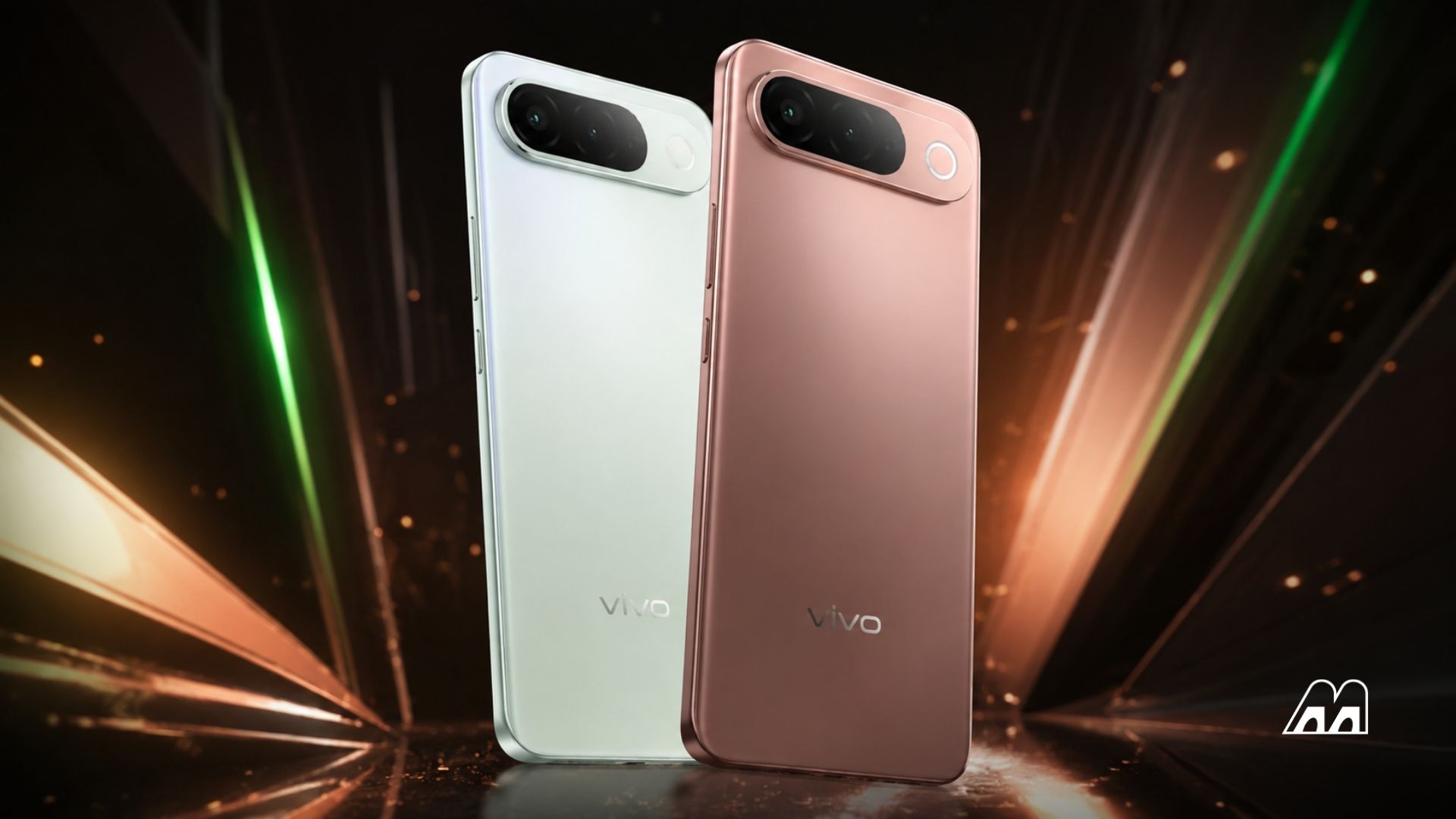
Vivo just confirmed the T5 for September 2 — a phone that scores over 1.2 million on AnTuTu and carries a 144Hz display, both unusual at this price. Here’s every confirmed spec, what Vivo hasn’t revealed yet, and whether it’s worth your attention.
What Makes the Vivo T5 Stand Out
On paper, this phone reads like a mid-ranger that wandered into the wrong price category. The Dimensity 7500 Turbo isn’t a budget processor — it’s the same chip family that powers phones $100 more expensive from competing brands.
But here’s what caught our attention: the design. Vivo’s officially said the T5 “appears nearly identical” to the iQOO Z11 that launched in India earlier this year. That’s not speculation — it’s the same chassis, same panel size, and potentially the same internal board layout repackaged under a different brand. Vivo and iQOO share parent company BBK Electronics, so this kind of hardware recycling isn’t unusual. Whether that bothers you depends on whether you care about exclusivity or value.

We think it’s actually a strength. The iQOO Z11 was well reviewed. Getting its hardware in a Vivo shell — with Vivo’s software experience and distribution — gives buyers a tested foundation at a competitive price.
The 144Hz Display: Does It Actually Matter?
Most phones at this price offer 120Hz. Vivo pushing to 144Hz sounds like marketing — but in practice, the difference shows up during scrolling and gaming. The jump from 60Hz to 120Hz is dramatic. The jump from 120Hz to 144Hz is subtler, but it makes fast-paced games feel noticeably smoother.

The display itself is a 3D curved AMOLED at 1.5K resolution, which means edges wrap slightly for a more immersive feel. Peak brightness hits 2,000 nits. That’s enough for comfortable outdoor use in direct sunlight — not the brightest in the category, but perfectly adequate.
Compared to the Vivo V70 Lite 4G that launched a few days earlier, the T5 shares the same 6.83-inch screen size but adds 24Hz of refresh rate headroom and swaps in a faster processor. The V70 Lite targets markets without infrastructure; the T5 is built for India’s growing networks.
Dimensity 7500 Turbo: Performance You Can Measure
MediaTek’s Dimensity 7500 Turbo is built on a 4nm process and delivers an AnTuTu score above 1.2 million. For perspective, that’s roughly 40% faster than the Snapdragon 695 that dominated budget phones in 2024.

The NPU (neural processing unit) — think of it as the chip responsible for AI tasks — handles 10 tokens per second on a 3-billion-parameter model. That means on-device AI features like photo enhancement, translation, and smart suggestions run locally instead of sending data to a server. It’s not headline AI performance, but it’s enough to keep the phone feeling modern for its update cycle.
One gap worth noting: the base RAM configuration is 6GB LPDDR4X. That’s functional, but in 2026, 8GB LPDDR5 is increasingly the standard at this price. Vivo compensates with up to 8GB of virtual RAM extension — a feature that uses storage to simulate additional memory. It helps with multitasking, but it’s not the same as actual hardware RAM.
Camera: Good Enough, Not Great
The 50MP main shooter with OIS at f/1.79 will handle daylight photography well. OIS is the real win here — it stabilizes shots mechanically rather than relying on software, which means less blur in low light and during video recording.

The 8MP ultrawide is standard for this price tier. Don’t expect much from it beyond basic landscape shots. The 32MP front camera is strong for selfies and video calls — better than what most competitors offer at this price.
Missing from the spec sheet: a telephoto or macro lens. If you need optical zoom, you’ll need to spend more.
Battery and Charging: The Trade-Off
At 7,050mAh, the battery is competitive. It matches the Vivo V80 Lite exactly and should deliver a full day of heavy use or close to two days of moderate usage.
But here’s where Vivo made a choice that’ll divide opinions: 44W charging. That’s slow by 2026 standards, where competitors like the Redmi Turbo 5 and Poco X8 Pro offer 100W. Charging a 7,050mAh battery at 44W takes well over an hour from empty to full. It’s the most obvious compromise Vivo made to hit its price target.
Reverse charging is supported, so you can use the phone as a power bank for earbuds or a smartwatch in a pinch.
IP68 + IP69: Built Tougher Than Expected
Both IP68 and IP69 certification mean this phone can handle submersion in water (up to 1.5m for 30 minutes) and resist high-pressure, high-temperature water jets. The dual stereo speakers round out a feature set that’s built for daily durability.
The phone ships with a case in the box — a small detail, but it’s one fewer accessory to buy on day one.
Who Should Wait for This Phone?
The Vivo T5 makes sense if you prioritize display smoothness and processor performance over fast charging speed. The 144Hz display and Dimensity 7500 Turbo are genuinely better than what most competitors offer at this price.

If charging speed matters more, look at the Poco X8 Pro (67W) or the Redmi Turbo 5 (100W). If raw battery capacity is king, the Poco X8 Power’s 10,000mAh cell launches two days later on September 4.
The expected price of ₹40,000–₹50,000 ($475–$595) puts it in a competitive bracket. Final pricing on September 2 will determine whether this is a strong buy or just an interesting option.
FAQs
How does the Vivo T5 compare to the Vivo V70 Lite 4G that launched recently?
The V70 Lite 4G has a bigger 8,100mAh battery but uses a slower Unisoc T7300 chip and lacks 5G support. The T5 is built for performance and connectivity with its Dimensity 7500 Turbo and 144Hz display. If you need 5G and faster processing, the T5 wins. If you’re in a region without 5G and just need maximum battery life, the V70 Lite costs less.
Is the Vivo T5 good for gaming?
The Dimensity 7500 Turbo handles popular games like BGMI, Genshin Impact, and Call of Duty Mobile at medium-to-high settings. The 144Hz refresh rate gives you a genuine advantage in competitive titles that support higher frame rates. The 7,050mAh battery also means extended gaming sessions without anxiety about running out of power mid-match.
What phones compete directly with the Poco F9 Pro in Vivo’s lineup?
Vivo’s X-series and V-series flagships compete with the Poco F9 Pro in the premium segment. The T5 sits two tiers below, competing instead with the standard Poco X8 and Realme’s P-series. Vivo’s upcoming X500 series is more directly comparable to Poco’s F9 lineup in both specs and pricing.
Does the Vivo T5 support expandable storage?
No. The T5 ships with 128GB UFS 3.1 internal storage and does not include a microSD card slot. If you need more space, you’ll rely on cloud storage. The virtual RAM extension feature uses storage, so the usable space will be slightly less than the advertised 128GB.
How does the Nothing Phone 4b stack up against the Vivo T5?
The Nothing Phone 4b uses a Snapdragon 6 Gen 4 and offers a cleaner near-stock Android experience with its distinctive Glyph interface design. The Vivo T5 counters with a faster 144Hz display, larger 7,050mAh battery, and a higher-resolution front camera. Nothing wins on design identity and software minimalism; Vivo wins on battery life and display refresh rate.














Leave a Reply