For nearly 30 years, people arrested by immigration enforcement officials inside the United States could typically live freely as they waited for the results of their immigration cases. Under the Trump administration, officials have tried to keep them locked up as part of its major deportation campaign. The legality of that approach is now hotly contested in federal courts.
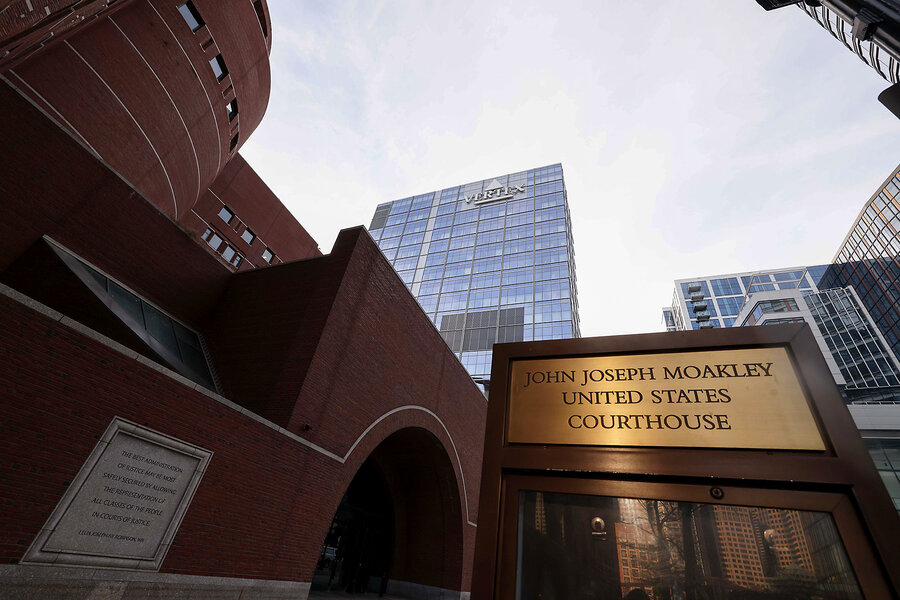
A Boston-based federal appeals court heard oral arguments in one such case Monday. The case could reverberate across New England – and is looking increasingly likely to wind up before the Supreme Court.
The class action lawsuit, Guerrero Orellana v. Moniz et al., deals with whether unauthorized immigrants detained by federal officials in the U.S. interior are entitled to a bond hearing before an immigration judge under federal law. Such hearings determine whether an immigrant can live in the U.S. freely while they fight their deportation, or if they must be jailed until litigation ends.
Why We Wrote This
The legality of the Trump administration’s policy of detaining everyone arrested by immigration enforcement officials – allowing no bond hearings – is splitting federal appellate courts and may wind up before the Supreme Court.
The Trump administration argues that the Immigration and Nationality Act (INA), the nation’s primary immigration statute, requires that any unauthorized immigrant detained on U.S. soil must be held without bond. Jose Arnulfo Guerrero Orellana, an immigrant from El Salvador who entered the country unlawfully in 2013, argues that the government’s position runs contrary to its own long-standing practice and the plain text of the law.
Since Congress reformed the INA in 1996, both Republican and Democratic administrations have treated virtually all immigrants detained within the U.S. as eligible for a bond hearing. But last July, the Department of Homeland Security issued a memo reinterpreting that provision, arguing instead that unauthorized immigrants were subject to mandatory detention. The Board of Immigration Appeals, an appellate immigration court that’s part of the executive branch, reaffirmed that rule in September.
Immigration detentions have surged as the Trump administration pushes its mass deportation agenda. In January 2025, the government held roughly 40,000 people in immigration detention. A year later, it held more than 68,000 people – a 70% increase, according to an analysis of government data by the American Immigration Council. The number of people held in immigration detention for more than a year increased from 938 at the end of October 2025 to 2,084 by the end of March 2026, public reports from U.S. Immigration and Customs Enforcement show.
The arguments dividing courts
Other cases like Monday’s have also reached the nation’s second-highest courts, with mixed outcomes. The 8th and 5th Circuit courts sided with the Trump administration earlier this spring. Last week, the New York-based 2nd Circuit court ruled against the administration, setting up a split and raising the possibility of Supreme Court review.
Monday’s oral argument in Boston hinged on several in-the-weeds questions about how to interpret the language of Sections 1225 and 1226 of the INA. Traditionally, Section 1225 has dealt with inspection, admission, and detention at ports of entry, while Section 1226 has governed the detention of immigrants already residing in the country, lawfully or not.
The sides disagree on whether an “applicant for admission,” which is defined in the statute as “an alien present in the United States who has not been admitted or who arrives in the United States,” is the same thing as someone “seeking admission.” Under Section 1225, an immigrant “seeking admission” who is “not clearly and beyond a doubt entitled to be admitted” should be detained while awaiting proceedings.
The government argues that the phrases are synonymous. “I don’t think that ‘seeking admission’ was supposed to essentially swallow the definition for applicant for admission,” said John Bailey, a lawyer for the Justice Department. “Someone who is an applicant for admission is seeking admission.”
Lawyers for Mr. Guerrero Orellana, by contrast, argue that the two terms are distinct. “What the government has done is import into ‘seeking admission’ this second term,” said Adriana Lafaille, a lawyer for the American Civil Liberties Union. “These terms are doing different things.”
Because Mr. Guerrero Orellana was arrested at a traffic stop in Massachusetts, and was not presenting himself to an immigration official at the border or a port of entry at that time, his lawyers argue that he was not seeking admission.
In other similar cases over bond hearings, hundreds of District Court judges across the country, appointed by both Republicans and Democrats, have by and large agreed with the latter interpretation of the law’s language. A District Court judge in Massachusetts ruled against the Trump administration in this case last year, setting up the current legal clash.
The panel of three judges on Monday asked pointed questions of both sides. Judges Sandra Lynch and Lara Montecalvo repeatedly asked the government to clarify its position on why the statute says “seeking admission.”
“‘Seeking admission’ seems to require some act on the part of an applicant for admission,” Judge Lynch said. “If [Congress] wanted mandatory detention of every applicant for admission, it would be very easy just not to use the phrase at all.”
Judge Joshua Dunlap asked Ms. Lafaille several times if the ACLU’s reading of the law would make parts of the INA superfluous, which judges try to avoid in their rulings. He implied that both parties argue that a statute can use two words to mean one thing.
“That same argument is what I understand both of you to be making,” he said. “You can use similar terms – not the exact same terms – in the same statute.”
U.S. Immigration and Customs Enforcement has already arrested more than 7,000 people in Massachusetts alone since Mr. Trump’s election, WBUR reported, almost five times the number arrested in the last 415 days of the Biden administration. The 1st Circuit’s decisions cover Maine, Massachusetts, New Hampshire, Rhode Island, and Puerto Rico.