
As regulatory requirements continue to evolve, compliance teams face a growing challenge in separating meaningful developments from the noise. Effective horizon scanning is no longer just about identifying what is changing, but understanding what matters, how it affects the business and what action needs to follow. The AI in Risk and Compliance 2026 report – co-authored by RegTech Analyst and Parker & Lawrence Research – delved into how firms can overcome regulatory noise today.
As part of the research for the report, Parker & Lawrence Research interviewed market leaders in the space to discuss the importance of overcoming the noise to build horizon scanning for actionable intelligence.
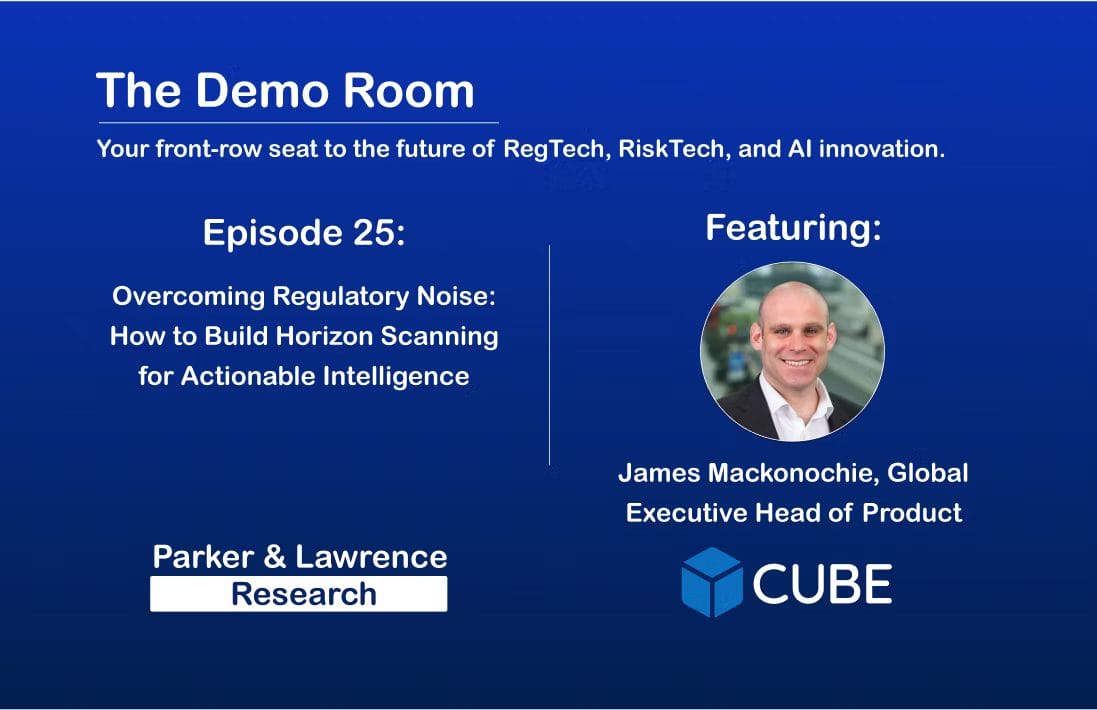
On this occasion, the firm spoke with James Mackonochie, global executive head of product at CUBE, aprovider of AI-powered horizon scanning and regulatory intelligence for financial institutions and other regulated organisations.
This interview was part of the wider AI in Risk and Compliance 2026 report conducted by RegTech Analyst and Parker Lawrence Research. To download the full report, click here.
Regulatory change is often framed as a volume problem. Yet for many compliance teams, the tougher challenge is working out what is actually relevant. A single publication might affect just one product, legal entity or jurisdiction. Another might simply restate an existing position. A third could appear minor yet quietly reshape a requirement that touches multiple policies and processes.
Effective horizon scanning, therefore, is about more than finding content. Firms must understand what has changed, whether it applies to them, who owns the response, and how each decision links back to an authoritative source.
Generative AI has made summarising regulatory text far easier, but it has also raised the stakes. A persuasive answer built on incomplete coverage, outdated context or an unverified source can travel rapidly into policies and controls. According to 2026 research, 57% of respondents rated AI-related risk in compliance management as high or above. Traceability and firm-specific relevance are now as critical as the summary itself.
Many change-management teams still rely on document-level alerts. Specialists must open each publication, judge its significance, compare it with earlier text, identify affected obligations and then distribute tasks across email, spreadsheets, GRC tools and business teams. Global institutions track overlapping regulators in several languages, meaning the same item may be reviewed repeatedly. Broad keyword searches generate noise, while unfamiliar terminology can conceal genuinely relevant change.
Generic AI assistants can shorten reading time, but they do not understand an institution’s footprint, products or priorities. Without that context, a model may deliver an excellent summary of the wrong item. And if AI is prioritising work, users must be able to see why, ensuring regulatory change does not become a black-box filtering exercise.
RegTech firm CUBE aims to close this gap by connecting regulatory intelligence to action. Its platform captures publications from more than 10,000 issuing bodies across 250 countries and territories in 100 languages, translating, classifying and mapping content into a common regulatory schema linked to primary sources. This is backed by over 250 regulatory, risk, research and editorial specialists.
A customer-specific “passport” records each organisation’s footprint, departments, products and services. A background agent then assesses new developments against this profile, recommending which items warrant attention.
Users can view the reasoning, inspect sources and amend outputs. Teams can also trigger impact assessments and workflows in RegFlow directly from RegInsight, while Priorities Coworker creates a timestamped audit trail of what was reviewed and against which obligations.
Early testing suggests CUBE’s agentic coworkers cut horizon scanning noise by around 60% compared with standard AI-powered tools.
Analysts at Parker & Lawrence argue the real test will be proving prioritisation quality, urging buyers to probe recall, precision, missed-change controls and multilingual consistency. As AI interfaces become easy to imitate, trusted data and an unbroken route from source to action may prove the true differentiator.
Read the original post from Parker & Lawrence Research here.
Copyright © 2026 FinTech Global
Investors
The following investor(s) were tagged in this article.












Leave a Reply