

The military services, like most organizations these days, are throwing artificial intelligence at their biggest challenges to see if the technology holds any promise for enhancing mission outcomes.
So far, the results have been mixed: Some applications have returned massive improvements on key operations, while others currently don’t live up to the hype.
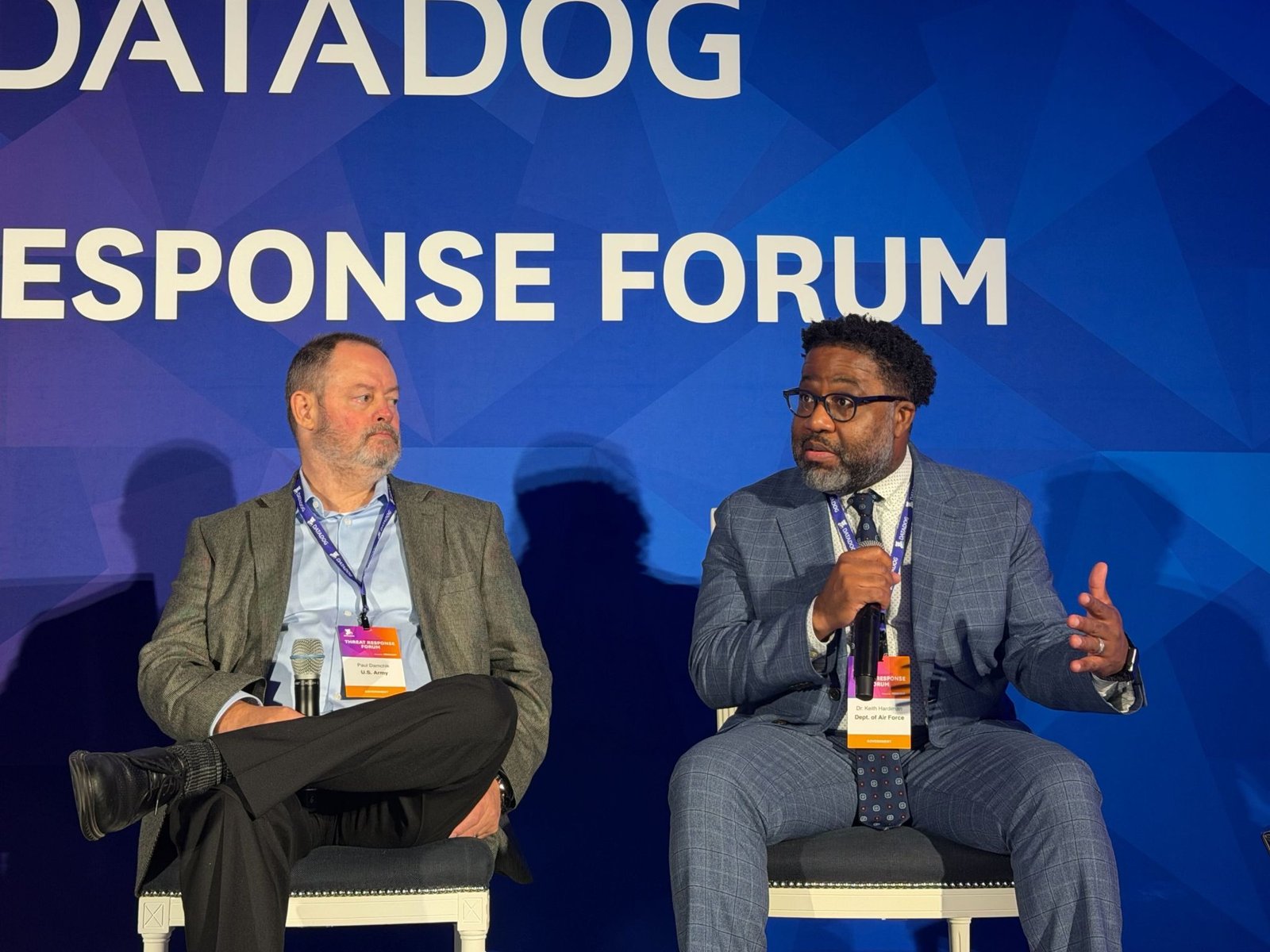
A pair of top IT officials from the Army and the Air Force shared examples of both Thursday at Datadog’s Threat Response Forum, presented by FedScoop, highlighting that while AI can turbocharge processes or ops previously conducted by service members, it’s not a panacea, and some use cases are still better addressed by humans, at least for now.
Paul Damchik, senior technical adviser for Army intelligence community information management for the deputy chief of staff for intelligence, emphatically pointed to automated target recognition as an application where AI “really earned its place in our ecosystem.”
“What used to take analysts days, months to train themselves and then each other, … now the super intelligence and agentic and the large LLMs out there, those models have trained rapidly in no way that a human could do” in a fraction of the time, Damchik said.
The result has been “a huge burden taken off the human analysts” who have had to do the work manually, he explained.
But Damchik said one area where the technology has been continuously overpromised is automated analysis in the intel community.
“Analysis is not just tech or science. There’s some art in there. There’s some training. Yes, we can train models. We can continue to train them, but automated analysis on the intel community side, that doesn’t exist today,” he said. And of course it can aid in research and querying data more rapidly, Damchik reasoned, but it can’t yet replace “what the human mind has to do from analysis because it is science, but it’s also art.”
On the Air Force side, AI has been a “key cog in ensuring that we have timely, accurate data when we need it” and in separating the signal from the noise, said Keith Hardiman, the service’s deputy CIO.
Hardiman took a measured approach to describing the functions of AI, calling it a “true enabler” of human-led operations. Similarly, he said he believes that the hype and overpromise often tied to the technology comes from a “misunderstanding of it.”
“I think we have to look at it from an augmentation standpoint; it’s not a replacement,” Hardiman said. “And I think that’s the misunderstanding of it, and that might be an overpromising interpretation of it.”
Instead, the Air Force has found AI to be most useful in removing personnel from “what we consider non-value activities” and refocusing their time and attention on “bespoke type of human-in-the-loop things,” Hardiman explained.
For example, AI has been a “critical force enabler” for HR and logistics management “on rationalization of application capabilities and just really ensuring that we’re looking at the same pane of truth,” he said.
“So I don’t say it’s overpromising. I say we’re maturing. We’re all growing together. I think it’s talking about the right alignment, the right way we want to go apply it, and how we want to use it further to help us out,” Hardiman said.






Leave a Reply