

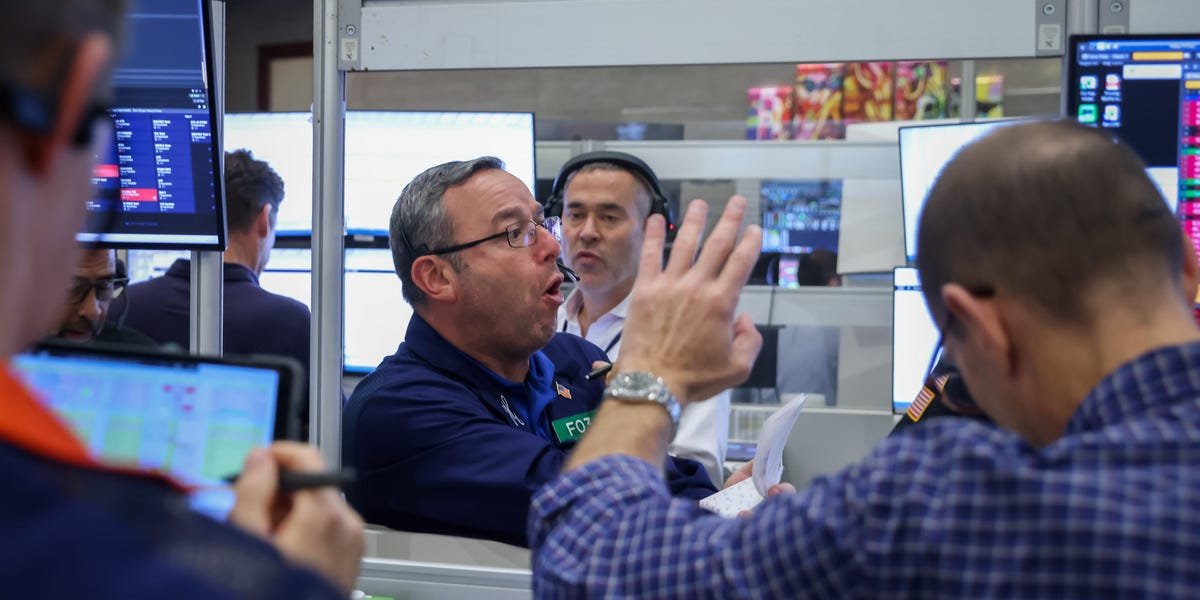
Investors’ postelection euphoria lasted just one day before fears about the AI trade came roaring into view.
Democrats’ sweeping victories on Tuesday sparked a monster postelection rally, but US stocks are now getting pummeled by worries that the blue wave will usher in a new era of tighter regulation for data centers and AI development, with cascading effects for the bull market and broader economic growth.
By the end of Thursday’s bloodbath, the Nasdaq 100 was deep in correction territory, having suffered its worst day since since March 2020.
Here’s where US indexes stood at the 4:00 p.m. ET closing bell:
At the forefront of investors’ anxieties is the idea that newly elected Democrats at the state and federal level will tighten the reins on data center construction, slowing AI capex at a time when investment spending is still powering a significant portion of economic growth and the yearslong bull market in tech stocks.
AI stocks plummeted on Thursday, extending yesterday’s declines for infrastructure firms like CoreWeave and chip makers like Nvidia. But whereas some AI-linked names such as hyperscalers gained in Wednesday’s session, the rout on Thursday battered the AI trade broadly.
The selling accelerated into the afternoon as top lawmakers called for an immediate moratorium on data centers in posts on social media.
The most painful losses were in neoclouds, memory and chip stocks, and data center operators. The iShares Semiconductor ETF, notably, was down 11%, on track for its worst day in six years.
All three benchmark indexes tumbled into the red, on track for their worst trading day since the Liberation Day stock crash in 2025. The Dow, which logged its best day on Wednesday since April 2025, dropped as much as 1,800 points. The Nasdaq 100 lost as much as 6%.
The tech-heavy index is now down 14% from its latest high and officially in a correction. It dropped below its 200-day moving average during the session, breaching a closely watched technical support level.
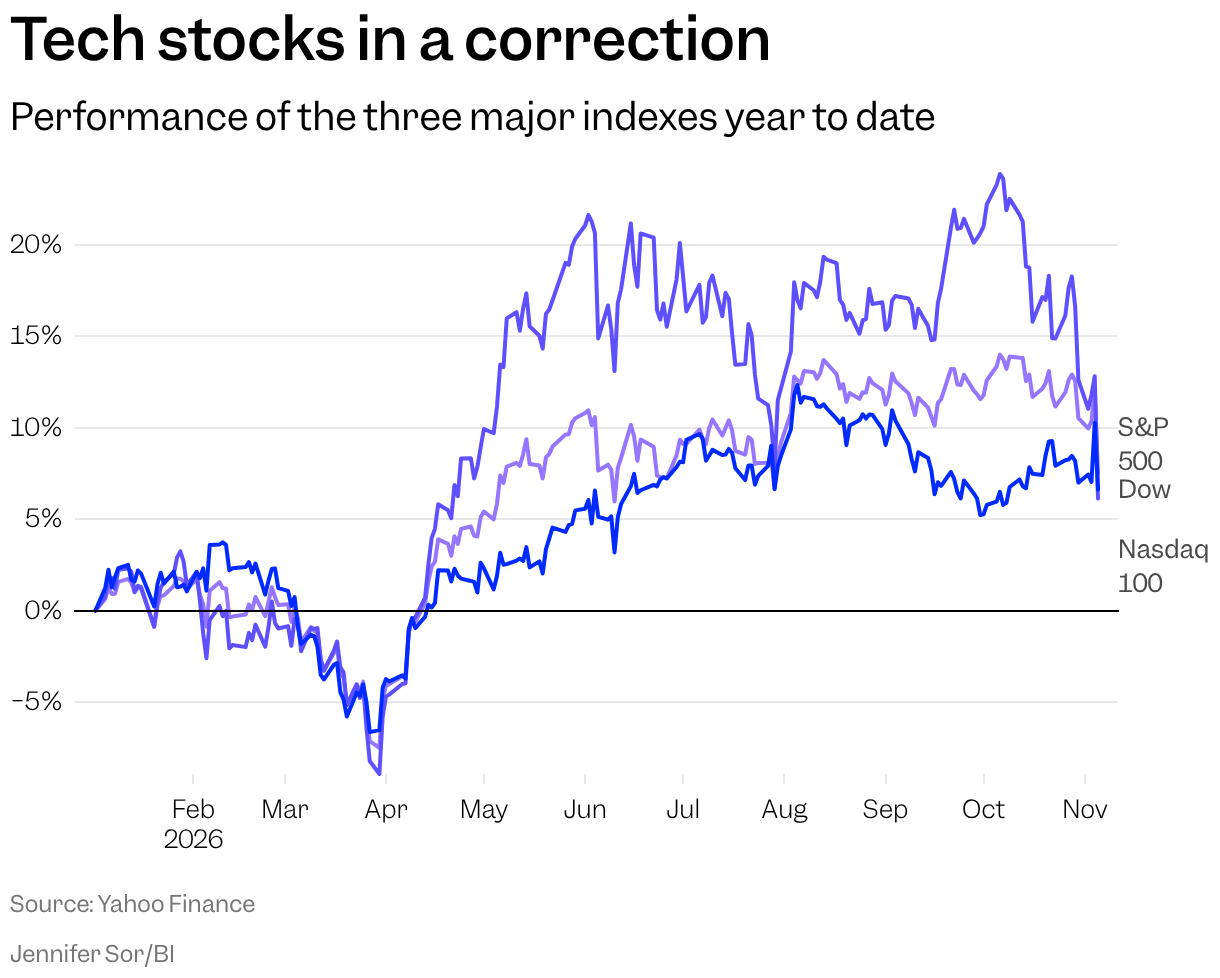
Thursday’s decline has erased the gains logged on Wednesday, when investors piled into hyperscalers on optimism that AI capex will slow, which would be a positive for these companies’ financials. The logic today, though, seems to be driven by a broader risk-off move, with investors looking to reduce exposure to the AI sector amid data center uncertainty.
Traders have also been eager to take profits lately, punishing various hyperscalers after quarterly earnings even when firms beat on the bottom line and signaled greater spending discipline heading into 2027. Retail investors dumped more than $330 million worth of single stocks, marking the biggest day of selling since the pandemic stock crash, according to data from Vanda Analytics.
Here were the most notable moves in the tech sector:
“There’s blood on the streets today as AI-linked names tumble,” Nick Puckrin, a cross-asset analyst, wrote in a note. “The midterm election result didn’t really create a new fear, it was just the gust of wind that pushed over the house of cards that was already getting shaky.”
“The narrative has shifted from ‘AI changes everything’ to the ‘Blue wave means datacenters will never be built again in this country,'” Chris Zaccarelli, the chief investment officer at Northlight Asset Management, said in a note.
Analysts at Jefferies called Democratic Sweep a “Worst-Case Near-Term Scenario” for the AI trade, pointing to the potential for tighter data center regulation. The firm also revised its outlook for data center capacity through the end of the decade downward.
Meta President Dina Powell McCormick also flagged greater difficulties firms would face going forward to build new data centers, adding to investor anxiety.
“What I mean by that is to start new data center build-outs today in the United States will be very challenging,” McCormick said, speaking at the Wall Street Journal Tech conference in California on Wednesday. Meta has emerged as one of the largest players in the data center space, with construction on its $50 billion Hyperion data center in Louisiana and its $14 billion Texas data center underway.
Investors are also wrestling with anxiety about what will happen to the US economy and bull market if investment slows. The market has been increasingly aware that AI is accounting for a growing share of US growth. Data center construction, for instance, was one of the only areas of construction spending that grew in September, soaring 80% while spending in most other sectors declined, according to an analysis from Harvard economist Jason Furman.
“Will the shift in Congress actually slow tech down? If yes (as many assume, though I’m less sure), can the rest of the market and economy thrive without the shield of tech earnings and spending?” top economist Mohamed El-Erian wrote on LinkedIn.
The AI infrastructure space appears to be facing a “reality check,” top economist David Rosenberg wrote in a note to clients on Thursday.
“The question becomes the economic impact as we see, at the least, a pause in the data center construction mania,” he added.
It’s been a volatile week for markets, with investors also slogging through Big Tech earnings and key economic data releases. All eyes will be on the October jobs report coming out Friday, which is expected to shape the Fed’s path for future rate hikes heading into 2027.









Leave a Reply