
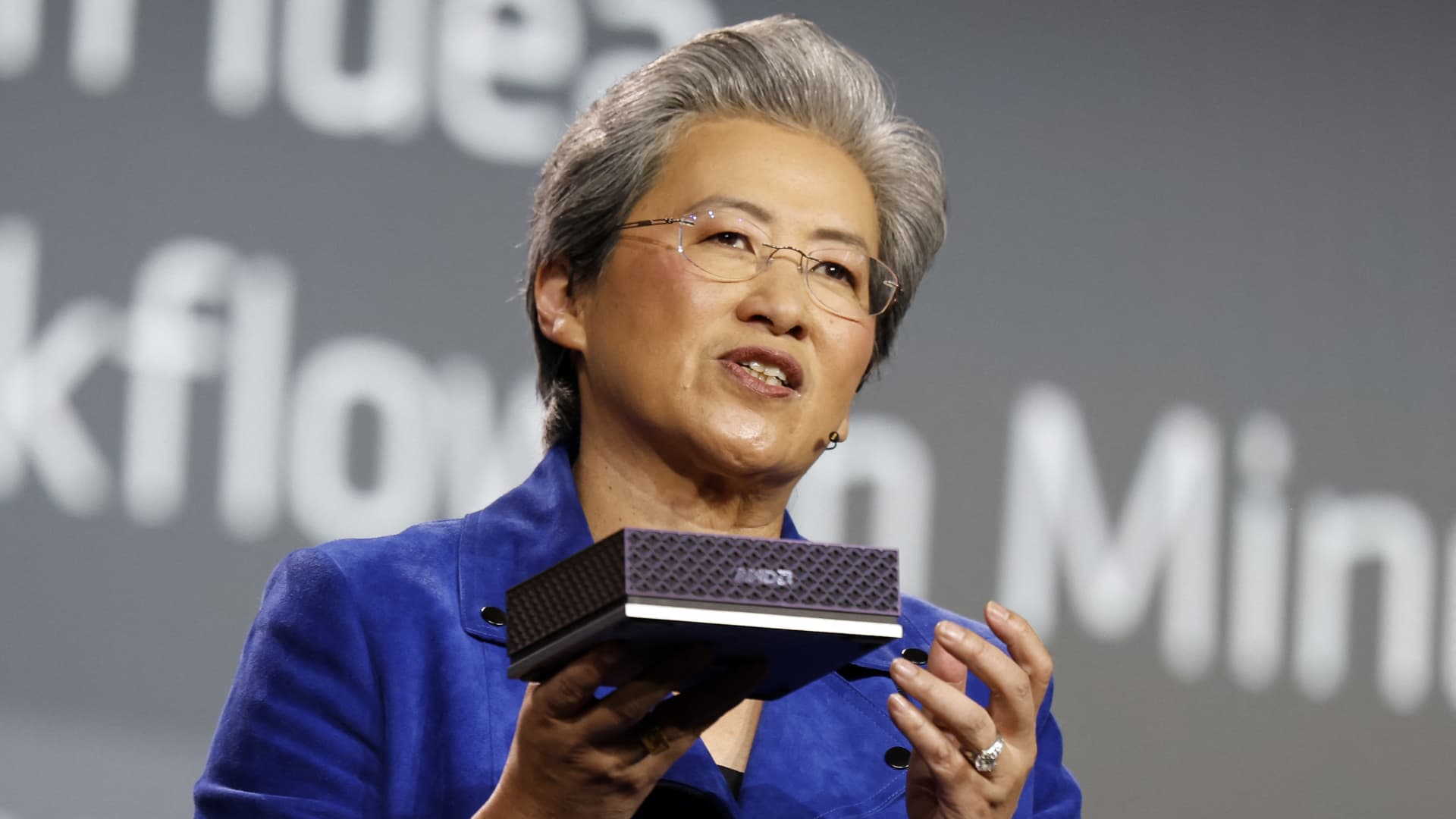
AMD announced on Monday that it has entered into an agreement to acquire World Labs, a San Francisco-based AI lab developing a kind of model called a world model, which can be used to simulate 3D environments.
AMD said on Monday that the lab was acquired for about $8.2 billion in an all-stock transaction. The chipmaker had previously invested in World Labs.
For AMD, it’s the chipmaker’s second-largest purchase on record, following the roughly $50 billion it paid for Xilinx in 2022.
AMD is making its biggest splash yet in the AI M&A market at a time when tech’s largest companies are opening their wallets for top engineering and research talent, even for businesses that are relatively nascent.
OpenAI purchased Jony Ive’s AI devices startup io for about $6.4 billion last year to bring in the famed iPhone designer. Nvidia spent a combined $33 billion on AI chipmaker Groq and open-source platform Hugging Face, buying assets from the former in December and agreeing to acquire the latter this month. And Meta shelled out $14 billion in 2025 for a minority stake in Scale AI in a deal that brought in the startup’s founder, Alexandr Wang, to spin up a new AI division.
AI researchers expect world models will be able to help develop robots and other physically-grounded artificial intelligence applications. AMD plans to keep World Labs separate from its chipmaking business until the transaction closes later this year.
The lab’s research on next-generation models will allow AMD to plan for what its AI chips need to be capable of years in advance.
World Labs was founded by AI researcher Fei-Fei Li, who is widely seen as an AI pioneer as a Stanford professor, and who previously worked for Google leading AI research.
Li will become an AMD’s chief scientist and an executive vice president at the company.
In a demo presented by Li and AMD CEO Lisa Su earlier this year, the two executives showed a World Labs model called Marble creating a three-dimensional scene out of a few images.
“Intelligent agents, whether it’s robots or vehicles or even tools, can learn inside very-rich physics-aware digital worlds before they even need to be deployed into the real one, making them much safer,” Li said at the presentation.
Li, in a social media post on Monday, called Su a “great friend.”
“We’re unwavering in our mission, and even more excited to continue building a world leading frontier research organization that is durable for the decades ahead,” Li wrote.












Leave a Reply