
What shade is your car? Blue? Red? Gray? I like to think of my Kia as a dark gray, but unfortunately I’ve got it all wrong. According to automakers, I’m looking at gravity gray but as far as I’m concerned, we aren’t in space. So, I began to question where are these car color names coming from and why are we overcomplicating gray?
The process of name selection is far more intentional than one could think. Behind every unusual shade is a carefully calculated process involving automotive designers, marketing teams and paint manufacturers.
Color names indicate a lot about a vehicle’s intended personality
These automotive brands aren’t just selling cars, rather they are selling you a personality. Calling a vehicle “blue” tells you what you’re looking at. However, calling it “Velocity Blue” suggests something far greater. It portrays an energetic sporty appeal that goes a step beyond its blue hue. In making these distinctive name choices, automakers are tapping into human psychology. Working to build an emotional connection with buyers to help a car feel less like a mode of transportation and more like an extension of the driver’s identity.

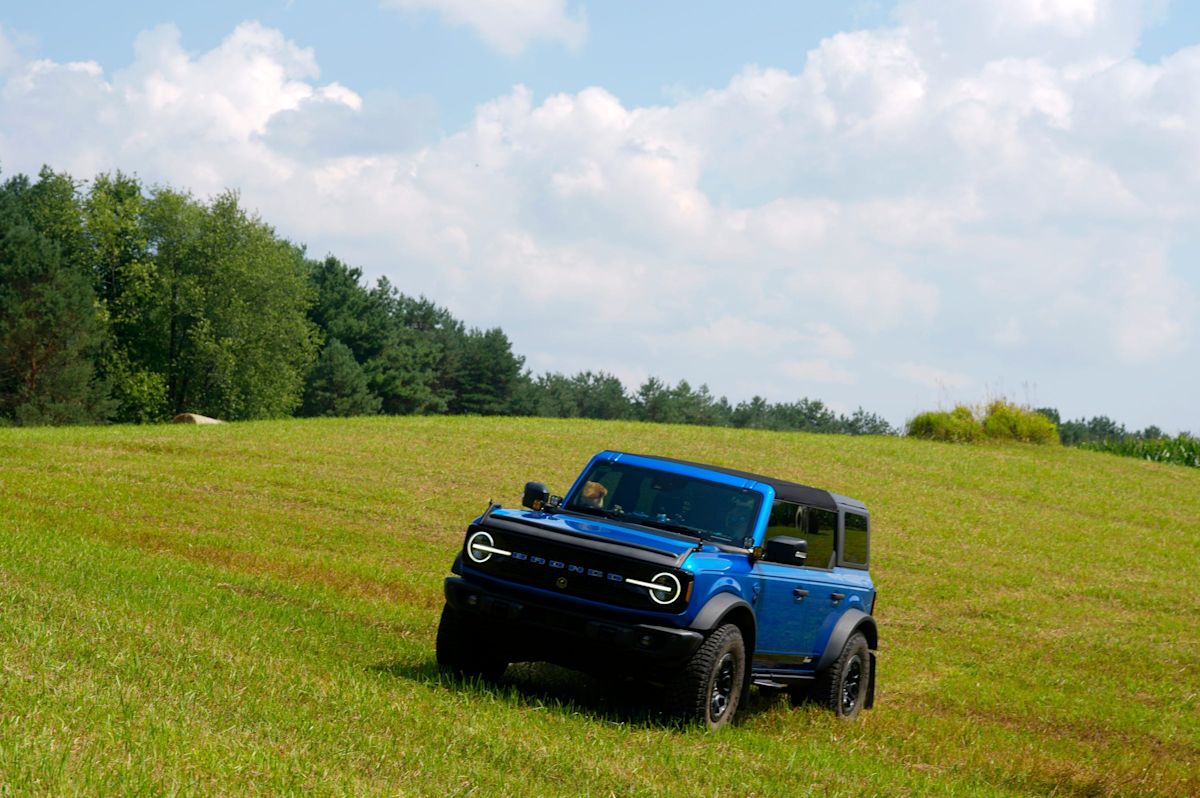
Tamara Gravelle, 60 of Howell, takes her 2022 Ford Bronco Velocity Blue Wildtrak on her large farm property on Wednesday, August 6, 2025.
Terrain-inspired names reinforce a rugged image
Rugged SUVs meant for off-roading adventures will lean towards more earth tone focused color options with names to compliment it. For instance, if you were in the market for a gray hued 2026 Ford Bronco, you could spend quite some time deciding if either avalanche gray or marsh gray was the right fit for you. Both names draw inspiration from natural landscapes and align with the Bronco’s outdoor oriented image.
Color names designed to evoke sophistication
The same strategy applies to luxury vehicles, although the messaging differs. Luxury brands often use color names to evoke sophistication and exclusivity.
Bentley Motors takes the concept a step further by explaining the inspiration behind its colors and the emotions they are intended to evoke. Take, for instance, the shade Portofino. While many people might simply call it blue, Bentley says the color “captures the reflections and undercurrent tonal accents of the Mediterranean Sea.”
Bold names to take on any race
Sports cars follow a similar formula. Automakers want to reinforce qualities such as performance, speed and exclusivity. That’s why many sports cars are offered in bold colors with equally bold names. Take for example Ferraris, Rosso Corsa, which translates to ‘Racing Red’ or Ford’s ‘Tangerine Scream’ to describe orange. Both are intentionally crafted to evoke an emotion of high-energy, aggression and loud personality to draw in the attention of those looking for their next race.

The 2026 Chevrolet Blazer EV SS trim starts at $62,495, according to General Motors.
Shaping the shopping experience
Automakers strive to create a complete experience for consumers, crafting a narrative in every detail, even when it involves something as simple as a paint color. These names transform a color into part of a vehicle’s identity, giving buyers another way to connect with what they drive.
So while I look outside at my otherwise ordinary gray SUV, I can’t help but wonder what its designers hoped to convey when they named it Gravity Gray. Maybe it’s meant to feel futuristic or sophisticated. Or maybe it’s proof that, in the automotive world, even gray doesn’t have to be just gray.
This article originally appeared on USA TODAY: Ever wonder why automakers give car colors such obscure names? We do too












Leave a Reply