
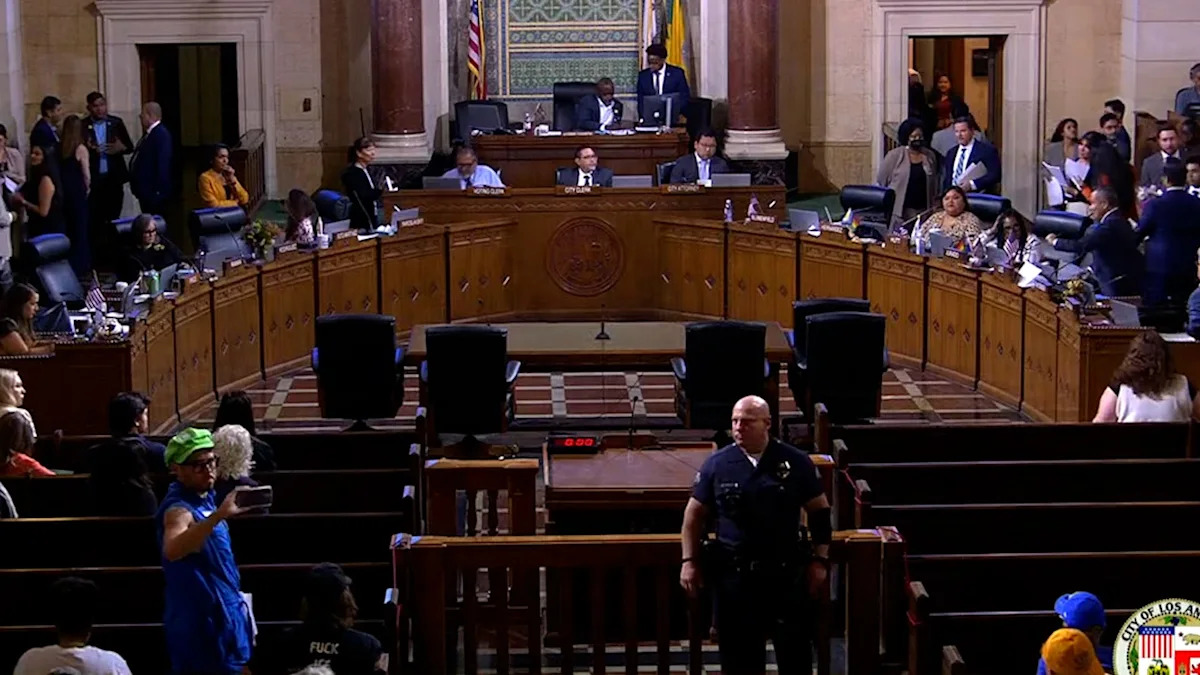
Free-speech groups are suing Los Angeles over its city council’s ban on using the N-word and C-word during public comments at meetings.
The council approved a motion that put the ban in place in summer 2025, which said it was necessary because both the N-word and C-word, a crude term often used to disparage women, had been used and disrupted the meetings “on many occasions.”
The Foundation for Individual Rights and Expression and the First Amendment Coalition sent a joint demand letter to the council in July that called the move unconstitutional and said they intended to sue if the council did not repeal it within 30 days.
The organizations are representing Los Angeles resident Stacey Segarra-Bohlinger in the lawsuit, filed in U.S. District Court for the Central District of California on Oct. 6. Segarra-Bohlinger serves on the Sherman Oaks Neighborhood Council and has used unorthodox means of expressing her opposition to the word ban at city council meetings, such as using the C-word while singing to the tune of the “Ghostbusters” theme song or Adele’s “Someone Like You.”
After being warned for doing so at an October 2025 meeting, Segarra-Bohlinger used the term during her comments at another meeting in early December. Council President Marqueece Harris-Dawson gave her another warning and then expelled her when she used the final second of her allotted time to repeat the word. Citing both the council’s word ban and its decorum rules, Harris-Dawson said she was banned from all other meetings that day.
The federal lawsuit alleges that the council’s ban violates the First Amendment right to the freedoms of speech and petition, as well as the Ralph M. Brown Act, a California law that allows legislative bodies to remove meeting attendees based on “behavior that actually disrupts, disturbs, impedes or renders infeasible the orderly conduct” of the proceedings.
Among other requests, the groups asked the court to declare that the council’s effort to ban participants from using certain words and block them from public meetings over doing so is unconstitutional and prohibit it from taking such actions moving forward.
USA TODAY reached out to the city and its council members for comment on the lawsuit.
A spokesperson for Harris-Dawson previously told USA TODAY the rule was “not a ban on offensive speech in general, nor does it limit the public’s right to criticize, protest, or speak passionately.”
“Instead, it draws a line at language that, by consistent and documented use, has disrupted the Council’s ability to conduct public business and discouraged public participation,” the spokesperson said.
Los Angeles residents representing various organizations and neighborhood councils previously told USA TODAY the words are regularly used during city council meetings and described them as upsetting incidents that distract from the important topics at hand.
The free-speech groups, though, say such concerns cannot outweigh the First Amendment implications.
“While the council is free to condemn speech it considers offensive, the Constitution prohibits the council from silencing it,” FIRE attorney Zach Silver said in the organizations’ joint Oct. 6 news release. “Giving government officials the power to decide which words people are allowed to use is exactly the kind of censorship the First Amendment is meant to prevent.”
David Loy, legal director of the First Amendment Coalition, similarly said the First Amendment “means the government can’t tell people how they can criticize the government.”
“This kind of censorship is a threat to everyone’s freedom of speech,” Loy said.
BrieAnna Frank’s role covering First Amendment issues at USA TODAY is made possible by a collaboration among Freedom Forum, Journalism Funding Partners and the USA TODAY Network. Freedom Forum does not provide editorial input. Reach BrieAnna at bjfrank@usatoday.com and @brieannafrank on X and Bluesky.
This article originally appeared on USA TODAY: Free-speech groups sue over LA council’s ban on N, C-words in meetings





Leave a Reply