
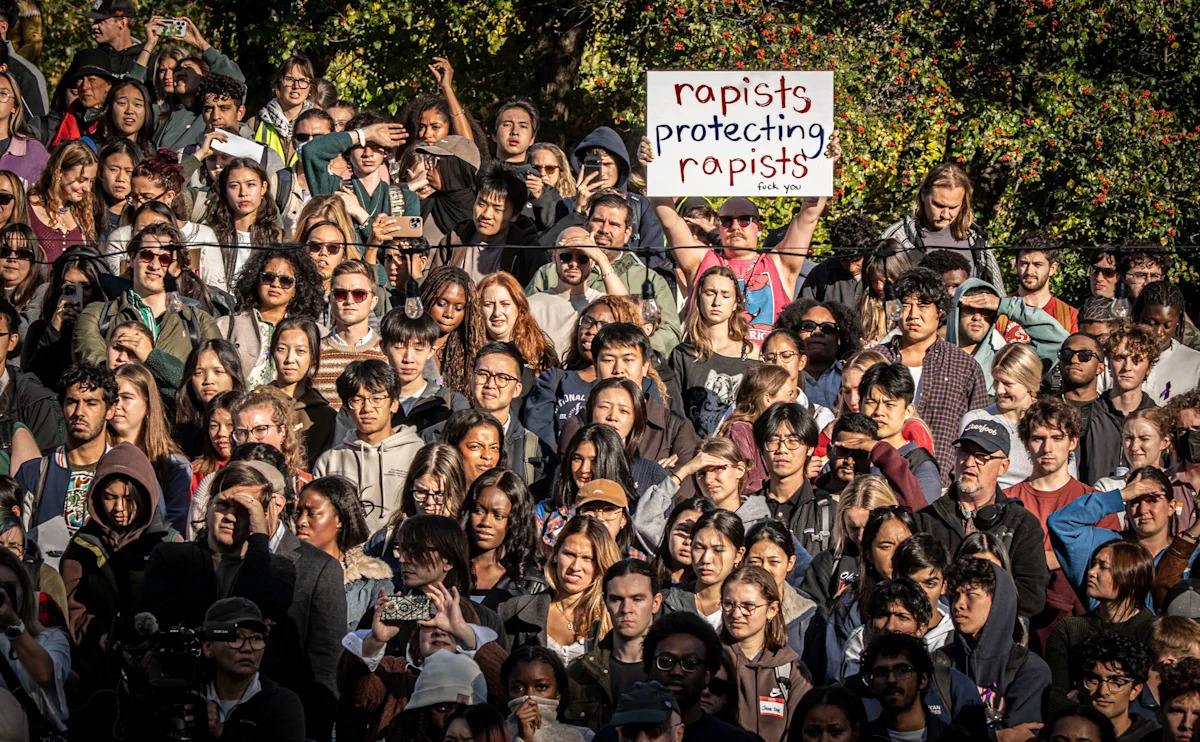
Survivors of sexual abuse, students, and advocates will hold walkouts, rallies, and vigils in communities and on college campuses in more than 40 states on Oct. 8 in response to Cornell University’s handling of allegations that a student was gang-raped by fraternity members in 2024.
The more than 150 expected nationwide events are titled #StopSexualViolence: From the Frat House to the White House National Day of Action. The organizers include Women’s March, Feminist, Feminist Generation, and me too International.
Students on more than 50 campuses are expected to walk out of class, Women’s March executive director Rachel O’Leary Carmona told USA TODAY.
The actions follow the filing of a Sept. 16 lawsuit by a young woman known anonymously as Jane Doe. The lawsuit alleges she was gang-raped on Oct. 19, 2024, by seven members of Cornell’s Chi Phi fraternity while she was too intoxicated to consent and after being pressured into taking ketamine.
All have denied wrongdoing and have not been charged with crimes. Their fraternity, Chi Phi, has been barred from campus.
Cornell President Michael Kotlikoff has called the assault allegations “deeply disturbing” and “a defining moment” in Cornell’s history. On Oct. 6, the university announced it had retained Sally Yates, a veteran prosecutor and a former acting U.S. attorney general, to review its sexual assault policies and procedures.
Carmona said she is hoping for changes across the nation.
“I do hope that this is the moment that is kind of a break-glass moment for our society to reckon with the spreading sexual violence and domestic violence and just gender-based violence that women have been experiencing in increasing numbers,” she said.
‘This is a rapid response’
There was an outcry from women and activists to do something, Carmona said, and the locally organized events quickly came together.
“This is a rapid response. And so it’s not going to be the size or shape of a big mobilization that might take months to plan. But I do hope that we see a very firm rejection of the type of coercive control that men in positions of power are trying to exert over women,” she said.
Several large protests are expected, including in New York City’s Foley Square; outside the New York State Supreme Court, where Jane Doe filed her civil lawsuit; and in Ithaca, New York, where Cornell is located.
The protests will also focus on a Louisiana State University student who alleged on TikTok that she was raped by an LSU football player in October 2025, saying “LSU does really protect their athletes, especially their football players.” The accused athlete has maintained his innocence.
Meanwhile, the East Baton Rouge District Attorney’s Office announced last month that it had opened a criminal investigation. LSU President Wade Rousse said the university was taking the allegations “very seriously” and that the school would be fully cooperating with the police’s investigation.
“In this moment right now, it’s students that are bringing us to a moment of action,” Carmona said.
‘Baffling’: Early Cornell rape investigation troubles experts
Cornell student: Oct. 5 protest represents ‘tipping point’
Major events are also planned in Philadelphia, Los Angeles, Seattle; Baltimore, Boston, Lexington, Massachusetts, Syracuse, New York, Orlando, Huntsville, Alabama, and Anchorage, Alaska. Other events can be found on the Women’s March website.
In Washington, DC, people will gather at 6 p.m. on the north lawn of the Washington Monument, which faces the White House, to hear from women who have accused President Donald Trump and Jeffrey Epstein of sexual assault.
Ky Polanco, cofounder of FEMINIST, said in a statement that millions of people are engaging online about sexual violence, but “this National Day of Action matters so much: it takes our action offline and into the streets, where we demand accountability with our bodies and our voices. We won’t let these systems continue to harm us, and we won’t stop until every survivor receives the accountability and justice they deserve.”
The actions come on the heels of a string of protests by Cornell University students who are critical of the school’s handling of sexual assault cases. Participants are calling on the university to make changes to how it handles abuse allegations.
Meanwhile, they hope what has happened will inspire a national conversation.
‘Speaking as a fellow Jane Doe’: Cornell students say alleged rape case reopened old wounds
Max Klinefelter, a sophomore studying bioscience, said the Oct. 5 protest at Cornell represented a “tipping point.” He added the most productive conversations he’s had since Jane Doe filed her Sept. 16 lawsuit were broadly about rape culture across the United States.
“I want to hear people that have interest in doing something,” the 20-year-old said. “I need some action.”
Athena Holloway, president of the school’s NAACP chapter and one of the lead organizers of the Cornell protests, urged people on Oct. 5 not to return to business as usual.
“Hope is what allows us to imagine something better than what we have now. So, it’s our responsibility to carry that hope forward, to turn it into movement,” she said. “Today, we demonstrated that we are courageous.”
This article originally appeared on USA TODAY: Nationwide demonstrations planned in wake of Cornell sexual assault case











Leave a Reply