
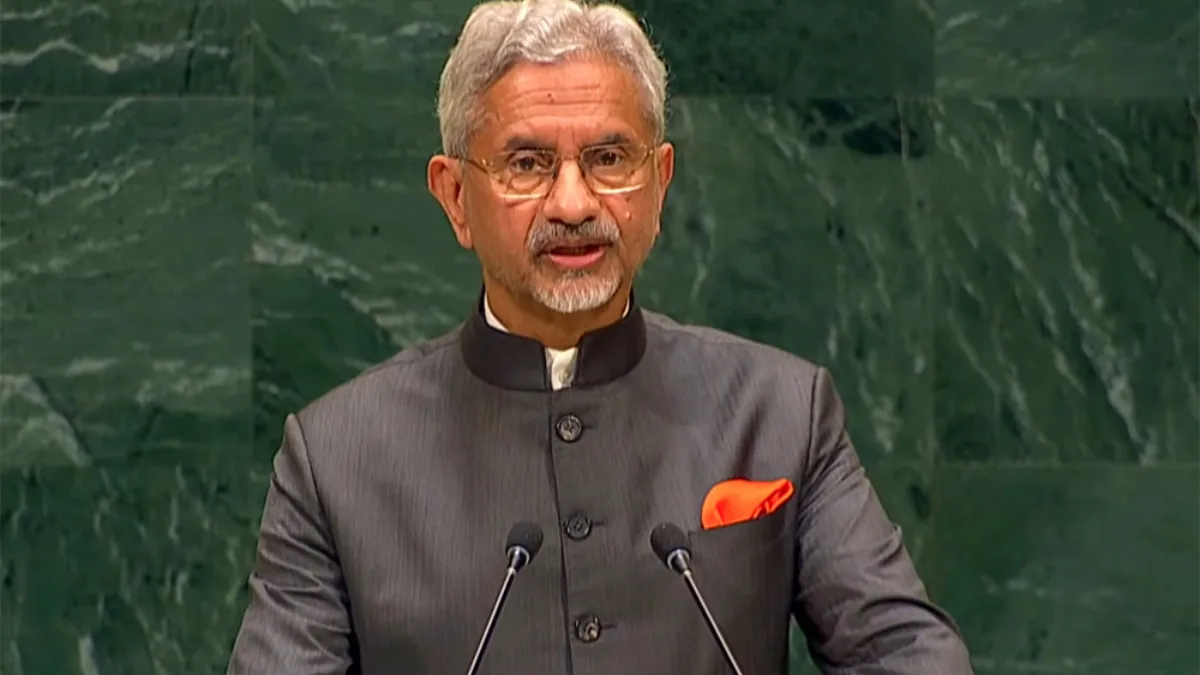
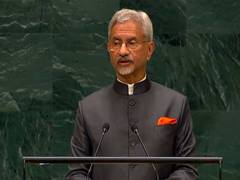
From calling out a “serial practitioner of terrorism” to warning of the “weaponisation of everything”, External Affairs Minister S Jaishankar on Saturday used his address to the 81st United Nations General Assembly to spell out India’s position on some of the biggest fault lines confronting the world.
Pakistan and cross-border terrorism drew some of his sharpest words. But Jaishankar’s message went much further. He addressed continuing conflicts in the Gulf and Ukraine, argued that nations should have the right to shape their own artificial intelligence ecosystems and sounded an alarm over a “4F crisis” confronting the Global South.
Advertisement
He also said the post-1945 global order was giving way to new realities and renewed India’s call for reform of international institutions as the world becomes increasingly multipolar.
Here are five key takeaways from Jaishankar’s UNGA address:
1. ‘Serial practitioner of terrorism’: Jaishankar’s sharp warning
Jaishankar reserved some of his strongest language for terrorism, asserting that India would exercise its right to defend itself and rejecting attempts to normalise terrorism or seek immunity from its consequences.
“Yesterday, a serial practitioner of terrorism misrepresented facts before this assembly. Arguments were invoked to normalise terrorism and claim immunity from its consequences. That will not stand. Our right to defend ourselves against terrorism will be exercised,” he said.
Jaishankar did not name Pakistan in that sentence. The remarks, however, came a day after Pakistan Prime Minister Shehbaz Sharif addressed the General Assembly. Sharif had referred to Kashmir and the 2025 India-Pakistan conflict in his speech.
Jaishankar also made it clear that New Delhi did not see normal relations and continued terrorism as compatible.
“Friendship and goodwill cannot coexist with terrorism,” he said, putting the onus on the perpetrator to “mend its ways”.
He described state-sponsored terrorism with a cross-border purpose as a direct challenge to the global order. Governments engaged in such practices must be held accountable, he said.
Jaishankar also called for zero tolerance towards terrorism and said its financing must be exposed and countered.
2. ‘Weaponisation of everything’: Jaishankar warns of a trust deficit
One of the most striking phrases in Jaishankar’s address came as he described an international system increasingly driven by competition and leverage.
“What we are actually seeing is a weaponization of everything,” he said.
He cited finance, market access, supply chains and technology among areas being used as instruments of pressure. Resources and connectivity were also increasingly subject to such leverage, according to the minister.
Countries were responding by trying to reduce risks and diversify their relationships. But Jaishankar warned that this was coming at a wider cost.
The international atmosphere, he said, was no longer characterised by trust and goodwill.
The argument formed part of his broader assessment of a world undergoing a redistribution of economic and political power.
“We are now well on our way towards a multi-polar world. The post-1945 order is giving way to new realities,” he said.
Jaishankar acknowledged that adjustment to the emerging order would not be easy, but argued that large sections of humanity could not continue to be excluded from international decision-making.
“The case for reformed multilateralism only gets stronger day after day,” he said.
3. Gulf to Ukraine: ‘Endless war must give way’ to peace
Jaishankar also focused on the costs of continuing conflicts, particularly for countries that are not directly involved in them.
“Countries far from conflicts are being penalised for no fault of theirs. Those most impacted often have the least say,” he said.
On the conflict in the Gulf, Jaishankar called on all sides to exercise restraint, reduce tensions, protect civilians and ensure that energy and commerce could continue to flow without disruption.
He also condemned attacks on commercial ships and seafarers in international waterways.
Indian seafarers were among those who had lost their lives in such attacks, Jaishankar said. He described the targeting of commercial shipping and seafarers as “completely unacceptable”.
India has joined Liberia and 23 other partners in an initiative focused on the safety and security of shipping and seafarers.
Turning to Ukraine, Jaishankar backed continuing efforts to secure peace and invoked Prime Minister Narendra Modi’s message that “endless war must give way now to an end to war”.
On West Asia, he reiterated India’s support for a two-state solution, with Israel and Palestine living alongside each other as sovereign states. India was also contributing humanitarian assistance for Palestinians, he said.
4. Every nation should have the right to shape its AI ecosystem
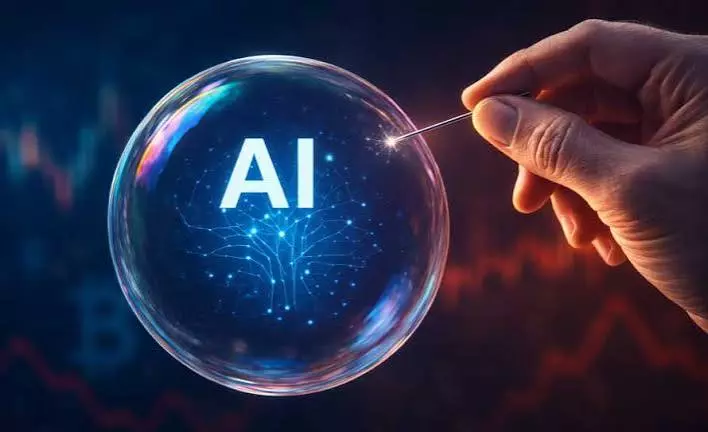
Jaishankar used another major global debate — artificial intelligence — to argue for greater national choice.
“We believe in the right of each nation to shape its ecosystem, with the development of its own models and deployment strategies, consistent with its national goals and priorities,” he said.
He described AI as a transformational driver capable of advancing human empowerment and economic prosperity and solving problems at population scale.
India, he said, intends to make AI part of its partnership agenda with the Global South.
But Jaishankar also warned about the risks surrounding the technology. Its misuse was sharpening bias and weakening mutual respect, he said.
His remarks effectively placed national priorities at the centre of India’s approach: countries should have room to determine the models they develop and how the technology is deployed rather than be pushed towards a single path.
Jaishankar also connected technological access with a wider need for respect between countries. Greater consideration for the interests and viewpoints of others, he argued, could improve the prospects for peace.
5. ‘4F crisis’: Jaishankar sounds alarm for Global South
Jaishankar devoted another major part of his address to pressures facing developing countries.
“The predicament of the Global South, is particularly acute. It faces a 4F crisis – of the security of food, fuel, fertilizer and finance,” he said.
He cited a super El Niño, fertiliser shortages and obstacles to the movement of grain among the causes for concern.
Progress towards the Sustainable Development Goals was under increasing pressure, he said. Developing nations’ ability to industrialise was also being hurt by non-market practices and restrictions on access to markets.
Against that backdrop, Jaishankar presented India’s domestic development and overseas partnerships as part of its response to challenges confronting the Global South.
He said India’s progress in health, nutrition, education and basic infrastructure had improved the prospects of one-sixth of humanity.
India’s digital public infrastructure was also being used to deliver socio-economic benefits, he said.
Jaishankar pointed to 600 major Indian development projects across 78 countries, covering areas ranging from infrastructure and manufacturing to agriculture. African countries and small island developing states were among India’s preferred partners.
India had also supplied medical assistance to conflict zones and countries affected by epidemics and natural disasters, he said.
The five themes eventually converged on Jaishankar’s broader argument: a more multipolar world requires international institutions that better represent countries whose economic and political weight has grown.
“Large sections of humanity cannot be excluded from that process,” he said.
He closed the address with Mahatma Gandhi’s words: “There is no way to peace. Peace is the way.”



Leave a Reply