
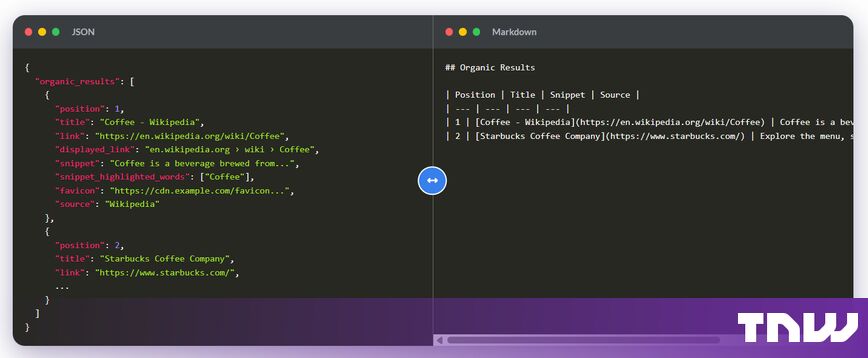
Across the infrastructure layer that powers AI applications, Markdown has been emerging as a new standard. More providers are turning to it as the default output for anything a model needs to read, and moving beyond JavaScript Object Notation (JSON) as the go-to, one-size-fits-all format.
This real, ongoing shift reflects how large language models are trained, how chat interfaces render answers, and how developers actually build with tokens, context windows, and cost in mind. And there is good reason for this adoption.
Markdown fits how models work
Large language models have been trained on enormous amounts of Markdown. Think of documentation sites, README files, technical blogs, forum threads, knowledge bases and so on. That exposure means models already speak Markdown fluently; they know how to analyze its headers, lists, tables, and code fences, and treat them as semantic signals rather than noise.
At the same time, user-facing chat interfaces can already render answers from Markdown. When a model outputs Markdown, the front end can display it cleanly without extra transformation. When the same model ingests Markdown, it receives information in a form that mirrors its training distribution and the way it is expected to respond. The result is a more natural input-output loop than feeding models dense, nested JSON that must be mentally unpacked before use.
If you look at things from a token perspective, Markdown is also the leaner approach. It strips away structural overhead and keeps the informational payload. For AI agents that must fit large amounts of context into a limited window, that efficiency translates directly into more relevant content per request and lower cost per inference.
A visible trend
The move to Markdown isn’t speculative either. It’s already being encoded in best-practice guidance from major model providers. OpenAI’s prompt engineering documentation explicitly recommends structuring developer messages with Markdown headers, bullet lists, and tables where helpful. The guidance advises using ‘##’ for major sections, inline backticks for code, and clear hierarchical formatting to improve model compliance and readability.
Third-party prompting guides are echoing this same pattern. They use Markdown headings to create section breaks, lists for enumerations, and tables for comparisons. Several analyses note that Markdown is more token-efficient and more naturally understood by models trained on documentation, which makes it a preferred formatting tool for complex prompts, especially with newer GPT-5 series models.
Infrastructure providers agree
API and data providers have also been won over by Markdown. Where JSON once ruled as the universal interchange format, many are now offering Markdown variants optimized for LLM consumption. The rationale is exactly the same: they want to reduce token bloat, simplify parsing for agents, and align with how models are prompted and how answers are displayed.
SerpApi, a nine-year-old, search-data API company, recently launched Markdown output across all 100+ of its APIs at no extra cost. SerpApi serves developers, researchers, and Fortune 500 companies with structured insights from Google, Bing, YouTube, and other sources. The feature lets developers request search results in a token-light Markdown format instead of JSON, aimed specifically at AI agents and LLM-powered applications. No new endpoint is required, and the format is requested via a query parameter, route extension, or header on existing integrations.
In a real-world example from SerpApi’s own benchmarks, a single Google search for “coffee” costs 24,723 tokens as JSON and 6,435 tokens as Markdown, adding up to a 74% reduction. When combined with field filtering, the same response dropped further to 1,298 tokens. Across its APIs, SerpApi reports average token savings of roughly 50%, with some endpoints seeing reductions of up to 90%.
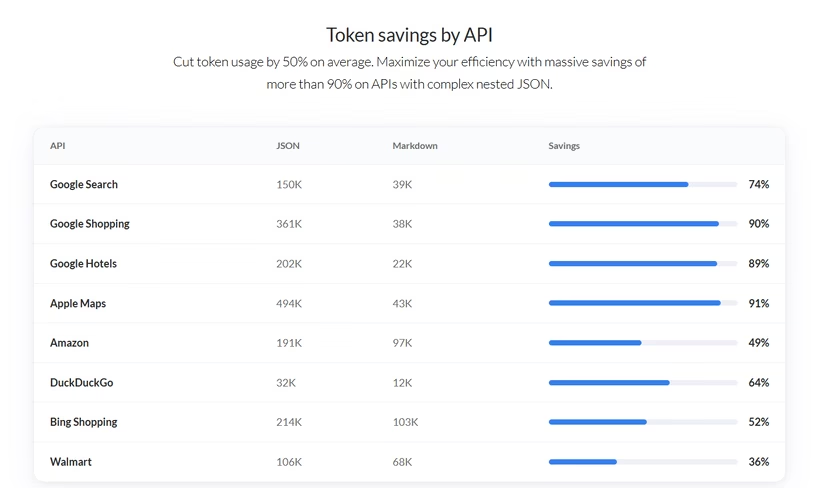
These numbers matter because search results are among the noisiest, most nested payloads that agents ingest. JSON responses carry redirect links, favicons, tracking parameters, and deeply nested metadata that models do not need to reason over. Markdown output, in contrast, preserves the core information, such as titles, snippets, links, prices, and ratings in tables and lists while automatically stripping much of the internal tracking noise and duplicate fields.
Developers can access the new Markdown format by adding ‘output=md’ to the query string, calling the ‘/search.md’ route, or setting an ‘Accept: text/markdown’ header. The responses include YAML frontmatter for metadata, structured Markdown tables for result sets, and native inline links, all designed to be dropped directly into prompts or agent memory.
What this all means
As more of the web gets consumed by agents instead of humans, the infrastructure layer will increasingly optimize for machine readability over human-friendly nesting. JSON remains essential for programmatic manipulation and strict schema enforcement, but for the context ingestion phase of AI workflows, Markdown is emerging as the new default.
In the coming months, one should therefore expect more data providers to offer Markdown variants of their responses, especially for search, e-commerce, maps, and content APIs where token efficiency has an immediate impact on cost and performance. Prompt templates and agent frameworks are also likely to standardize on Markdown sections, tables, and lists as the canonical way to present retrieved context to models. Tooling should also evolve around measuring and minimizing token footprint, with Markdown as a primary lever.
For developers building with LLMs today, the writing is on the wall. When feeding external data into models, one should prefer formats that match how models are trained and how they output. Markdown is no longer just a documentation tool. It’s becoming the new lingua franca between search data and AI models.














Leave a Reply