
“We’re all worried. There are people who are getting close to retirement and want to be able to get there,” he said.

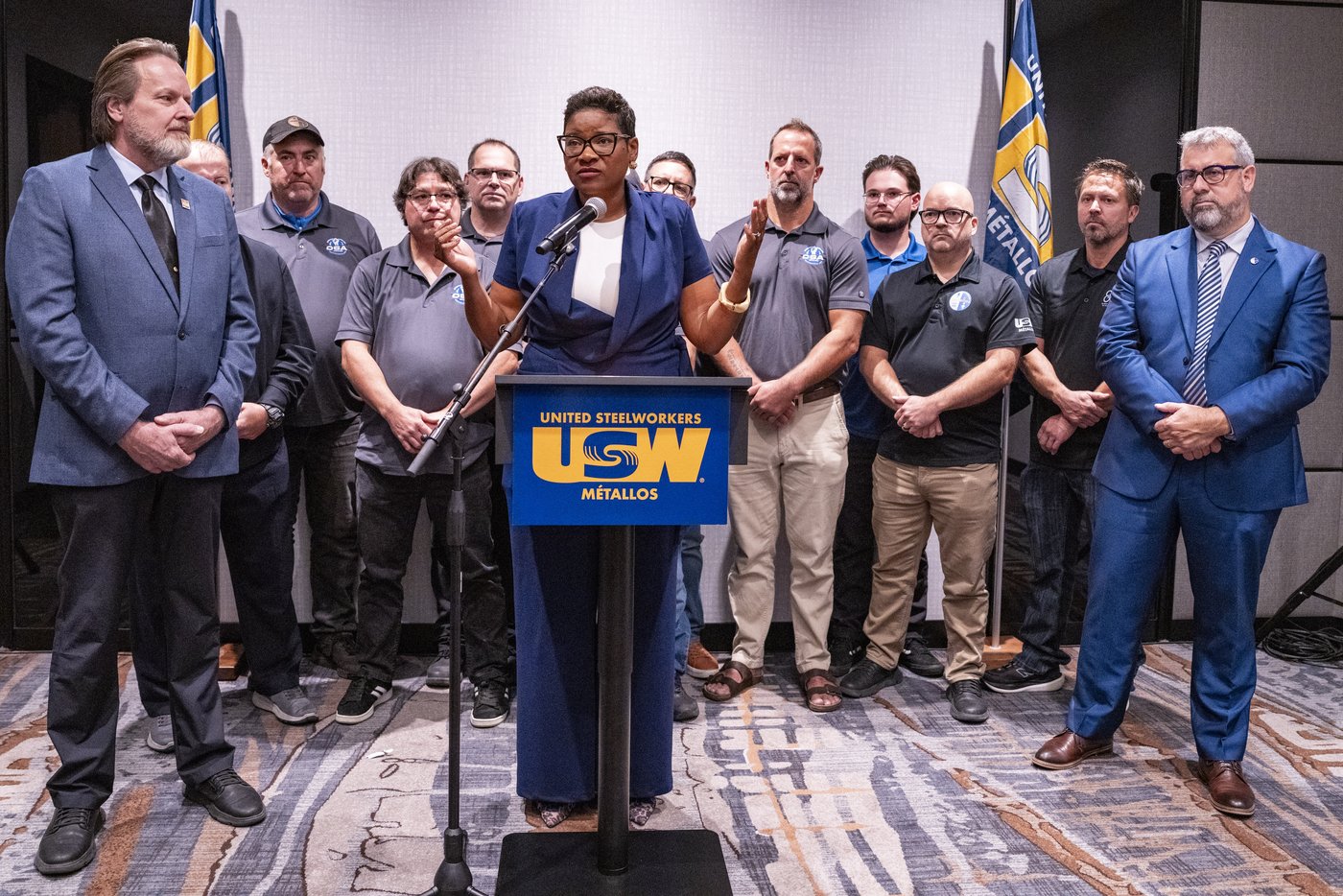
On Tuesday, Roxanne Brown, the international president of the United Steelworkers union, gave a press conference about U.S.-Canada relations in Laval, north of Montreal.
The United States imposed 50 per cent tariffs on steel this summer, and Canada responded with equivalent counter-tariffs.
Brown said the North American steel industry depends on cross-border collaboration between the two countries.
“When the steel worker in Pennsylvania loses work because of market disruption, workers in Ontario feel it. When an aluminum worker in Quebec faces uncertainty, workers in Ohio feel it,” she said.
Industries like defence and transport depend on steel workers on both sides of the border, she said. She pointed to the example of submarines made in Virginia and equipped with sonar and radar systems from Nova Scotia.
Brown called on the Canadian and American governments to resume trade negotiations.
“Put workers first. Return to meaningful dialogue. Resolve this dispute. The relationship between our countries is too important to be defined by division,” she said.
She said North American leaders should be focusing on international competition from markets like China.
China is producing more steel than it needs, and the surplus is flooding international markets at low costs and hurting the North American steel industry, she said.
“We can literally sit here all day and talk about what’s happened to the steel industry, to the aluminum industry, the pulp and paper industry, to the glass industry, to the container industry, to the box industry, to the … I can go on and on,” she said.
She said neither country has done enough to address these issues to protect North American manufacturing jobs.
Alain Duhamel, a local branch president of the union working for metal tubing manufacturer Nova Tube, also asked the Canadian government to do more to support steel workers.
Over the last few years, the Canadian government has put in place multiple measures to support the steel industry, including a $100-million program to support interprovincial steel trade and $70 million in support for steel workers through the Workforce Tariff Response program.
While Duhamel acknowledged the support they have already received through subsidies, he said some of these measures came too late.
“We’re asking (the Canadian government) to inject in the market and to (create more measures) for the workers who were involved and were laid off,” he said.
Another local president, Jason Braconnier, works at steel transformation mill ArcelorMittal, which sends about 30 per cent of its production to the United States.
Braconnier said he and his colleagues first felt the effects of tariffs in 2018, when the first wave of American tariffs came in.
“It wasn’t ideal, but now, with 50 per cent, factories are closing one by one.… The ones that haven’t closed down are on life support right now,” he said.
This report by The Canadian Press was first published Sept. 15, 2026.
Marieke Glorieux-Stryckman, The Canadian Press











Leave a Reply