
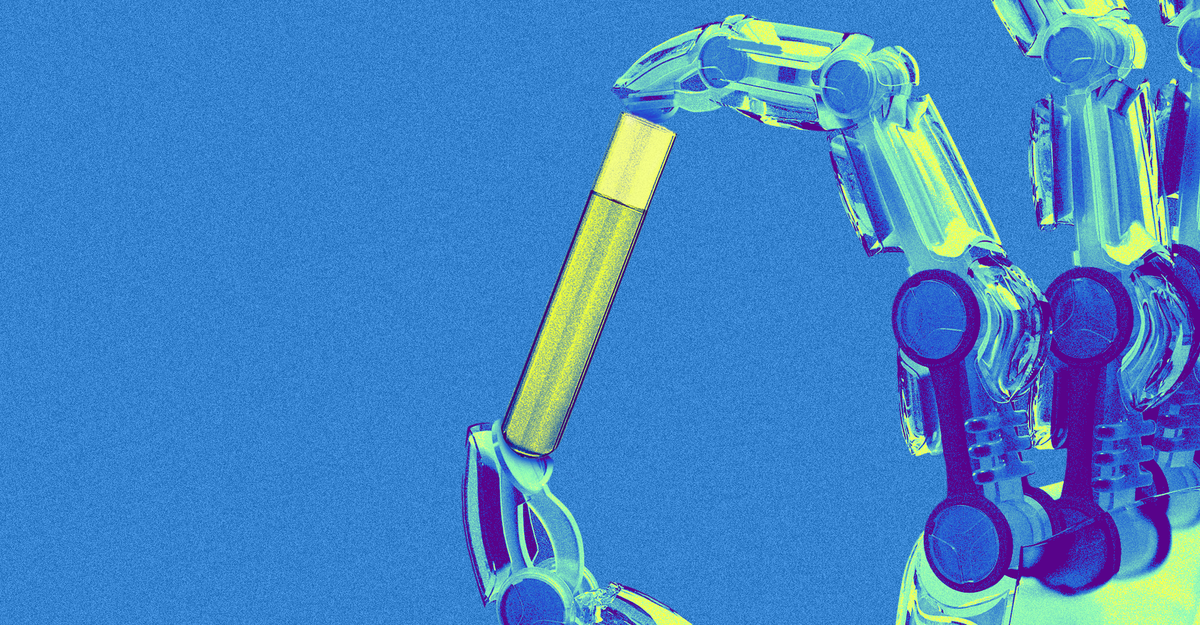
When did AI companies become AI labs? That term, and the image of studious, exacting white-coated scientists that it conjures, has become curiously entrenched as a descriptor for the businesses swiftly escorting the world into an existentially unsettling future. AI companies themselves have embraced the label: When Chris Olah, a co-founder of Anthropic, addressed the pope earlier this year, he repeatedly referred to his company, one of the most powerful AI enterprises in the world, as a lab. Industry press releases, technology commentators, and news publications have all picked up the word too. You’ll see the term on transit advertisements in San Francisco and in the pages of The New York Times (and, yes, The Atlantic).
Here is my proposal: Everyone, please stop. This term has gone too far. Although AI companies do invest heavily in research and development, using a word typically associated with groups of truth-seeking scientists is misleading, odd, and too favorable to these companies’ own ends. As a software engineer working in tech, I’ve seen little evidence that AI companies’ research practices differ significantly from those of the rest of the tech industry. Google and Microsoft, for example, have robust research divisions, but we still call them companies. So why has the laboratory term become so deeply enmeshed with AI?
Part of the reason is historical. Over the past century, research laboratories have played a crucial role in computer science. Studies performed at Bell Labs, one of America’s first industrial labs, resulted in the development of the transistor and the cellular network. In the 1970s, scientists at the MIT Laboratory for Computer Science pioneered the foundations of modern cryptography. As the Harvard historian Steven Shapin writes in his book The Scientific Life, countless innovations such as these that originated in corporate labs during the 20th century helped change the public’s perception of science. No longer simply knowledge for knowledge’s sake, science became viewed as a key engine of societal and economic progress.
In their early years, OpenAI and Anthropic mainly performed research, similar to other industrial labs. Since then, however, they have commercialized rapidly: Each company is now valued near $1 trillion and generates billions in quarterly revenue. Holding on to the lab label seems to have the obvious PR benefit of allowing both companies to lean into their scientific legacy. Because of concerns about child safety, privacy, and job displacement, Americans largely hold a negative perception of the industry—and tech as a whole. That’s translated into popular opposition from politicians, data-center activists, and religious leaders who are concerned about the outsize influence of these companies: Spending on AI as a share of U.S. GDP now rivals defense spending. Meanwhile, scientists remain relatively popular. A 2026 Pew Research Center poll found that more than 75 percent of Americans trust scientists to act in the public interest, but the majority do not trust business leaders to do the same. These positive connotations associated with scientific research help the AI industry signal altruism while downplaying their profit-making ambitions. OpenAI and Anthropic’s leaders write at length about how AI’s risks and perils must be carefully studied for the sake of humanity. Research is portrayed as essential to this mission: OpenAI says it treats “safety as a science,” and Anthropic writes that “providing trustworthy research” will improve policy outcomes.
The problem is, these companies act much more like private enterprises than bastions of science. Much of the research listed in the Publications section on both Anthropic’s and OpenAI’s websites are not peer-reviewed papers accepted by scholarly outlets. I examined 100 recent pieces of research from both companies’ Research pages; the overwhelming majority had no corresponding peer-reviewed paper accepted by a conference or journal. It’s unclear whether these were submitted to academic venues and, if so, whether they were rejected, are under review, or are forthcoming. (Neither OpenAI nor Anthropic responded to requests for comment.)
Legal risks and long peer-review cycles are typically cited as reasons that fast-moving tech companies seldom share data or engage in peer review. And to its credit, the industry doesn’t always choose research topics that paint its products in a positive light. Anthropic has conducted studies on its models’ undesirable behaviors, such as disempowerment and sycophancy.
Even so, Anthropic has a habit of landing on ambiguity about the fallout of its technology. In its education report, for instance, Anthropic, the entity best equipped to observe whether students are using Claude to cheat, concludes that the question of “How much are students using AI to cheat?” is “hard to answer.”
The practice of assuming scientific authority while exercising potentially biased research practices has more in common with quasi-scientific advocacy organizations than it does with traditional laboratories. Take, for example, the George C. Marshall Institute, a think tank founded in 1984 whose leaders worked closely with the Reagan White House. The institute, whose publications defended oil interests and the tobacco industry, operated under the motto “Science for better public policy.” As the historians Naomi Oreskes and Erik Conway reported in the book Merchants of Doubt, the institute strategically refused to publish in journals subject to independent peer review. Instead, it disseminated reports and briefings to policy makers that merely reproduced the “trappings of scientific argumentation—graphs, charts, references, and the like.”
If Anthropic, OpenAI, and other AI giants want to keep referring to themselves as labs, they should adhere to scientific best practices: open-sourcing code, preregistering studies, and, most important, subjecting research to independent peer review. Ultimately, AI companies such as Anthropic and OpenAI aren’t tweedy labs doing arcane research—they’re industry-defining corporations reshaping our workplaces, our schools, and our communities. Holding them accountable could start with calling them out for what they are—and what they aren’t.











Leave a Reply