

Supermarket Market
The Supermarket Market serves as the backbone of everyday household consumption, bringing food, beverages, household essentials, and health and beauty products together under one roof and, increasingly, under one digital experience. Supermarkets matter because they anchor recurring purchase cycles, shape local supply chains, and set pricing benchmarks that influence the wider retail economy. Their applications span daily grocery shopping, bulk household replenishment, personal care purchases, and convenience-led top-up trips.
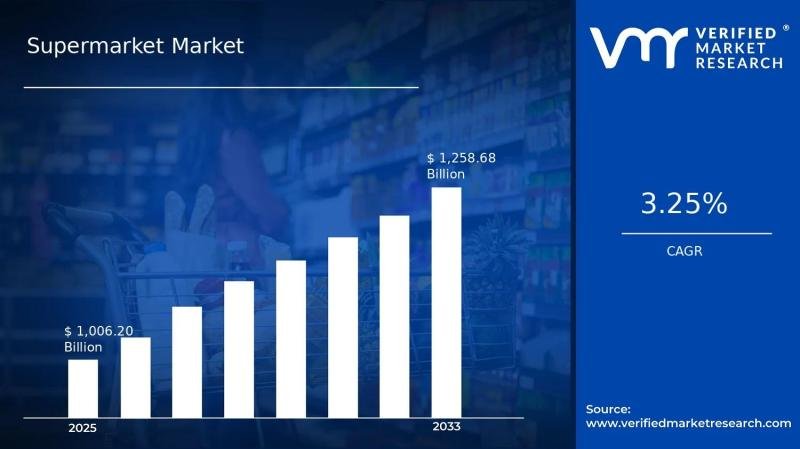
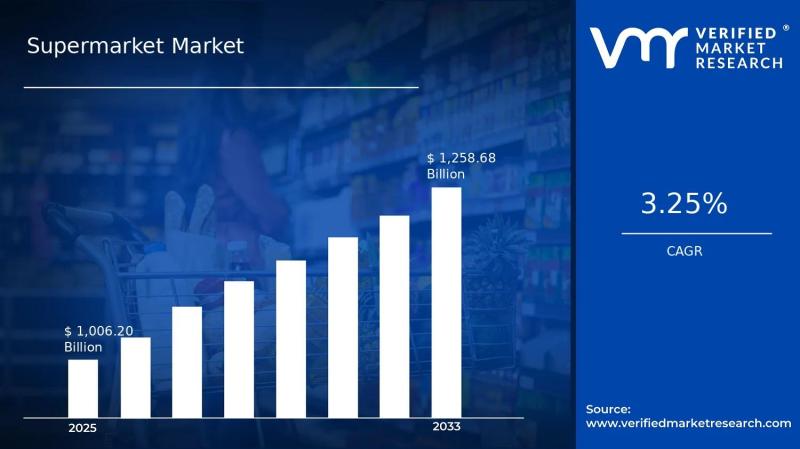
According to analysis by Verified Market Research®, the Supermarket Market was valued at $1,006.20 Bn in 2025 and is projected to reach $1,258.68 Bn by 2033, growing at a CAGR of 3.3% from 2025 to 2033. This points to steady, dependable demand rather than volatile expansion, reflecting how deeply grocery spending is embedded in household budgets.
👉 Get the full PDF sample copy of the report @ https://www.verifiedmarketresearch.com/download-sample/?rid=542956
Beyond headline figures, the market is being reshaped by retailers who are modernizing formats, refining category mix, and weaving digital fulfillment into traditional store networks.
📊 Market Size & Forecast
Valued at $1,006.20 Bn in 2025, the Supermarket Market is forecast to climb to $1,258.68 Bn by 2033, advancing at a 3.3% CAGR over the 2025 to 2033 forecast period. This growth trajectory is measured and resilient, consistent with the recurring nature of grocery purchasing. Rather than relying on sharp cyclical swings, the industry benefits from consistent basket frequency and dependable baseline sales.
The outlook is supported by category mix shifts, distribution-channel modernization, and rising shopper expectations around convenience and value. Retail pricing discipline and stronger supply chain resilience are also reducing volatility in product availability, which helps sustain sales across regions. For investors and industry planners, the market offers stability, scale, and gradual value creation through operational efficiency.
📈 Market Demand Analysis
Demand is anchored in the everyday necessity of food and household goods, but its character is evolving. Shoppers increasingly expect seamless experiences that connect physical stores with online ordering, coordinated promotions, and flexible fulfillment. Retailers are responding by expanding online capabilities and integrating offers across stores and digital touchpoints, which strengthens customer retention and shopping frequency.
Consumer preferences are also leaning toward health and quality. This shift supports higher spending per shopper even when unit volumes remain stable, as consumers trade up toward fresher, better-curated, and wellness-oriented products. Convenience-led formats are gaining traction among time-pressed urban households, while private-label ranges give value-conscious buyers credible alternatives to national brands. Regulatory attention to food safety, labeling, and retail standards further encourages transparency and quality discipline across the supply chain.
💡 Growth Opportunities
Significant opportunities lie in the continued shift toward convenience-led formats, where smaller, accessible stores and fast fulfillment options meet changing lifestyles. Private-label expansion presents another avenue, allowing supermarkets to improve margins, differentiate their offerings, and build loyalty through trusted own-brand products. Category mix optimization, meaning a sharper focus on higher-value, health-oriented, and fresh assortments, can lift basket value without relying on volume growth alone.
👉 Get Discount On The Purchase Of This Report @ https://www.verifiedmarketresearch.com/select-licence/?rid=542956
Investment in logistics, inventory intelligence, and digital platforms is opening additional room for growth. Retailers that modernize fulfillment networks and unify store and online operations are better positioned to capture demand from emerging urban populations and digitally active shoppers. As disposable incomes rise in developing economies, organized grocery retail stands to gain share from traditional channels, creating long-term demand for supermarket formats.
🏆 Competitive Landscape
The competitive environment is defined by scale, supply chain strength, and omnichannel capability. Walmart Inc. leads the market, owing to its scale in omnichannel grocery fulfillment and logistics. Its ability to coordinate store networks, distribution infrastructure, and online ordering allows it to serve customers efficiently across multiple touchpoints while maintaining pricing discipline.
The report covers 22 key players, and competition among them centers on assortment quality, private-label development, delivery speed, and promotional effectiveness. Companies that can balance low prices with convenience and reliable availability are best placed to defend and expand their positions.
🌍 Regional Analysis
Asia Pacific leads the Supermarket Market with approximately 35% market share. This dominance is driven by rapid urbanization and rising disposable incomes, which are pushing more households toward organized retail formats and broader product choices. Expanding middle-class populations and changing shopping habits continue to strengthen regional demand.
Growth drivers in Asia Pacific include the spread of modern retail infrastructure, growing comfort with online and omnichannel shopping, and increasing appetite for packaged, fresh, and health-focused products. Looking ahead, the region offers substantial opportunity for convenience formats, digital grocery platforms, and private-label growth. The study spans five regions in total, each showing distinct retail maturity and consumer behavior patterns.
🧩 Market Segmentation
Based on Product Category, the market is divided into Food and Beverages, Household Goods, Health and Beauty Products, and Others. Food and Beverages is the dominant segment due to the highest consumer basket frequency, as these items are purchased repeatedly and form the core of nearly every shopping trip. Household Goods support steady replenishment demand, while Health and Beauty Products benefit from growing interest in wellness and personal care. The Others category captures complementary items that round out the shopping basket.
Based on Distribution Channel, the market is segmented into Brick-and-Mortar Stores and Online & Omnichannel Supermarkets. Brick-and-mortar stores remain central to the grocery experience, offering immediacy, product visibility, and fresh assortments. Online and omnichannel supermarkets are gaining relevance as retailers expand digital fulfillment and integrate promotions across channels, giving shoppers greater flexibility and convenience.
🔮 Future Outlook
The industry is moving toward a more integrated retail model in which physical stores and digital platforms operate as a single, connected ecosystem. Technology evolution will center on smarter fulfillment, data-driven assortment planning, and personalized promotions that improve both efficiency and shopper satisfaction.
Demand is expected to remain stable, supported by essential consumption and gradual premiumization within health and quality-oriented categories. Investment is likely to flow toward logistics modernization, private-label development, and omnichannel infrastructure, while long-term opportunities will emerge from urbanizing populations and evolving convenience expectations. As adoption of online and hybrid grocery models deepens, supermarkets that combine operational resilience with customer-centric innovation will be best positioned to sustain growth.
📚 Related Reports
👉 Food Retail Market
https://www.verifiedmarketresearch.com/product/food-retail-market/
👉 Food And Grocery Retail Market
https://www.verifiedmarketresearch.com/product/food-grocery-retail-market/
👉 Grocery Delivery Software Market
https://www.verifiedmarketresearch.com/product/grocery-delivery-software-market/
About us: Verified Market Research
Verified Market Research is a leading global research and consulting firm with over 10 years of experience providing advanced analytical research solutions, tailored consulting and in-depth data analysis to individuals and companies seeking accurate, reliable and timely research. Data and technology consulting. It provides insights into strategic and growth analysis, the data you need to achieve business goals, and helps you make key revenue decisions.
Our research works as partners to provide our clients with accurate and valuable information to help them make better data-driven decisions, understand market forecasts, capitalize on future opportunities and help optimize efficiency. The industries we cover span a wide range of industries including technology, chemicals, manufacturing, energy, food and beverage, automotive, robotics, packaging, construction, mining and gas. etc.
Verified Market Research help you understand comprehensive market indicator factors as well as current and future market trends. Our analysts have extensive expertise in data collection and management, using industry methodologies to collect and examine data at every step. They are trained to combine the latest data collection techniques, superior research methodologies, specialized knowledge, and years of collective experience to produce informative and accurate research results.
Having served over 5,000 clients, we provide trusted market research services to over 100 global Fortune 500 companies, including Amazon, Dell, IBM, Shell, Exxon Mobil, General Electric, Siemens, Microsoft, Sony, and Hitachi. We provided it. We work with some of the world’s leading consulting firms, including McKinsey & Company, Boston Consulting Group, and Bain & Company, delivering customized research and consulting projects for companies around the world.
📧 Contact us:
Mr. Edwyne Fernandes
Verified Market Research®
📞 US: +1 (650)-781-4080
📞 UK: +44 (753)-715-0008
📞 APAC: +61 (488)-85-9400
📞 US Toll-Free: +1 (800)-782-1773
This release was published on openPR.








Leave a Reply